
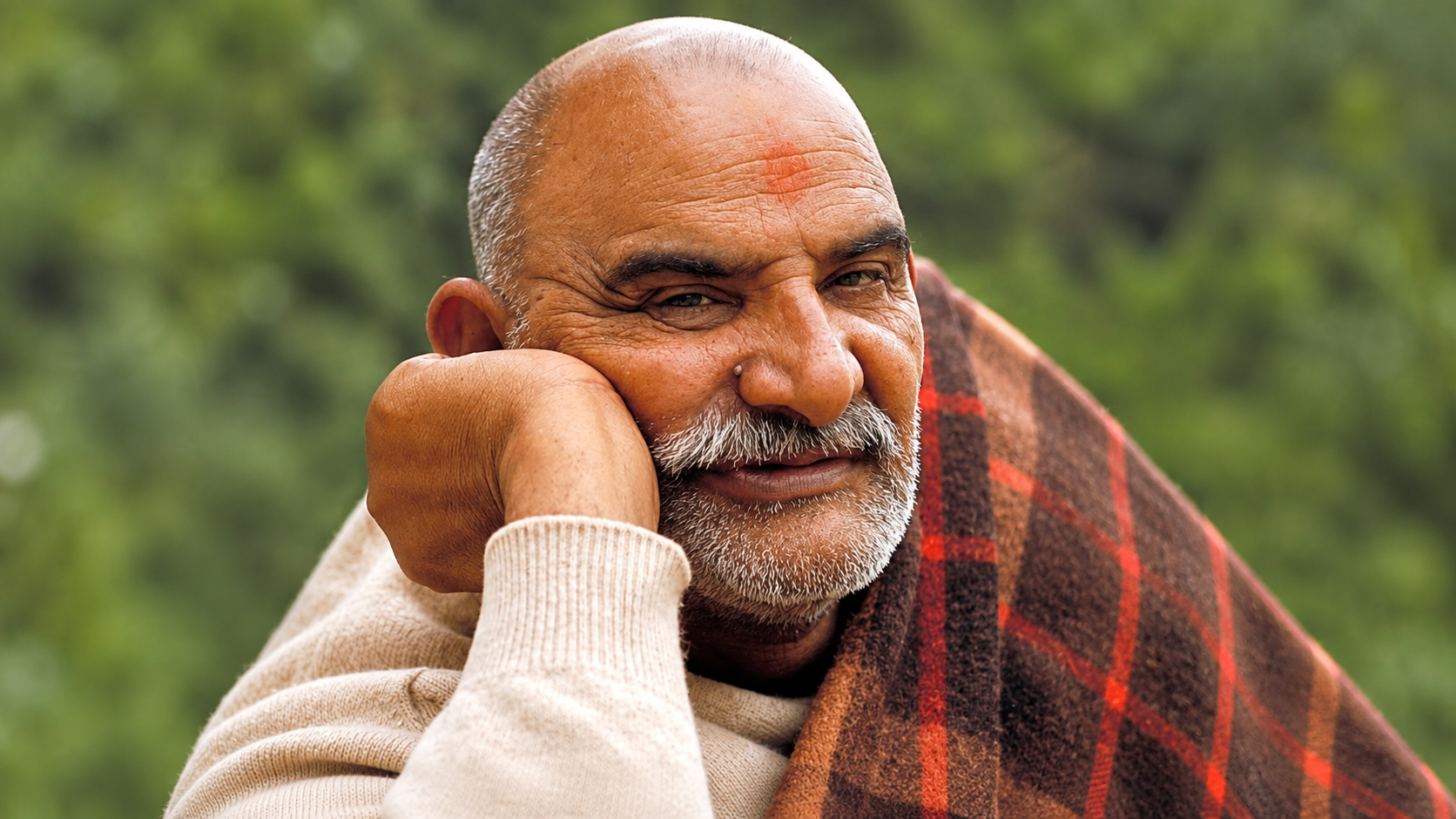
Who is Neem Karoli Baba, and why did some of the most driven people of the last century, from a dismissed Harvard psychologist to the founders of Apple and Facebook, travel to a small ashram in the Kumaon hills to sit near a man wrapped in a blanket? The question has become urgent again since Hanuman Ansh turned a modest biopic into a box-office phenomenon, and it deserves a better answer than a list of celebrity devotees.
Neem Karoli Baba gave no lectures, wrote no books and taught no technique. What he offered instead was something psychologically much rarer, and once you see what it was, you understand why accomplished people have never been able to forget him.
Neem Karoli Baba, known to his followers as Maharaj-ji, was a Hindu saint born Lakshman Narayan Sharma in the village of Akbarpur, Uttar Pradesh, around 1900. A lifelong devotee of Hanuman, he spent long periods as a wandering sadhu before settling in the hills of Kumaon, where he founded the Kainchi Dham ashram near Nainital in 1964. He died in Vrindavan on 11 September 1973. His teaching was never written down as a system; it survives as a handful of instructions he repeated to almost everyone who came: love everyone, serve everyone, feed everyone, remember God, tell the truth.
His Western devotees included the psychologist Richard Alpert, who became Ram Dass and wrote Be Here Now, and the physician Larry Brilliant, who went on to help eradicate smallpox. Steve Jobs travelled to India to meet him in 1974 and arrived a year too late. Mark Zuckerberg visited Kainchi Dham on Jobs’s advice. Julia Roberts has said in interviews that a photograph of him first drew her towards Hinduism.
That is the summary. The more interesting question is what all of these people were looking for, and why they believed they had found it in a man who asked nothing of them.
The facts of a life that resisted biography
He was born into a comfortable Brahmin family and married, by his parents’ arrangement, at the age of eleven. Around 1911 he left home to live as a sadhu. His father eventually asked him to return, and he did, going on to have two sons and a daughter. This detail matters more than it seems. The popular image of the Indian saint is a man who renounced the world once and for all. Neem Karoli Baba moved between the household and the road for most of his life, and his teaching carries that stamp: it was for people with families, jobs and obligations, not only for renunciates.
The name came from a village. According to the story devotees tell, he was put off a train for travelling without a ticket near the village of Neeb Karori, and the train would not move until the guard invited him back on board. He agreed on two conditions: a station for the village and more respect for sadhus. Whether you read that as a literal event or as a parable, the shape of it is telling. Here was a man whom institutions kept trying to remove, and then found they could not proceed without.
Long before any American arrived, he was known across north India as the miracle baba. Photographs show a heavy-set man in a plaid blanket, often laughing, usually surrounded by people. He built or inspired more than a hundred temples, most of them dedicated to Hanuman. Kainchi Dham, named for the scissor-like hairpin bends in the road that reaches it, became his base for the last decade of his life, and its annual bhandara on 15 June still feeds thousands of pilgrims.
On the night of 10 September 1973, returning from Agra where he had seen a heart specialist, he got off the train at Mathura and was taken to Vrindavan. He died there in the early hours of 11 September, in a diabetic coma. Fifty-three years on, his samadhi in Vrindavan and the ashram at Kainchi draw more visitors than they ever did in his lifetime, and a film about him made on a budget of around two crore rupees has, according to Open magazine’s report, passed fifty crore at the box office. I have written separately about what that film gets right in my Hanuman Ansh review.
Why did Steve Jobs and Mark Zuckerberg go to Kainchi Dham?
This is the most-searched and least understood part of his story, so it is worth looking carefully at who came, and when.
Richard Alpert was dismissed from Harvard in 1963 after his psychedelic research with Timothy Leary. He arrived in India in 1967, was led to Neem Karoli Baba by a young American seeker called Bhagavan Das, and left with a new name. The story Ram Dass told for the rest of his life is that he gave the old man an enormous dose of LSD, watched for a reaction, and saw none. Maharaj-ji told him the same state could be reached through meditation. Be Here Now, published in 1971, went on to sell two million copies.
Larry Brilliant was a newly qualified doctor when he reached the ashram with his wife. Maharaj-ji called him Doctor America and told him it was his destiny to join the World Health Organization’s smallpox programme in New Delhi. He went. Smallpox was declared eradicated in 1980, and Brilliant told the Harvard School of Public Health graduating class of 2013: “How he knew smallpox could be, would be eradicated, I will never understand.”
Steve Jobs was nineteen, a college dropout, when he went to India in 1974 with his friend Daniel Kottke hoping to meet Neem Karoli Baba. Maharaj-ji had died the previous September. Jobs visited Kainchi anyway, and what he took home was not a guru but a conviction. He told his biographer Walter Isaacson that intuition was, in his opinion, more powerful than intellect, and that returning to America was a greater culture shock than arriving in India had been.
Mark Zuckerberg went to Kainchi during a difficult stretch in Facebook’s early years, because Jobs told him to. At a Facebook town hall with the Indian prime minister in September 2015, he explained that Jobs had said that “in order to reconnect with what I believed as the mission of the company I should visit this temple that he had gone to in India.”
Notice the pattern. Not one of them arrived at the top of the mountain. Each arrived at a threshold: dismissed, unqualified, unfinished, unsure. They were not looking for a strategy. They were looking for someone who could see them clearly at the moment they could not see themselves.
What did Neem Karoli Baba actually teach?
Nothing you could put on a syllabus, which is precisely the point. The nearest thing to a doctrine is two words in Hindi, sub ek, all is one. The rest was instruction, and every instruction was behavioural: love everyone, serve everyone, feed everyone, remember God, tell the truth.
Look at what is missing. There is no meditation technique. There is no philosophy of mind. There is no promise about what you will attain. What there is instead is a kitchen. The bhandara, the free feeding of everyone who arrives, was not an add-on to the teaching; it was the teaching, in its most practical form.
I find this psychologically astute. Most spiritual and most self-improvement teaching operates in the cognitive register: understand this, believe that, and your behaviour will change. Neem Karoli Baba worked in the opposite direction. Do this, feed that person, tell this truth, and let understanding follow. Anyone who has tried to change a habit knows which direction is more reliable. Identity follows action far more consistently than action follows insight, and the old man in the blanket seems to have known it. It is the same principle I explored in the Bhagavad Gita’s idea of nishkama karma: act fully, and stop bargaining with the result.
The psychology of a man who wanted nothing from you
In 1957, the psychologist Carl Rogers published a paper arguing that certain conditions were necessary and sufficient for a person to change, and that one of them was unconditional positive regard: being accepted by another person without any conditions attached to your worth. You can read the original on PubMed. Rogers was describing what a therapist should offer. Devotees of Neem Karoli Baba describe receiving exactly that, without the fee, the fifty-minute hour or the case notes.
I call this experience the unearned welcome: being completely received by another person before you have proved anything to them. It sounds simple. For a certain kind of person it is almost unimaginable. High achievers organise their entire lives around earning welcome. Grades, offers, valuations, invitations, applause: every one of these is a welcome that has been paid for in advance. Some people become so good at earning it that they reach forty, or sixty, without once having experienced the other kind. When they finally do, they cannot explain it, which is why the accounts of Maharaj-ji are so full of the word love and so short of argument.
This also gives you a way to think about the miracles. Devotees say he knew things he could not have known: the illness Alpert’s mother had died of, the disease Brilliant would spend his life fighting. I do not need to adjudicate on siddhis to notice what the stories have in common. Whether you read them as supernatural knowledge or as an extraordinary quality of attention, the effect on the person was identical: someone saw the whole of me, including the parts I hide, and did not flinch. That is what is rare. Most of us have spent our lives being partially seen and conditionally approved of, and we have mistaken that for being known.
A few questions worth sitting with, privately:
- When did someone last receive you without needing anything from you in return?
- In the first ten minutes with a new person, are you proving yourself or receiving them?
- If nobody were keeping score this week, what would you still do?
Some of the most accomplished people of the last century crossed the world to sit with a man in a blanket who wanted nothing from them. That was not the mystery. That was the medicine.
What he means if you are not looking for a guru
You do not have to become a devotee, believe the train story, or make a pilgrimage to Kainchi to take something usable from him. Three things travel well.
Receive before you evaluate. Most leadership conversations begin with assessment, and people can feel it. Try beginning with welcome instead, for even a minute, and notice how much more they tell you.
Serve in logistics, not in sentiment. Feed everyone is not a feeling; it is a rota. The measure of your care for the people around you is what you actually do for them at six in the morning, not what you feel about them at midnight.
Tell the truth, which of the four instructions is by some distance the hardest, because it costs you the welcome you have been earning.
There is something else the devotees’ accounts have in common, and it is worth naming. Almost all of them describe arriving at Kainchi and feeling, for the first time in years, that they could stop. I have written before about what home really is: not a building but the state the nervous system enters when it decides it no longer has to scan for threat. Read the memoirs and that is what you find. People who had everything that can be ranked went looking for the one thing that cannot be, which is a theme I return to in inner peace is the new rich.
So, who is Neem Karoli Baba? The films will tell you he was Hanuman in a blanket, and for millions of people that answer is complete. The one I keep is smaller and, I think, more useful. He was a man who demonstrated, over seventy-odd years, that the thing driven people spend their lives chasing cannot be earned, only received, and that this is good news rather than bad, because it means it was available all along.
If you recognise yourself in the people who reached Kainchi at a threshold, and you would like a place to stop proving for an hour, my life coaching page explains how I work, and you can book a free 15-minute conversation from there to see whether it fits.


