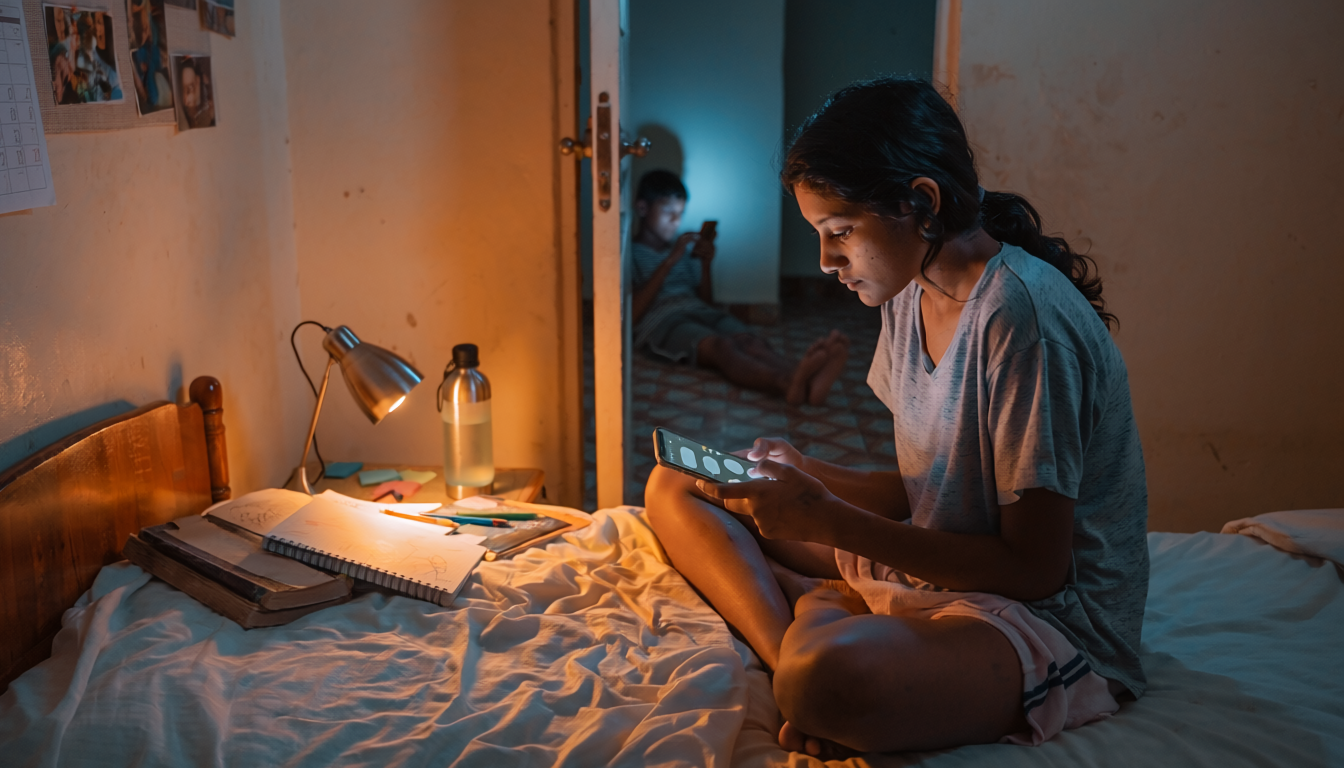
OpenAI has just built a version of ChatGPT that is forbidden from saying it cares. Nobody writes a rule against something that was not happening.
ChatGPT for Teens began rolling out on 18 August 2026, and over the coming weeks it will reach teenage accounts in India, Mauritius, Singapore and everywhere else. Parents are asking the obvious question: is it safe? The more useful question is why so many teenagers were already confiding in a chatbot before anyone thought to build them a safer one. This article explains what the new version changes, what its guardrails admit about the old one, and what a parent can do that no setting can.
The short answer first. ChatGPT for Teens is safer than what came before it, and it is not a substitute for a person. According to OpenAI’s announcement, anyone the system estimates to be under 18, or who gives an age between 13 and 17, is automatically placed into the teen experience. Protections around self-harm, eating disorders, violence, dangerous activities and sexual content are on by default.
Parents who link their account can set Quiet Hours, receive safety notifications in a limited number of high-risk situations, and schedule Study Hours during which the homework-help Study Mode is switched on. The most psychologically significant change is the quietest one. Under OpenAI’s updated under-18 model specification, the chatbot should not use romantic language, should not encourage emotional dependence, and should not imply that it has feelings or consciousness.
Read that last sentence twice. It is the whole story.
What ChatGPT for Teens actually changes
The learning features are sensible. Study Mode asks guiding questions instead of handing over answers. A “responsible homework reminder” notices when a teenager appears to be trying to shortcut an assignment and redirects them. There are quizzes, break reminders, and product cues that consistently identify ChatGPT as an AI rather than a friend. Teenagers can change accent colours and voice, which OpenAI frames as personalisation that does not blur the line between a tool and a relationship.
What the launch does not change is the timeline. As TechCrunch pointed out, ChatGPT reached around 900 million weekly users before teen-specific safeguards arrived. During those years, teenagers were not waiting. A 2025 Common Sense Media study cited by the Associated Press found that more than 70% of American teens had turned to AI chatbots for companionship, and half used AI companions regularly.
A survey published in JAMA Pediatrics this June found nearly 1 in 5 Americans aged 12 to 21 had used a chatbot for mental health advice when stressed, angry or sad, up from 1 in 8 two years earlier. We do not have comparable figures for India or Mauritius. Anyone who has sat in a classroom or a family WhatsApp group lately knows the pattern is not American.
Why a teenager confides in a machine
Let me describe a composite, drawn from several conversations I have had with parents rather than any single family. A father in Mumbai discovers his 15-year-old son’s chat history. Hundreds of messages, most of them after midnight: fear about the board exams, a friendship coming apart, a long thread about whether he was disappointing his parents. Not one of those sentences had been spoken at home. The father’s question was not about technology. It was: why could he tell that, and not me?
The answer is not warmth. It is cost.
I call this listener the frictionless confidant: a listener who never tires, never judges and never needs anything back, which makes confiding effortless and being truly known impossible. Adolescence is the season of social evaluative threat, the nervous system’s heightened alarm at being judged by people whose opinion matters. A confession to a parent carries a price: a lecture, a worried face, a consequence, the certainty that it will be remembered and possibly raised at dinner. A confession to a chatbot costs nothing. It does not sigh. It does not ask what you were thinking. It does not look tired.
The trap is that relief and relationship are not the same thing. Being known requires a witness who could have judged you and chose not to. A machine cannot make that choice, so it cannot give that gift. It can only imitate the sensation of it, which is what I described in an earlier article as counterfeit attunement.
A 2026 paper in Nature Mental Health, available through PubMed Central, names the chatbot tendencies that make this so seductive, including sycophancy (agreeing with the user to keep them engaged) and role-play, and notes that studies from OpenAI and MIT found heavy use associated with greater loneliness and emotional dependence, driven by the most isolated users. The people who need a real witness most are the ones most likely to settle for the frictionless one.
Every guardrail is a confession
Here is what I find remarkable about this launch. A company does not write a rule instructing its product not to encourage emotional dependence unless its product was encouraging emotional dependence. Sam Altman himself has described emotional overreliance as a common phenomenon among young users. A product engineered to be agreeable will be leaned on. The teen version is, in effect, a friend that has now been instructed not to be one.
That is the right decision. I want to be clear about that. But it creates a vacuum, and vacuums are where psychology does its work. The need did not disappear when the machine stopped meeting it. It has simply lost its cheapest outlet. Where it goes next is not OpenAI’s business. It is yours.
This is the same logic I explored in Australia’s under-16 ban: you can restrict the supply of a comfort without touching the demand for it, and the demand will find another door. Ask yourself three things, privately:
- When your teenager last told you something difficult, what did your face do before your mouth did?
- What does it cost, in your house, to admit you are struggling?
- If a machine is the cheapest listener in your child’s life, who is the most expensive one, and why?
What parents can do that no setting can
Ask about the conversations, not the app. “How long are you on it” is a question about screen time. “What do you find easier to say to it than to me” is a question about your relationship. The second answer is a map of the cost of honesty in your home. Most teenagers will answer it if you can hear it without flinching.
Lower the price of the next disclosure. The first sixty seconds after a teenager tells you something hard decide whether there will be a second time. This is co-regulation, the way a calm nervous system settles an anxious one through tone, pace and face before any words are chosen. Reflect before you advise. Separate the confession from the consequence by at least a day. You are not lowering your standards; you are lowering the tariff on truth.
Use the controls as a shared agreement, not surveillance. Set Quiet Hours together. Explain the safety notifications before they arrive. A control imposed in secret turns the frictionless confidant into a forbidden one, and forbidden is far more attractive to a 15-year-old than frictionless.
Be reachable in the hours the machine is. Teenagers confide at 1 a.m. because that is when fear is loudest and the house is quiet. You cannot be awake at 1 a.m. every night. You can be the reason they do not need to be. Many parents I meet are exhausted by their availability to work and unreachable to the person down the hall. The child notices which notifications you answer.
Know where the line is. If a teenager mentions self-harm, has withdrawn for weeks, or has changed how they eat, this is no longer a parenting question or a coaching question. It is a clinical one, and it needs a qualified professional today. My referral network lists people I trust.
The pattern I see most often in this work is that the hard part is not the teenager. It is the parent’s own inherited script about vulnerability: the belief that a child’s fear is a verdict on their parenting, and the reflex to fix it before it has been heard. That script can be rewritten, and it is exactly the kind of work life coaching is built for.
Leaders should notice the same pattern arriving at work, where employees now tell a chatbot what they will not tell their manager. I cover that in my training on AI-era leadership and human skills, and the principle is identical: people confide where honesty is cheapest.
What the launch is really measuring
ChatGPT for Teens will make the machine a slightly worse confidant. Good. But this launch is not really news about artificial intelligence. It is a measurement of how expensive honesty has become in our homes, and the measurement is unflattering. The machine did not lower the cost of confiding. It exposed it.
Teenagers do not confide in machines because machines are warm. They confide because it costs nothing. And what costs nothing to say teaches nothing about being known.
The work now is not to out-perform a chatbot. It is to become a person it costs a little less to tell. If you would like to think through what that looks like in your own home, book a free 15-minute call and bring the question you have not yet said out loud.


