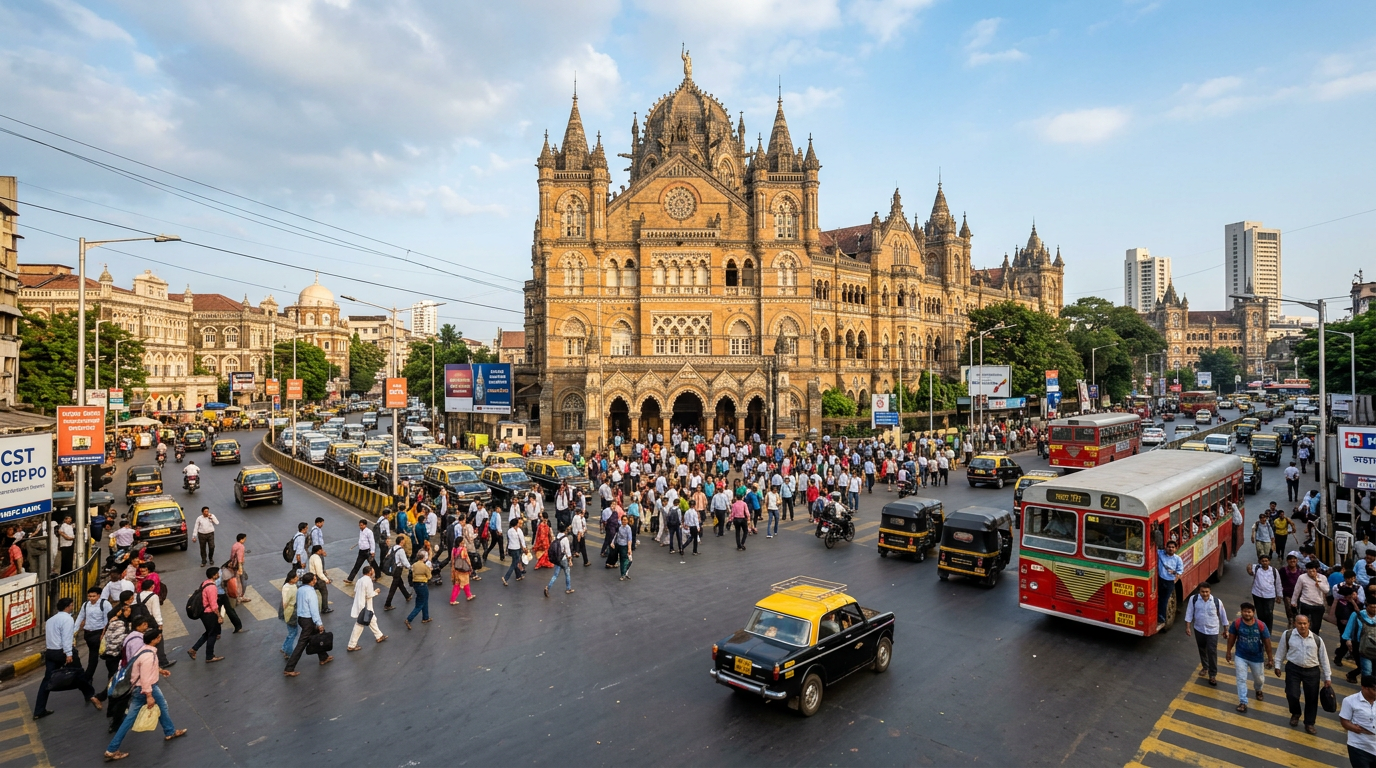
Leaving Mumbai after six years is not one goodbye. It is a hundred small ones: to friends on a badminton court, to a music class, to dinners that ran long past midnight, and to the person I became in a city where almost nobody knew my name. I am relocating to Mauritius, which will be my base from now on, and I am leaving with feelings that refuse to agree with each other.
If you are leaving a city you have loved, resented or both, this piece is for you. It explains why gratitude and grief arrive together, and why that mixture is not a sign that you chose wrongly.
Here is the short answer. Leaving a city you have lived in for years brings mixed feelings because you are ending something that mattered, and the mind does not file meaningful endings under a single emotion. Psychologists call this poignancy: happiness and sadness felt at the same moment, in the face of a meaningful last time. The mixture is not confusion. It is accuracy. You are grateful for what the place gave you, sore about what it took, and quietly grieving a version of yourself that may only have existed there.
Why Leaving Mumbai Feels Like Grief and Gratitude at Once
The clearest research on this comes from a 2008 paper in the Journal of Personality and Social Psychology by Hal Ersner-Hershfield, Laura Carstensen and colleagues. In one study, people who pictured themselves at a meaningful place for the final time reported more mixed emotions than those who simply pictured being there. In another, graduates on graduation day were randomly reminded, or not, that it was their last day as students. The authors concluded that poignancy is tied to meaningful endings.
What I take from this is simple. An ending does not cancel the good. It sharpens it. The happiness stays, and sadness sits down beside it.
That is why the final weeks before a move feel so strange. Ordinary things acquire a quiet prefix: the last game, the last class, the last dinner at the usual table. Nothing about the shuttlecock, the song or the food has changed. What has changed is that your mind now knows these things are finite, and finite things are felt more fully.
What Mumbai Gave Me
Mumbai has given me so much, and taken from me too. I will start with the gifts, because they are easier to name.
It gave me badminton friends. A particular kind of friendship forms between rallies: people who know your backhand better than your CV, who notice when you are off your game and do not need the reason. It gave me music classes, and with them something rare for a coach who spends his working days on the other side of the questions: permission to be a beginner again. I have long believed in how music supports mental health, but believing it and sitting in a class as a learner are different things. It gave me late-night dinners, where conversations went to places daylight rarely allows. And it gave me a five-day course in Andheri that brought me back to poetry, and to friendships I did not expect to make at this stage of life.
Notice that most of these are not the relationships we put in biographies. Research by Gillian Sandstrom and Elizabeth Dunn found that students felt happier and more connected on days when they interacted with more classmates than usual, and that even acquaintances contribute to social and emotional well-being. That is why leaving a city surprises people. We prepare to miss our closest friends. We are not prepared to miss the peripheral cast: the court regulars, the classmates, the familiar faces whose names we never fully learned. They were holding up more of our lives than we knew.
Being a Stranger in a City of Millions
Mumbai has a way of making you anonymous and free in the same breath. More than a century ago, the sociologist Georg Simmel argued that big-city life trains people into a protective reserve, a polite distance that makes crowds bearable. Mumbai has that reserve. It also has an unexpected generosity: in a city of millions, nobody is waiting to tell you who you are supposed to be.
For someone who grew up in a small village in Mauritius, where your surname arrives before you do, that anonymity was oxygen. I have written about the elsewhere self, the version of yourself you can only imagine becoming somewhere else. Mumbai was where I met mine.
But anonymity has a price. You can be surrounded by millions and known by very few. Being a stranger is liberating on the good days and lonely on the others, and a big city offers plenty of both. The friendships above matter precisely because they were built against that backdrop. In a small place, belonging is often given. In a city like Mumbai, it is earned, one shared game and one late dinner at a time.
What Mumbai Took
I said the city took from me too, and I will leave most of that unwritten. Some losses belong to the person who carried them. What I will say is this: cities take time, sleep, certain illusions, and sometimes the life we thought we were going to have. A place can be generous and costly at once.
If you are sad about leaving a city, you are not being dramatic. In the late 1950s, the psychologist Marc Fried interviewed hundreds of residents displaced from Boston’s West End to understand the emotional effects of relocation. His work helped establish that people can grieve the loss of something other than a loved person, and that close-knit neighbourhoods give residents a rootedness essential to identity and purpose. Grief for a place is not a metaphor. It is grief.
There is also a quieter temptation when leaving: to settle the account early. Some people declare the city wonderful so the departure feels tragic. Others declare it terrible so the departure feels like escape. Psychologists call the underlying move splitting: seeing something as all good or all bad because holding both at once is uncomfortable. It makes leaving easier and understanding harder. I would rather leave Mumbai with the account open.
The City-Shaped Self
Here is what I think we are really leaving when we leave a city. I call it the city-shaped self: the version of you that a particular place drew out, through its people, its rhythms and its pressures, and which does not fit in the suitcase.
Mumbai shaped a version of me that said yes to dinners at midnight, turned up on court, sat in a class as a beginner, and learned to be a stranger without becoming a ghost. Some of that self will travel as capacity: the stamina, the discernment, the friendships that survive distance. Some of it will stay behind as context, because it only made sense in that light, that traffic, that sea air. You take the lessons. The city keeps the context.
Pause here for a moment, privately. Who has your city allowed you to become that your hometown would not have? Which goodbyes are you rushing because the feeling is too mixed to sit with? And what part of this version of you do you want to keep, deliberately, wherever you go next?
Mixed feelings are not proof that you are unsure. They are proof that the place was real. Only somewhere that both gave to you and took from you can be left with gratitude and grief in the same breath.

How to Leave a City Well
Whether you are leaving Mumbai or any city that has held a chapter of your life, a few things help.
- Name your last times. Endings that are marked are easier to carry than endings that simply happen. Play the last game knowing it is the last, and say the goodbye out loud. Unmarked endings tend to become unfinished business, a pattern I explored in how to let go of the past.
- Say goodbye to the peripheral cast. The court regulars and classmates deserve a farewell too. They were part of the structure, not the decoration.
- Keep the account open. Resist rewriting the city as heaven or hell to make the move feel justified.
- Pack rituals, not only boxes. Find a court, a class or a late dinner table in the new place within your first weeks. The body recognises home through repeated cues long before the mind decides it belongs.
- Let nostalgia help. In a series of studies, Zhou, Sedikides, Wildschut and Gao found that loneliness lowered people’s sense of social support but also raised nostalgia, which in turn increased their sense of support. Looking back warmly is one of the ways the mind keeps people close across distance.
- Expect the grief to arrive late. It often waits until the logistics are finished. The quiet week after the move is when the city finally catches up with you.
Going Back to the Island
There is a particular complexity in my move. I am not only leaving a city; I am returning to the island I grew up on. Returning is its own kind of leaving. The Mauritius I left has changed, and so has the man coming back.
In What Is Home? I described home not as a postcode but as the state your nervous system enters when it can stop scanning. Going back does not guarantee that state. It has to be built again, ritual by ritual, the same way Mumbai was. Much of my life coaching work, in India and in Mauritius, sits at thresholds exactly like this one: people who have arrived somewhere new, or returned somewhere old, and are quietly waiting for the body to catch up.
The City Stays in You
We tend to think we leave a city when the flight takes off. In truth, we leave it slowly, and never completely. Mumbai will no longer be my address, but it will remain in how I listen, how I play, and how late I am willing to stay at a table when a conversation is worth it. That is what a city gives you if you let it: not only a place to return to, but a way of being that you carry onwards.
Thank you, Mumbai. For all of it. Even the parts I will not write down.
If you are standing at a threshold of your own, a move, a return or a chapter quietly closing, you are welcome to book a free 15-minute consultation. It is a relaxed, no-obligation conversation, and sometimes that is the best place to sort through feelings that refuse to agree.


