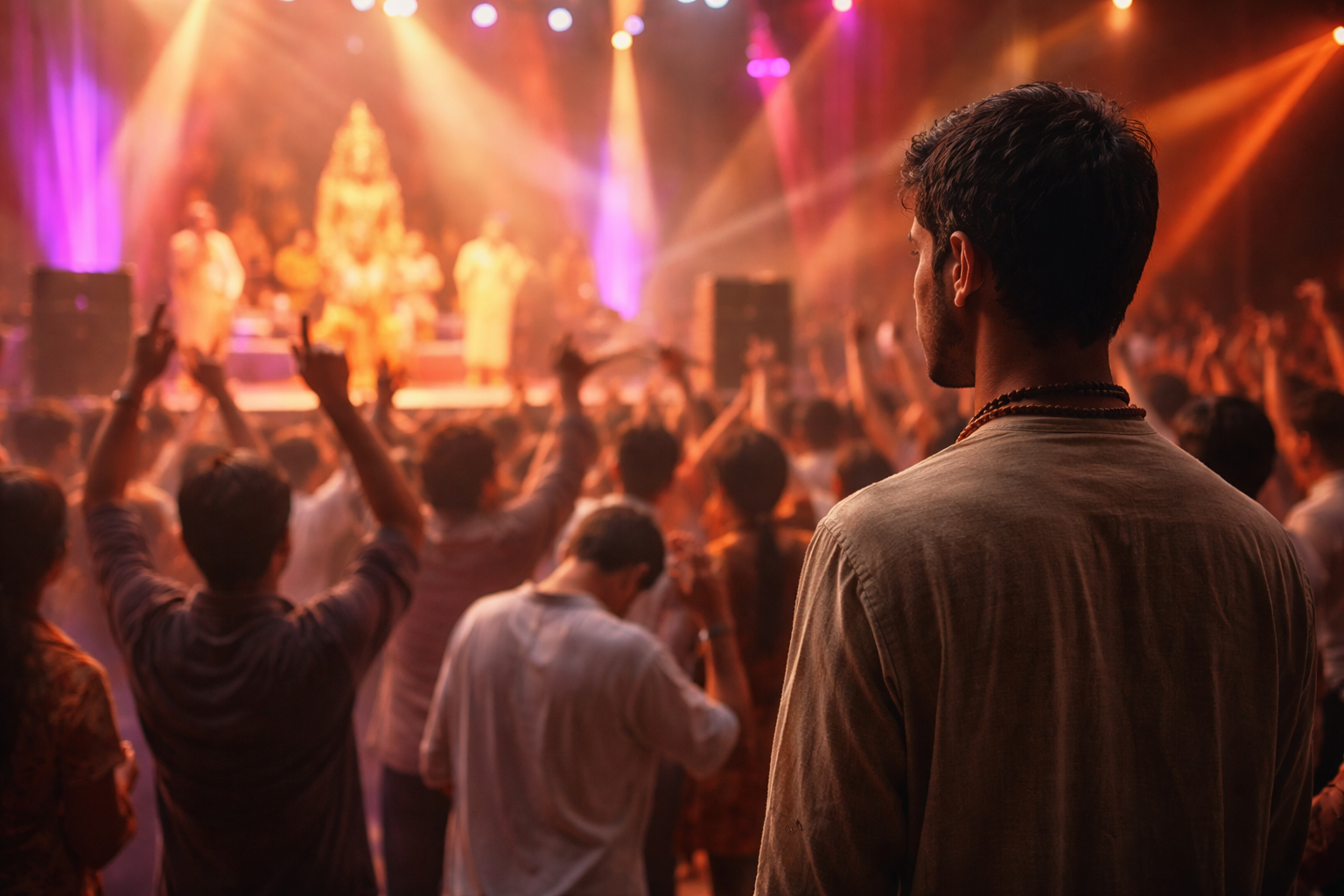
The keyword I keep hearing, increasingly without irony, is bhajan clubbing in India. It arrives dressed as a modern bridge between youth culture and devotion. The promise is seductive: come as you are, bring your friends, sing God’s name, feel a collective high, and leave “uplifted”.
I understand the impulse. Many people are lonely, burnt out, and hungry for something larger than their notifications. If a room full of voices can soften the ache, why question it?
Because, as a life coach, an aspiring yogi, and a student of the brain, I cannot ignore what I see: a powerful spiritual technology being repackaged as entertainment, often without the ethical spine that makes it healing. I’m not against bhajans. I’m not against joy. I’m not against young people finding their way. I’m against the way bhajan clubbing in India is quietly training our minds and nervous systems to confuse intensity with intimacy.
Let me give you five reasons, honestly and tenderly, for why I don’t believe in it.
1) It Trains the Brain to Chase a High, Not a Home
A few years ago, I attended an event a client insisted would “change my energy”. The hall was dark, the speakers were enormous, and the bassline was so heavy my ribs felt like they were being coached into surrender. People swayed, hands raised, eyes closed. It looked devotional. It also looked like a nightclub, just with different lyrics.
Here is the psychological truth: the brain learns by repetition. When devotion is repeatedly paired with club-style stimulation, the nervous system starts expecting worship to feel like a surge. Dopamine does what dopamine does. It marks intensity as important. Soon, silence feels boring. Ordinary prayer feels flat. The mind begins to say, subtly, “If it doesn’t spike me, it doesn’t count.”
Devotion, at its best, is not a spike. It is a homecoming. It is the slow release of the jaw. It is the breath becoming honest. Bhajan clubbing often conditions the opposite. It trains people to seek the next peak, not deepen into presence.
Societal question: Are we healing, or are we simply switching playlists on the same addiction to stimulation?
2) It Turns Sacred Practice into Performance, and Performance into Identity
Watch any crowd long enough, and you will notice two parallel events: one devotional, one social. The devotional event is singing. The social event is being seen singing. Cameras rise. Stories are posted. Aesthetic captions appear before the voice has even cooled down.
I have coached too many high-functioning people who feel invisible in their families and unheard in their marriages. When they enter a space like this, they feel instantly “belonging”. But belonging can be real, and it can also be a costume. Performative spirituality is not always narcissism. Sometimes it is a wounded bid for validation.
In bhajan clubbing, devotion can become a stage where people finally feel special. The problem is not the feeling. The problem is the dependency. If your spirituality becomes another identity to perform, it stops being a path of truth and becomes a brand.
In yogic language, we might say the ego has simply learnt Sanskrit.
3) It Confuses Emotional Catharsis with Inner Work
Tears flow easily in a loud room. Collective singing can unlock emotion quickly. People feel cleansed. They mistake the release for resolution.
In neuroscience terms, intense music, rhythmic chanting, and group synchrony can shift your state fast. You can go from numb to moved in minutes. That can be beautiful. It can also bypass the deeper work of integration. Catharsis is a doorway, not a destination.
I once spoke with a young man who attended these events weekly. He described feeling “pure” for a few hours, then crashing into irritation and pornography later at night. He assumed he was “failing spiritually”. I told him something that surprised him: his system was not failing. His system was swinging. High arousal, then a rebound. Peak and collapse. That is a nervous-system pattern, not a moral verdict.
Bhajan clubbing can create a weekly cycle of emotional fireworks without helping people build daily practices of regulation, reflection, accountability, and repair. The bhajan becomes a substitute for therapy, discipline, and honest relationships.
And the societal question gets sharper: are we creating spiritual events, or are we creating emotional discharge stations for a chronically dysregulated culture?
4) It Dilutes the Meaning of Bhajan by Removing Context and Restraint
Bhajans grew in temples, satsangs, homes, and pilgrimages, surrounded by context: humility, seva, guidance, and restraint. There was usually a sense of maryada, a quiet boundary that said: this is not just music. This is offering.
When the same practice is placed in a club-like environment, the meaning changes. Not always intentionally. But psychology is shaped by setting. A sacred practice without sacred framing becomes ambiguous. People do not know whether to dance, pray, flirt, network, or film. The mind multitasks. The heart fragments.
In coaching, I often ask: “What are you practising without realising it?” In such spaces, people may be practising devotion, yes. They may also be practising distraction, consumption, and social comparison, all at once.
This is why I’m cautious about bhajan clubbing. It can slowly rewrite bhajan from an inner offering to an outer experience.
And here’s my uncomfortable question: if we need club aesthetics to make God marketable, what does that say about our attention spans, and our faith?
5) It Replaces Quiet Transformation with Loud Agreement
Real spiritual growth has a particular texture. It is often inconvenient. It asks for apologies. It asks for boundaries. It asks for consistency when nobody is clapping. It asks you to face your patterns, your cravings, your anger, your avoidance.
A loud devotional event can create instant agreement. Everyone nods. Everyone feels aligned. Everyone feels good. But then they go home and still shout at their parents, still manipulate their partners, still gossip, still numb out.
I don’t say this with judgement. I say it with compassion. The mind loves shortcuts. The heart loves community. But transformation requires what I call “quiet repetition”. It is the daily choice to become less reactive, more honest, more kind, more steady.
Bhajan clubbing can make spirituality feel like a weekend personality rather than a weekday practice.
If devotion does not change the way we speak to the people we claim to love, what exactly are we celebrating?
What I Believe Instead
I believe bhajan is medicine when it is rooted in sincerity. I believe singing can heal trauma held in the throat. I believe community can save lives. I also believe we need to be careful with what we are normalising in the name of “making spirituality cool”.
If you are drawn to bhajan clubbing, I’m not here to shame you. I’m here to invite a cleaner question: what are you truly seeking?
If it is connection, seek spaces that honour stillness too.
If it is devotion, seek practices that continue after the music ends.
If it is healing, seek integration, not just intensity.
Because the soul does not need a spotlight. It needs a steady flame.


