
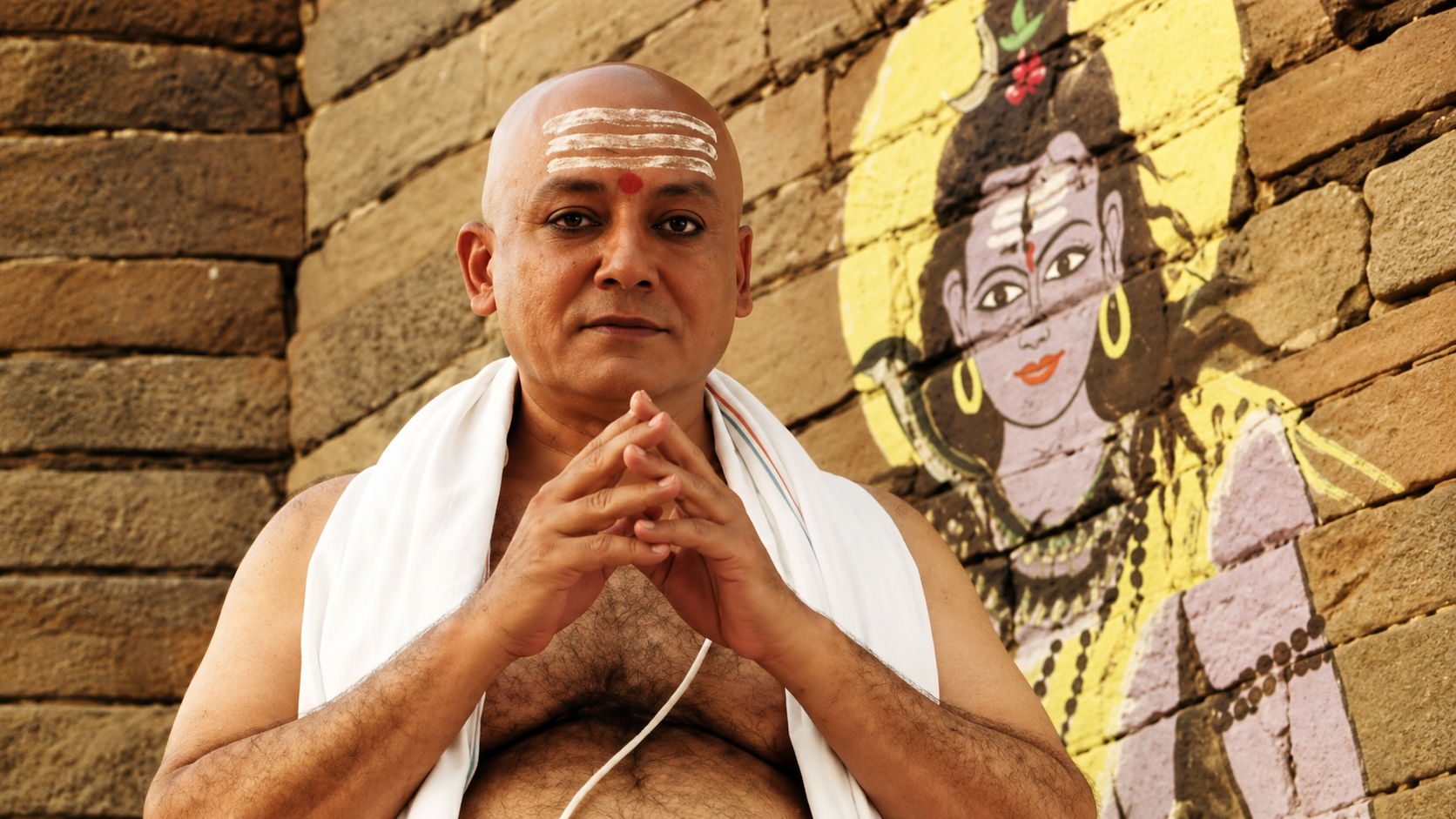
Bhavna Talwar’s Dharm is a film most people have never heard of, and one I return to more than almost any other. On the surface, it is a story about a Brahmin priest in Varanasi who raises an abandoned infant, then learns the child was born to a Muslim mother. Underneath, it is one of the most honest portraits I know of what happens inside a person when a belief they have organised their whole life around collides with someone they love. That collision isn’t confined to priests or religion. It is the quiet crisis of every leader, parent and professional who has ever had to choose between being right and being whole.
If you want the short answer: watch the Dharm movie because it shows, with almost no speeches, how a good person can drift into cruelty without ever feeling cruel. Pandit Chaturvedi, played by Pankaj Kapur with extraordinary restraint, is not a villain. He is devout, disciplined, gentle with his family, and respected by his community. When the truth about the boy’s birth arrives, he does not lash out. He purifies. He fasts, performs penance, scrubs at a contamination that exists only in his framework. The child, whom he named Kartikeya, watches a father withdraw for reasons a child cannot possibly understand. The film’s lesson is not “be tolerant”. It is something more uncomfortable: the beliefs that make us feel clean are often the ones that make us unkind.
Released in 2007, the film closed the World Cinema section at Cannes, won the National Film Award for Best Feature Film on National Integration, and was India’s official submission for the Academy Awards that year. Supriya Pathak plays Parvati, the priest’s wife, and a very young Pankaj Tripathi appears as the agitator who leads the mob. It barely reached cinemas. That obscurity is part of why I am writing this.
What is the Dharm movie actually about?
The plot is deceptively simple. An infant arrives in the household of Pandit Chaturvedi, a scholar-priest whose days are governed by ritual precision. Against his initial reluctance, the boy becomes his son in everything but blood. Then the child’s mother returns to claim him, and with her comes the revelation that the boy is Muslim by birth.
What follows is not a courtroom drama or a shouting match. It is a slow internal collapse. The pandit treats his own love as a defilement and sets about undoing it through austerity. Meanwhile, the city outside begins to burn with communal violence. The two crises, one inside a man and one inside a city, are the same crisis at different scales. That is the film’s central intelligence.
The ending, which I will not spoil in detail, brings the pandit face to face with a mob and asks him to decide, in one wordless moment, what his dharm actually is. It is among the finest closing sequences in Indian cinema, precisely because nobody explains it.
The psychology of a good man behaving badly
Psychologists call the discomfort the pandit experiences cognitive dissonance: the mental strain of holding two things that cannot both be true. “I am a pure Brahmin who observes every rule” and “I love this Muslim child as my son” are, within his framework, incompatible. Human beings resolve dissonance not by choosing the truer belief but by choosing the one that protects their identity. The pandit chooses ritual over relationship because ritual is what he has been rewarded for his entire life.
This is where the film becomes a mirror rather than a period piece. I see the same mechanism in boardrooms. A founder who has built a self-image as “decisive” keeps a failing strategy alive rather than admit doubt. A senior leader who identifies as “loyal” defends a colleague long past the point where the evidence has turned. The belief is not evil. It is simply older than the situation, and the person would rather amputate the situation than revise the belief.
The film also shows what I would call moral cleansing, a pattern documented in behavioural research where people restore a sense of moral purity through symbolic acts rather than through repair. The pandit’s penance does nothing for the child. It does everything for the pandit’s sense of himself. Notice how much of our own busyness works the same way: the apology that is really about feeling forgiven, the resignation that is really about looking principled.
Rigidity is not the same as principle
Here is the distinction I most want you to take from Dharm. Principle bends towards the person in front of you. Rigidity bends the person to fit the rule.
The pandit at the start of the film believes these are identical. His discipline, his precision, his refusal to compromise: these feel like integrity. The film patiently shows that they are, in part, a defence. Rigid people are often frightened people. The rules hold the fear at a distance, and any ambiguity, such as a child who belongs to two worlds, threatens to let the fear back in.
In coaching, I meet this constantly, though rarely in religious dress. The executive who cannot delegate is not usually arrogant. She is managing an anxiety about being found insufficient, and control is her ritual. The professional who cannot forgive a colleague’s mistake is often protecting an image of himself as someone who never makes them. The question is never “are your standards too high?” The question is “what are your standards protecting you from feeling?”
What Dharm teaches about spiritual intelligence
I have written before about the three intelligences a complete leader needs, and this film is a case study in the third. Intellectually, the pandit is formidable. Emotionally, he is capable of deep tenderness; the early scenes with the boy are among the warmest in the film. What fails him is spiritual intelligence, the capacity to hold values with enough maturity that they serve life rather than police it.
Spiritual intelligence is not religiosity. The pandit has plenty of that. It is the ability to ask, of any belief, “what is this for?” and to answer honestly. When the film finally lets him answer, he discovers that dharm was never the rules. It was the reason the rules existed. Everything he had been protecting was a container. He had mistaken the container for the contents.
This is why I think the film matters more now than it did in 2007. We are living through a period of hardening, politically, professionally and personally. People sort themselves into camps and then defend the camp more fiercely than the values that supposedly created it. Dharm is a two-hour argument that the camp was never the point.
The beliefs that make us feel clean are very often the ones that make us unkind. Dharm shows a good man discovering this without a single villain to blame.
A brief reflection
Sit with these privately, without answering them too quickly.
- Which belief about yourself would you defend even if it cost you someone you love?
- When you feel most righteous, who in your life is quietly paying for it?
- What would you have to feel if you loosened your grip on the rule?
Why the film’s silence is its strength
Talwar directs with a restraint that is almost unfashionable. There is no background score telling you what to feel, no monologue about tolerance. Pankaj Kapur does most of the work with his hands and his eyes. In the penance scenes his body is tightly held, as if the discipline is physically squeezing something out of him. In the final sequence his shoulders drop, and that single change in posture carries more than any speech could.
I find this instructive for anyone who leads. Transformation rarely announces itself. It shows up in the nervous system before it shows up in the vocabulary. People soften, or stiffen, long before they can explain why. If you want to know what someone truly believes, watch what their body does when their belief is tested. Watch what yours does.
The lesson for today’s world
The research on prejudice is remarkably consistent on one point: sustained, meaningful contact with people from a group we hold at a distance reduces hostility towards that group, an effect confirmed across hundreds of studies in Pettigrew and Tropp’s meta-analysis of intergroup contact. Dharm dramatises this at the level of one household. The pandit’s transformation is not caused by a better argument. It is caused by a relationship he could not un-have.
That is the film’s most hopeful claim, and I believe it. We are rarely argued out of our rigidities. We are loved out of them, or shocked out of them, usually by a person who refuses to fit our categories. Dharm asks you to notice who that person is in your life, and whether you have been treating them as a contamination or as a teacher.
If the film moved you, it may be worth exploring the deeper question of what your personal values are actually doing for you, and whether some of them have quietly become armour. Many leaders I work with discover, as the pandit did, that the hardest thing to let go of is not a habit but a version of themselves. That process of letting go of the past is rarely tidy, and it is almost always worth it.
Dharm ends with a man walking home, a child beside him, having lost nothing that mattered and everything that did not. Watch it. Then ask yourself what you are still carrying that you could set down on the steps of your own ghat.
If you recognise yourself in the pandit’s rigidity and want to understand what your own principles are protecting, executive coaching offers a structured, confidential space to find out.


