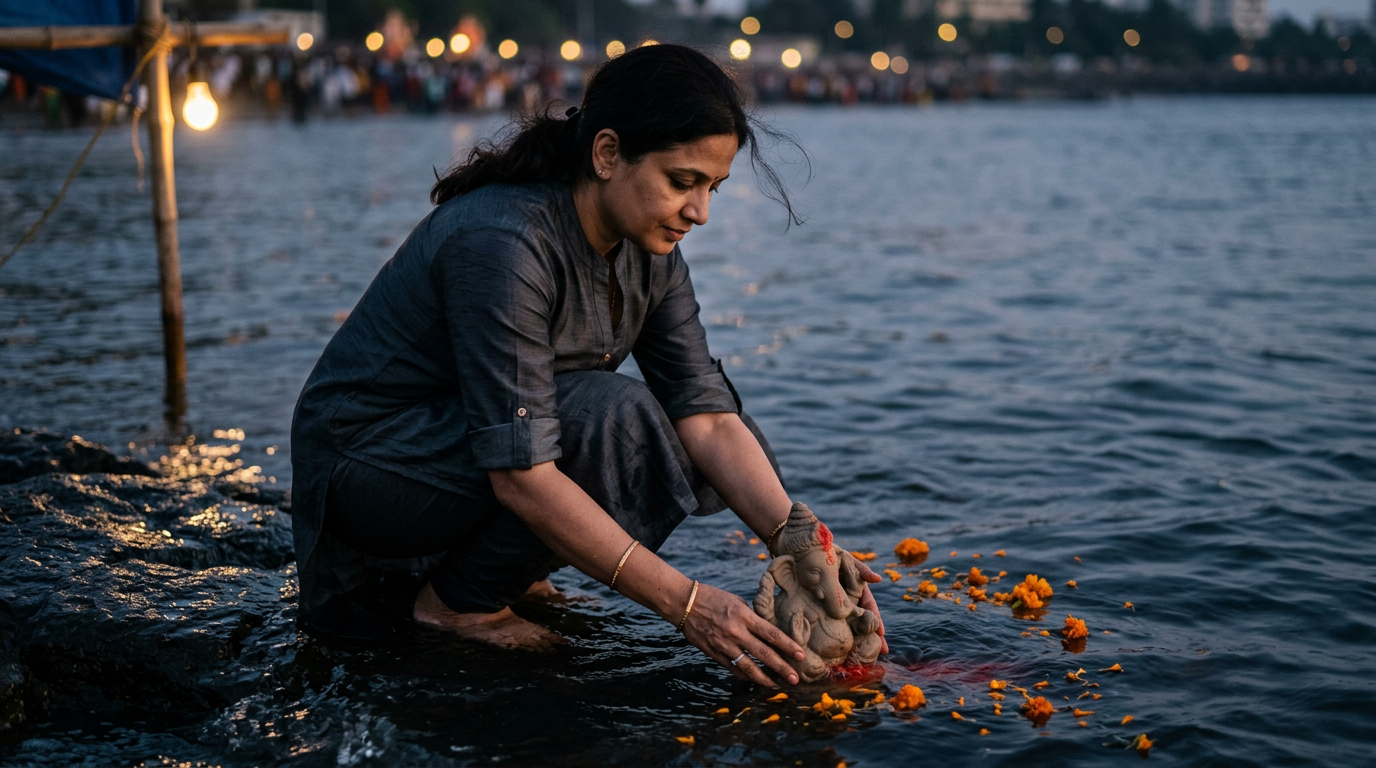
Ganesh Chaturthi 2026 begins on Monday 14 September in India and is observed as a public holiday two days later, on Wednesday 16 September, in Mauritius. For up to ten days, families in Mumbai, Vacoas, London and Toronto will do something psychologically unusual: they will welcome a guest into the home with full ceremony while knowing, from the first hour, the exact day they will let him go.
This article covers how the festival is celebrated in India, Mauritius and the wider diaspora, what the 2026 immersion rules mean in practice, and the practices worth keeping this year. It also sits with the question the tenth day quietly puts to all of us: what are you still hosting past its time?
Here is the short answer for anyone planning. The murti goes in on Monday 14 September, the main immersion falls on Friday 25 September, Mauritius takes its holiday on Wednesday 16 September, and most diaspora temples gather on the nearest weekend. Everything after that is about what the festival does to a person, and why, in a year as heavy as this one, that matters more than the height of the pandal.
When is Ganesh Chaturthi 2026?
In India, the Chaturthi tithi (the fourth lunar day of the bright fortnight of Bhadrapada) begins at 7:06 am on Monday 14 September and ends at 7:44 am the next morning, which makes 14 September the day of sthapana, the installation of the murti at home or in the pandal. The favoured midday window runs roughly from 11 am to 1:30 pm, shifting by a few minutes from city to city. Anant Chaturdashi, the day of the main immersion, falls on Friday 25 September, though a great many households say goodbye after a day and a half, five days or seven.
In Mauritius, the Prime Minister’s Office has fixed the public holiday on Wednesday 16 September. Across the diaspora, temples and cultural associations tend to hold their largest gatherings on the nearest weekend so that working families can attend, which in 2026 means the weekends either side of the installation.
How India celebrates: two festivals in one
Ganesh Chaturthi in India is two festivals stacked on top of each other. The older one is domestic: a clay murti brought home with ceremony, prana pratishtha (the rite that invites life into the image), aarti morning and evening, modak that somebody’s mother insists cannot be bought, and a house that rearranges itself around a guest. The younger one is public. The community celebration was begun by Bal Gangadhar Tilak in Pune in 1893, and it turned a household devotion into a collective one, with pandals, music, competitions and, in time, the towering idols of Mumbai’s mandals. In Mumbai alone, around 150,000 murtis are immersed every year.
The public festival is now reckoning with its own scale. For 2026, the Brihanmumbai Municipal Corporation has confirmed that idols under six feet must be immersed in artificial ponds, in line with Bombay High Court directions, and has arranged 281 artificial ponds alongside 44 beaches and jetties and 23 natural lakes, 348 immersion sites in all. Maharashtra has extended its plaster-of-Paris guidelines until the court’s final verdict, including the red mark on the back of every PoP idol and a nudge to mandals to keep a large idol for reuse and immerse a smaller symbolic one. I will come back to why that last idea is more than an environmental compromise.
How Mauritius celebrates: an island keeps one community’s festival
I grew up in Mauritius, and it took leaving the island to notice how unusual its version of the festival is. Ganesh Chaturthi arrived with the indentured labourers of the nineteenth century and belongs, in origin, to the Marathi community, a minority within the island’s Hindu population. Yet the whole country takes the day off. Schools close, offices close, and families of every faith know to expect drums on the coast road.
The festival was first kept inside Marathi homes, then spread to temples and community prayers, and only later grew into the processions of imported murtis, navvari sarees and traditional music that walk to the beach at Flic-en-Flac, where thousands of immersions take place on the day. The south-west, where the community is concentrated, is where the day feels most alive, though towns such as Vacoas-Phoenix and Grand Baie hold celebrations of their own and Ganga Talao, the sacred crater lake in the highlands, receives murtis as well.
What strikes me now, after years of coaching in Mauritius, is the psychology of a country holding a minority’s festival as a national day. It is not tolerance, which merely permits. It is participation, and participation is what belonging feels like from the inside.
How the rest of the world celebrates
Beyond India and Mauritius, the festival is kept in Nepal, particularly the Terai, and by Hindu communities across Australia, New Zealand, Canada, Singapore, Malaysia, the Caribbean, Fiji, South Africa, the United States and Europe. Nepal deserves its own sentence this year. Catastrophic floods struck the country’s border with China at the end of August, and by 5 September authorities on both sides had reported more than 1,350 dead and over 5,000 missing. Many Nepali families will keep Ganesh Chaturthi this year in mourning, or not at all. The rest of us should hold that in mind when the drums start.
Britain has produced some of the festival’s most unexpected images: a London celebration that ends with a procession to Ham and an immersion in the Thames, followed by thousands of devotees, and murtis carried into the North Sea at Clacton-on-Sea. What the diaspora has learnt is adaptation without dilution. The large gatherings move to the weekend; during the pandemic, the Mauritian Marathi Society in the UK live-streamed its aarti and visarjan so that an elderly community could still take part. The idol travels badly. The sequence travels perfectly: welcome, host, release.
What the ritual does to the mind
It is tempting to treat all this as colour. Psychology has stopped doing so. A review in Personality and Social Psychology Review frames rituals as serving three regulatory functions: they regulate emotion, they regulate the goal states we need for performance, and they regulate social connection. Ganesh Chaturthi does all three inside ten days, which is rare.
Take the ending first, because it is the part the festival gets right and modern life gets wrong. In experiments at Harvard Business School, people who performed a ritual after a loss, whether of a person, a partner or a lottery prize, reported less grief, and the effect ran through a restored sense of control. It held even for participants who said they did not believe in rituals. Visarjan, in other words, is not a superstition about clay dissolving. It is a structured way of handing an ending to the body so that the mind does not have to carry it alone.
Then the crowd. What Durkheim called collective effervescence is now measured as perceived emotional synchrony, the felt sense that a crowd is moving through the same emotion together, and researchers have linked it to social cohesion, prosocial behaviour and well-being. Anyone who has stood in a visarjan procession at Girgaon Chowpatty or Flic-en-Flac will not need the paper to believe it. The nervous system reads a crowd chanting the same four words as safety, and safety is the precondition for joy.
Most rituals do one of these jobs. A funeral regulates grief. A wedding regulates connection. A pre-match routine regulates performance. Ganesh Chaturthi runs the whole arc, from welcome to hosting to release, and it does so with the ending announced on the first day. That is the part I want to keep.
The tenth-day clause
I have started calling this the tenth-day clause: the agreement you make with yourself, on the day you welcome something, about the day you will release it. Whether your Ganpati stays a day and a half or the full ten, nobody brings the murti home believing it is permanent. The whole devotion is organised around an ending everyone has already accepted. And because the ending is agreed, the hosting can be wholehearted.
You do not hold back affection from a guest because he is leaving on Friday. You cook better. The ending, once agreed, is what makes the welcome wholehearted.
Compare that with how most of us hold roles, relationships, identities and successes. We welcome them with no clause at all. The founder who cannot leave the company he built. The parent whose child has outgrown the cradle but not the grip. The professional still hosting a version of herself that stopped being true three promotions ago. Writing about Janmashtami, I described the Kamsa reflex, the instinct to eliminate whatever might replace you rather than raise it. The tenth-day clause is its antidote. Kamsa’s problem was never that his time would end; it was that he never agreed to an ending, so every sign of one became a threat.
The older texts are careful about Ganesha in a way the greeting cards are not. He is Vighnaharta, the remover of obstacles, but he is also Vighnakarta, the one who places them. In that reading an obstacle is not a punishment; it is information about where you are refusing an ending. And there is the tusk. In the tradition where Ganesha writes the Mahabharata as Vyasa dictates, his pen breaks and he snaps off his own tusk to keep writing. He chose to finish the work over keeping himself intact. Most of us do the reverse: we keep ourselves intact and finish nothing.
Three questions before the drums begin:
- What have you been hosting that arrived without a tenth-day clause?
- If you named its ending today, what would you finally allow yourself to give it while it is still here?
- Which obstacle in your life this year might be information rather than bad luck?
If letting go is the part you struggle with, I have written separately about the psychology of finally putting the past down, and the four moves of the Open Hand Method apply as well to a role as to a memory.
Good practices for Ganesh Chaturthi 2026
Some of these are environmental, some are psychological, and a few are simply about being a decent neighbour.
- Choose clay, and choose small. A shadu (river clay) murti with natural colours dissolves in hours and asks nothing of the water. The mandals that keep a large idol for reuse and immerse a small symbolic one are, without saying so, modelling a healthier relationship with endings: keep the meaning, release the object.
- Follow the immersion rules where you live. In Mumbai and much of Maharashtra, that means artificial ponds for idols under six feet, and the red mark on PoP idols. A festival about removing obstacles should not leave one on the seabed.
- Compost the nirmalya. Flowers, durva and leaves gathered across ten days belong in a municipal nirmalya collection or a garden, not in the sea with the murti.
- Make a decibel promise. Decide before day one when the speakers go off, and keep it for the infant next door, the elderly and the animals. Joy that costs someone else their sleep is volume, not devotion.
- Let the trained people do the deep water. Immersions are where the day’s accidents happen. Hand the murti to the lifeguards and volunteers at the ghat; the ritual is complete the moment you let go, not the moment you wade in.
- Invite someone who does not celebrate. Mauritius does this at a national level. Do it at the level of one household: a neighbour of another faith, a colleague new to the city, a friend who lives alone. The public festival was built for exactly this.
- Put the phone down for aarti. Five minutes with both hands free and both eyes on the flame. You cannot be in the ritual and in the feed at the same time; attention does not split, it alternates.
- Add the tenth-day gift. Before Ganpati leaves, give away something with the weight of what you spent on him: a donation to flood relief in Nepal, a meal for the mandal’s clean-up crew, time for a family with less. In my Diwali article, I called this the second diya, the lamp you light for a darkness that is not your own. This is its September form.
- Say the ending out loud on day one. When the murti is installed, tell the children which day he leaves. That sentence is the whole festival.
The farewell that is also an invitation
The parting chant, Ganpati Bappa Morya, pudhchya varshi lavkar ya, translates roughly as: Lord Ganesha, come again soon next year. Notice what kind of sentence that is. It is not a lament. It is an invitation, and you can only issue it to something you have let go. The people who cannot say goodbye never get to say come back; they lose the second sentence because they refused the first.
That is what I would carry out of Ganesh Chaturthi 2026: not the height of the idol or the length of the queue, but the discipline of welcoming fully because you have agreed to release fully. If something in your life arrived without a tenth-day clause and you would like a steady, evidence-informed space to work out what its ending should look like, that is the kind of work life coaching is for.


