
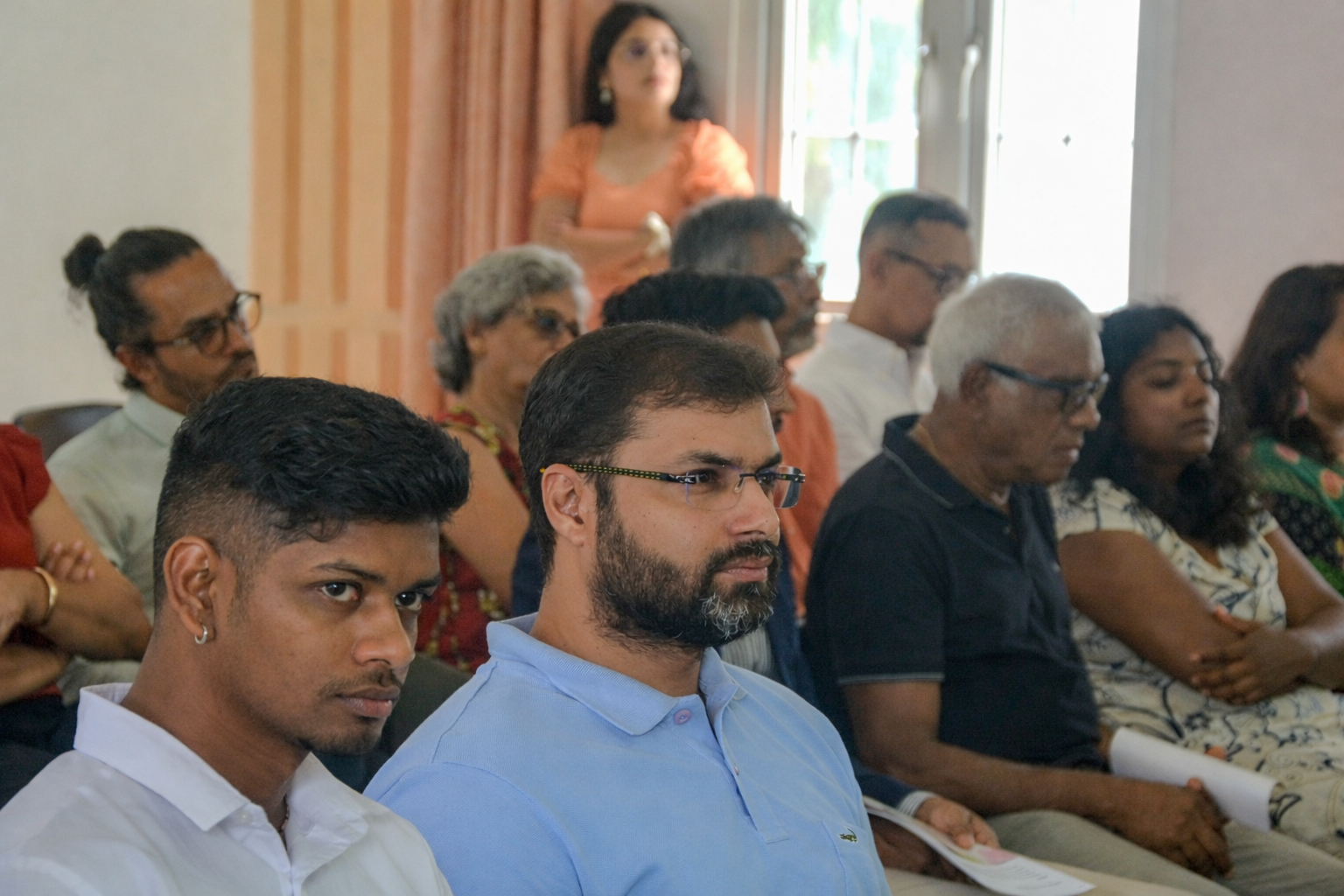
I walked into the World Religion Day gathering today with the cautious curiosity I reserve for anything that uses a phrase like “reconceptualising justice”. It can sound like a conference room trying to sound like a conscience.
The event was organised by the Bahá’í community, and the theme was quietly daring: “Reconceptualising Justice for a Gender-Equal World”. In Mauritius, we value harmony. We even package it as identity. Yet harmony is not the same as justice. Harmony can be silence with good PR.
As a life coach, I do not only listen to what people say. I listen to what their nervous system is protecting.
When Justice Becomes a Felt Sense
Somewhere between the opening remarks and the first shared reflection, I noticed my shoulders drop. My jaw unclenched. It surprised me. “Justice” usually tightens people up. It summons courtrooms, accusations, and the polite fear of conflict.
What I felt in that room was different. Not performative outrage. Not guilt dressed up as progress. More like a steadier emotional temperature, the kind that arrives when someone names a truth you have been carrying alone.
This is a psychological clue: we experience justice as regulation. When systems are fair, bodies soften. When systems are unfair, bodies brace. People call it resilience. Often, it is simply chronic bracing becoming normal.

Gender Equal Justice in Mauritius What World Religion Day Made Me See Dr Krishna Athal 
Gender Equal Justice in Mauritius What World Religion Day Made Me See Dr Krishna Athal 
Gender Equal Justice in Mauritius What World Religion Day Made Me See Dr Krishna Athal 
Gender Equal Justice in Mauritius What World Religion Day Made Me See Dr Krishna Athal 
Gender Equal Justice in Mauritius What World Religion Day Made Me See Dr Krishna Athal 
Gender Equal Justice in Mauritius What World Religion Day Made Me See Dr Krishna Athal 
Gender Equal Justice in Mauritius What World Religion Day Made Me See Dr Krishna Athal 
Gender Equal Justice in Mauritius What World Religion Day Made Me See Dr Krishna Athal 
Gender Equal Justice in Mauritius What World Religion Day Made Me See Dr Krishna Athal 
Gender Equal Justice in Mauritius What World Religion Day Made Me See Dr Krishna Athal
Reconceptualising Justice: Beyond Laws and Slogans
The theme pushed me to reconsider what justice even is. If we reduce it to policy and punishment, we miss its inner architecture. Justice is not only what happens in public. Justice is what becomes possible in private.
A gender-equal world is not just a world where women can enter the room. It is a world where they do not have to leave parts of themselves at the door.
One speaker touched on how “neutral” rules can reward those who were already advantaged. That landed. Neutrality can be a well-lit disguise for historical imbalance.
This is where gender-equal justice in Mauritius becomes an honest question. Do we celebrate women’s strength because we respect it, or because we rely on it while avoiding responsibility?
The Peacekeeper Culture and Its Hidden Cost
Mauritius is skilled at social peace. Families, workplaces, communities, even friendships often run on a quiet contract: do not make things awkward. But gender inequality survives best in environments where awkwardness is punished.
I thought of a coaching client from years ago. Brilliant, composed, high-performing. Her life looked successful from the outside. Yet every time she tried to ask for something simple at home, help, rest, shared decision-making, her throat would tighten. She would say, “I don’t want to start a fight.” The fight had already started. It was happening inside her.
That is the peacekeeper trap. It is not kindness. It is fear rehearsed as politeness.
Reconceptualising justice asks a sharper question: who is paying for the peace?
How Inequality Becomes Invisible
Gender inequality persists partly because it becomes normal. In psychology, we call this habituation. What we are exposed to repeatedly stops registering as a problem. We stop seeing what we have learned to survive.
Language plays a role. “She is strong” can be praise, but it can also justify neglect. “He is just like that” can be a shrug that excuses harm. And then there is the most dangerous sentence in any culture: “That’s how it is.”
In coaching, I often ask: who benefits when you believe that story? In the context of gender-equal justice in Mauritius, it becomes a mirror we do not always want to hold.
A Yogic Lens: Non-Violence Is Not Passive
As an aspiring yogi, I kept returning to ahimsa, non-violence. We often think of it as not hurting others. But there is also the violence of dismissal, the violence of ridicule, the violence of making someone earn basic respect.
A gender-equal world requires non-violence not just in headlines, but in households. It asks men to examine not only their behaviour, but their entitlement. It asks women to examine not only their endurance, but their permission to want.
It also asks all of us to notice where we spiritualise suffering. Mauritius has a deep spiritual texture across religions. That is a gift. But spirituality becomes corrosive when it is used to advise endurance instead of transformation. Sometimes “be patient” is wisdom. Sometimes it is a polite way of saying “stay small”.
From Women’s Issue to Human Standard
One moment from today stayed with me. A participant shared, gently, that gender equality is often discussed as a women’s issue, as if men are spectators. The room went quiet in the best way. Quiet that indicates reflection, not avoidance.
If we want gender-equal justice in Mauritius, we have to stop treating it like a theme and start treating it like a behavioural standard. Justice is not what we claim. It is what we practise when no one is watching.
Families teach this early. Daughters are often trained for competence. Sons are often trained for comfort. Nobody intends harm. But intention does not cancel impact.

Gender Equal Justice in Mauritius What World Religion Day Made Me See Dr Krishna Athal 
Gender Equal Justice in Mauritius What World Religion Day Made Me See Dr Krishna Athal 
Gender Equal Justice in Mauritius What World Religion Day Made Me See Dr Krishna Athal 
Gender Equal Justice in Mauritius What World Religion Day Made Me See Dr Krishna Athal 
Gender Equal Justice in Mauritius What World Religion Day Made Me See Dr Krishna Athal 
Gender Equal Justice in Mauritius What World Religion Day Made Me See Dr Krishna Athal 
Gender Equal Justice in Mauritius What World Religion Day Made Me See Dr Krishna Athal 
Gender Equal Justice in Mauritius What World Religion Day Made Me See Dr Krishna Athal 
Gender Equal Justice in Mauritius What World Religion Day Made Me See Dr Krishna Athal 
Gender Equal Justice in Mauritius What World Religion Day Made Me See Dr Krishna Athal 
Gender Equal Justice in Mauritius What World Religion Day Made Me See Dr Krishna Athal 
Gender Equal Justice in Mauritius What World Religion Day Made Me See Dr Krishna Athal 
Gender Equal Justice in Mauritius What World Religion Day Made Me See Dr Krishna Athal 
Gender Equal Justice in Mauritius What World Religion Day Made Me See Dr Krishna Athal 
Gender Equal Justice in Mauritius What World Religion Day Made Me See Dr Krishna Athal 
Gender Equal Justice in Mauritius What World Religion Day Made Me See Dr Krishna Athal 
Gender Equal Justice in Mauritius What World Religion Day Made Me See Dr Krishna Athal 
Gender Equal Justice in Mauritius What World Religion Day Made Me See Dr Krishna Athal 
Gender Equal Justice in Mauritius What World Religion Day Made Me See Dr Krishna Athal 
Gender Equal Justice in Mauritius What World Religion Day Made Me See Dr Krishna Athal
The Inner Work: From Blame to Responsibility
Whenever gender inequality is discussed, it is tempting to locate villains. The mind loves villains because they keep the system intact. But justice is not served by blame alone. Blame burns fast and leaves little behind.
Responsibility is slower. More mature. More inconvenient.
If you are a man reading this, you do not need to drown in guilt. Guilt can become self-focused. What helps is curiosity. Ask: where do I expect ease at someone else’s expense? Where do I call something “tradition” because it protects my comfort?
If you are a woman reading this, you do not need to become harder to become equal. You need to become freer. Ask: where have I confused being loved with being low-maintenance? Where have I been loyal to peace at the cost of my own voice?
Leaving with a Better Question
When the event ended, I stepped outside into the ordinary world again. Cars, errands, WhatsApp messages, the usual swirl. And yet something stayed with me. Not a slogan. A question.
What would gender-equal justice in Mauritius look like if it began in the nervous system, not just in policy? If boys were taught emotional responsibility as early as they are taught ambition? If girls were taught self-trust as early as they are taught courtesy?
A gender-equal world is not built only by institutions. It is built by ordinary people refusing to normalise what harms.
Today, I did not leave with answers. I left with a deeper quality of attention. And that might be the first real definition of justice: to see clearly, to feel honestly, and to act with courage, even when harmony would be easier.


Leave a Reply