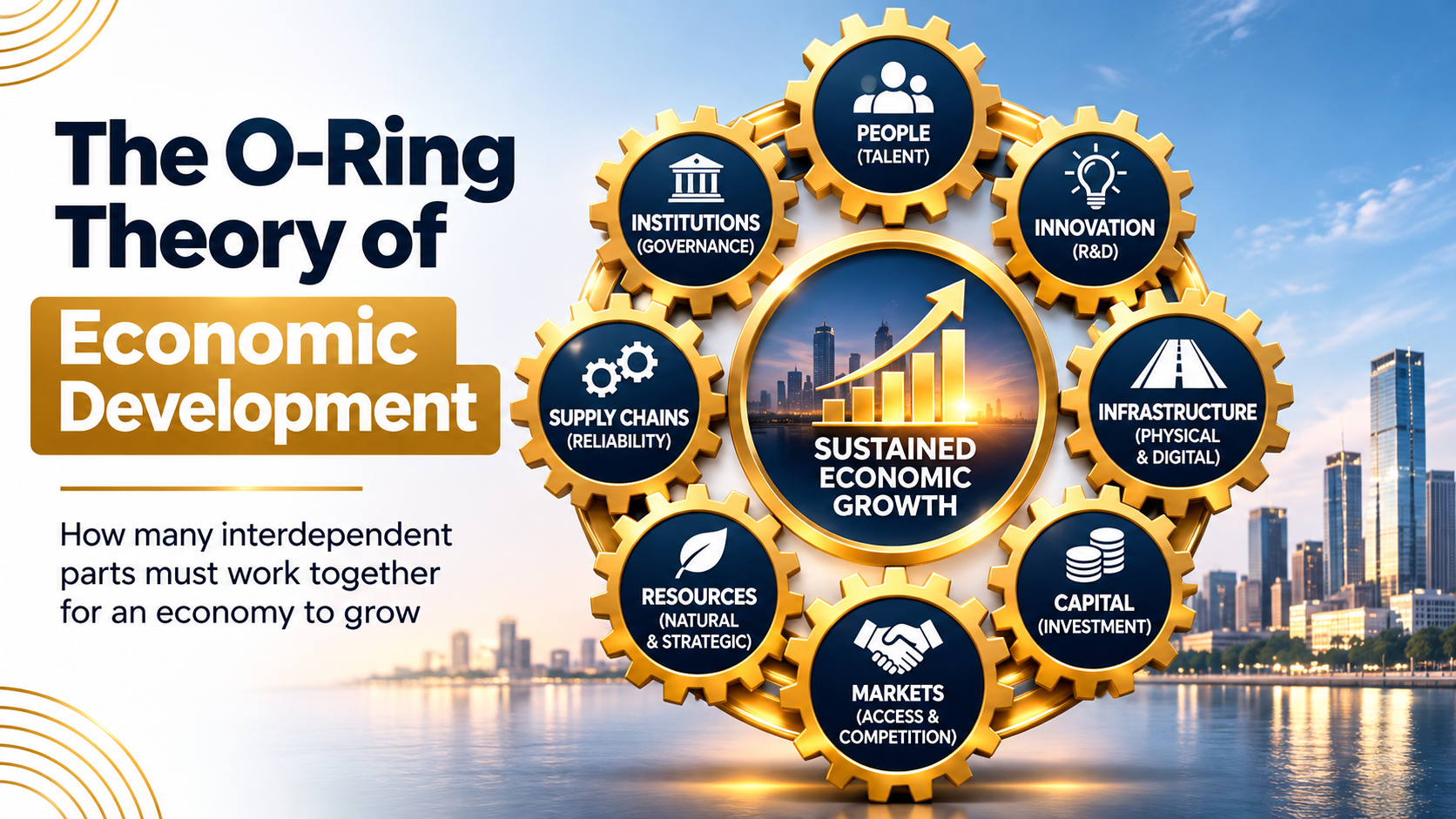
The O-ring theory of economic development asks a deceptively simple question: why do small differences in skill produce enormous differences in income, between firms and between entire nations? Michael Kremer’s answer, published in 1993, took its name from a rubber seal that failed on a cold Florida morning. It remains one of the most useful ideas in economics for anyone who leads people, because it explains why excellence cannot be averaged.
Here is what the theory says, how the model works, where it falls short, and what it quietly asks of every leader.
What is the O-ring theory of economic development?
The O-ring theory of economic development is a model proposed by the economist Michael Kremer in a 1993 paper in The Quarterly Journal of Economics. It treats production as a chain of tasks that must all be done well for the final product to keep its value.
The key move is this. Quality multiplies across tasks rather than adding up. One poorly executed step does not nudge the average down a little. It can wipe out most of the value everyone else created.
From that single assumption, Kremer drew three striking conclusions:
- skilled workers end up working with other skilled workers
- wages rise steeply with skill
- countries with only slightly lower average skill can end up dramatically poorer
Kremer later shared the 2019 Nobel Prize in economics with Abhijit Banerjee and Esther Duflo for experimental work on global poverty. The O-ring paper is not what won it, but it remains one of the most widely cited ideas in development economics.
Why is it called the O-ring theory?
On 28 January 1986, the space shuttle Challenger broke apart shortly after launch, killing all seven crew. The cause was not a dramatic engine failure. It was a rubber seal, an O-ring, in a joint of the right solid rocket booster, stiffened by unusually cold weather.
Thousands of components worked perfectly. One small, cheap part did not, and nothing else mattered.
That is the image Kremer borrowed. In some kinds of work, being 95% excellent does not earn 95% of the reward.
How the O-ring model works, in plain English
Kremer describes production with a production function, which is simply a formula linking inputs, such as workers and their skill, to output.
Step 1: give each worker a quality score.
- Each worker has a skill level, written as q, between 0 and 1.
- You can read it as the probability that the worker performs their task correctly.
Step 2: multiply the scores together.
- Output equals the scores of everyone in the chain multiplied together, scaled up by the value of the product.
- Multiplication is unforgiving, as a simple hypothetical shows:
| Each stage done right | Stages in the chain | Value surviving |
|---|---|---|
| 95% of the time | 5 | about 77% |
| 95% of the time | 20 | about 36% |
| 99% of the time | 20 | about 82% |
The lesson is that complexity is a tax on carelessness. The more steps a product depends on, the more brutally small error rates compound.
Step 3: like works with like.
This produces what economists call positive assortative matching: people of similar skill end up working together. A quick example shows why:
- Imagine two strong workers (q = 0.9) and two weaker ones (q = 0.5), working in pairs.
- Pair strong with strong and weak with weak: total output is 0.81 + 0.25 = 1.06.
- Mix them: total output is 0.45 + 0.45 = 0.90.
- The economy produces more when strong workers cluster.
- A firm full of skilled people can therefore pay more for the same job, because each new hire’s reliability is multiplied by everyone else’s.
Step 4: what the model predicts.
Kremer argued the model is consistent with:
- large income gaps between countries
- the predominance of small firms in poor countries
- the tendency for wages in different occupations within the same firm to move together
It also suggests that rich countries specialise in complex products, where long chains of near-flawless work pay off. Poorer economies are pushed towards simpler production.
The O-ring trap: why your skills depend on who sits beside you
The most psychologically interesting part of the model concerns a worker’s decision to invest in skill.
Kremer introduced strategic complementarity, meaning that the payoff from my effort depends on your effort.
- In an O-ring world, my training is worth far more if my colleagues are also highly skilled.
- If everyone around me is unreliable, my excellence will be swallowed by their mistakes, so why invest?
- When skill is hard to observe and matching is imperfect, this can trap whole communities or countries in a low-skill equilibrium. Nobody upgrades because nobody else has.
This is why the model is often used to discuss brain drain:
- A talented engineer’s skill is worth more in a firm full of talented engineers.
- If that firm happens to be abroad, the economics of leaving are obvious.
It is also why Kremer saw a strong case for subsidising education. Raising everyone’s skill raises the return to each person’s skill.
Where the O-ring theory falls short
No serious account should present this model as the whole story. Its limits are worth knowing:
- Not all work is O-ring work.
- The economist Garett Jones (2013) distinguished an “O-ring” sector, where tasks are tightly complementary, from a “foolproof” sector, where an extra worker simply adds output and one person’s mistakes do not destroy everyone else’s work.
- Most organisations contain both.
- Policy guidance is thin. Development economists Michael Todaro and Stephen Smith noted that the model offers limited practical policy implications.
- Productivity sits in the job, not the person. This raises an awkward question the model does not answer: how do workers gain access to the high-productivity jobs in the first place?
- Other forces matter too. Institutions, natural resources, history and capital help explain why countries differ. Many economists accept O-ring logic inside firms more readily than as the main explanation for gaps between nations.
- Growth is not only about avoiding mistakes. Much modern prosperity comes from people generating good ideas, which this framework does not capture.
- Redundancy changes the arithmetic. Challenger’s joint had a secondary O-ring designed as a backup, and part of the case made for launching rested on it. Well-designed systems build in such seals. Badly run ones treat the backup as permission to ignore the warning.
What the O-ring theory means for leaders
Here is where I think the theory becomes more than an economics exam answer.
Every O-ring organisation runs on two chains:
- The task chain: the sequence of work that must be done right.
- The information chain: the sequence of people through whom bad news must travel.
Kremer’s model describes the first. Challenger is a story about the second.
The night before the launch, engineers at the booster’s manufacturer recommended not launching below 53°F. Their concerns were overruled. The presidential commission later concluded that the decision to launch was flawed, and that key decision-makers were unaware of the original recommendation and the engineers’ continuing opposition.
The seal failed in the air, but the warning had already failed on the ground.
The altitude filter. I call the second failure the altitude filter: the quiet editing every message undergoes on its way up to a senior leader, because each person carrying it has a stake in how it will be received. I explored it in what an executive coach does for senior leaders. In O-ring work it is lethal, because the one warning that matters is often held by someone with the least status in the room.
Normalisation of deviance. The sociologist Diane Vaughan described how Challenger’s managers came to see repeated O-ring damage as acceptable. She called this normalisation of deviance: small, tolerated departures from standard slowly become the new standard. Psychologically, it is how intelligent people talk themselves out of a fear they once had.
Excellence does not average out. Where quality multiplies, the weakest link is not a drag on the score. It is the ceiling.
Four practical moves follow:
- Map your O-ring tasks.
- Which steps, if done at 90%, would quietly destroy the value of everything else?
- These are often unglamorous: compliance checks, handovers, data entry, the final proofread, the night shift.
- Hire and train for floors, not only ceilings.
- Organisations love stars because stars are visible.
- O-ring logic says the return on lifting your weakest critical link is often higher than adding one more star.
- Make “it is too cold” cheap to say.
- Psychological safety is not a soft extra in O-ring work. It is the information chain’s O-ring.
- This is the core of my programme on difficult conversations, conflict and psychological safety.
- Decide in advance who can stop the launch.
- Ambiguous decision rights let warnings be heard and still ignored.
- A clear structure such as the DACI decision-rights matrix makes it obvious who can say no, and to whom.
A short reflection before you move on:
- Which task in your work would undo everything if it were done slightly badly, and do you know who does it?
- When did someone last tell you something was “too cold”, and what happened to them afterwards?
- Are you hiring stars to compensate for a seal you have never inspected?
The quiet lesson of a rubber ring
The O-ring theory of economic development began as an explanation of why some nations stay poor. It ends as a mirror for every team that believes its brilliance will cover its blind spots. The shuttle did not fail for lack of genius; it failed because genius was multiplied by a weakness nobody wanted to hear about.
If you lead an organisation where one unnoticed error can undo everyone else’s excellence, you may find it useful to see how I approach corporate training that builds capability across the whole team.


