
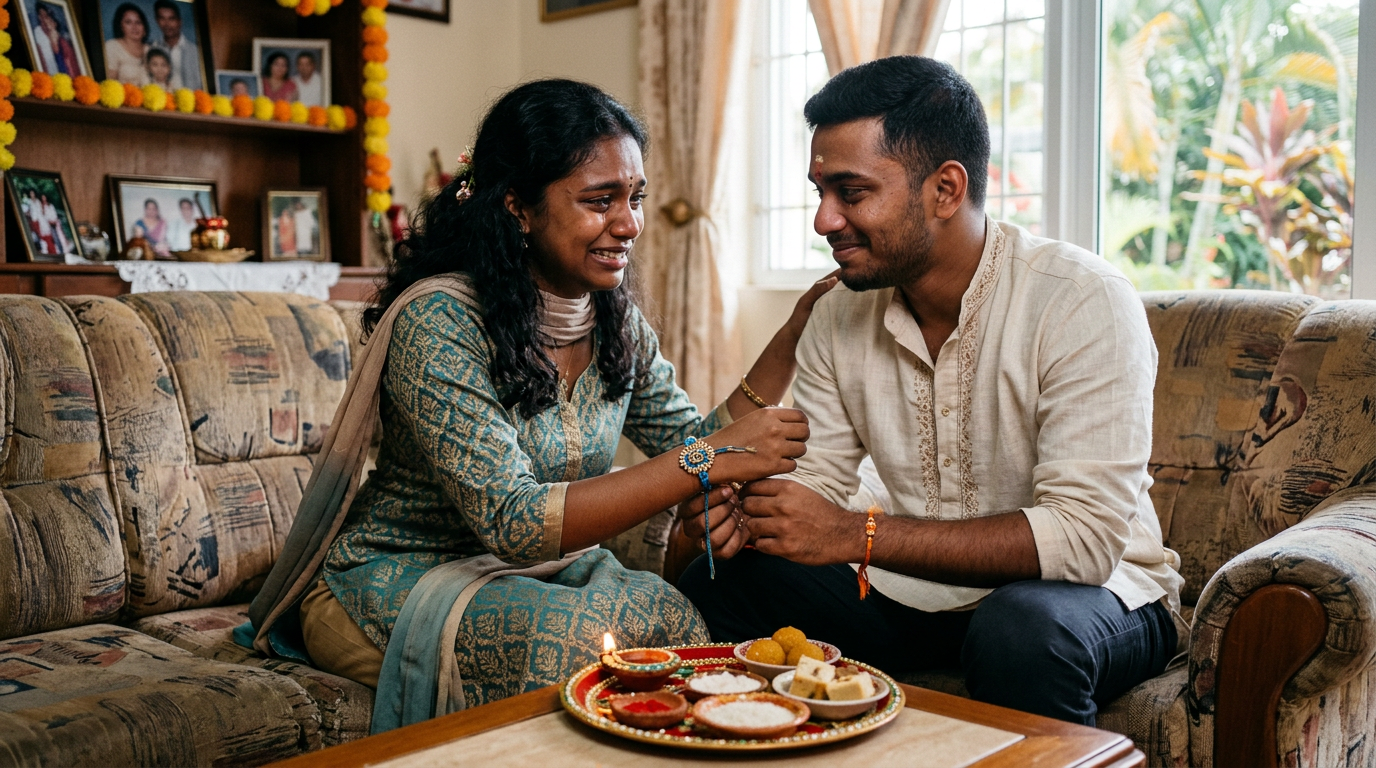
Tomorrow, on Friday 28 August, millions of wrists will receive a thread. Some will be tied across a kitchen table, some across a video call, and some will arrive by courier to a flat in a city the sister has never seen. So it is worth asking, plainly, what Raksha Bandhan in modern society is still for.
My answer is that it has quietly become one of the most important rituals we have. Not because the old story of a brother guarding a sister still fits, but because the bond it renews is now rarer, more stretched and more easily lost than at any point in its long history.
Here is the short version. Raksha Bandhan matters more today than ever because the three conditions that once made the sibling bond automatic have all weakened at the same time. We have fewer siblings than any previous generation. We live further from the ones we have. And we are living through what the World Health Organization now calls a global crisis of social disconnection. In that landscape, a ritual that forces two people to stop, touch, promise and be seen once a year is not a quaint leftover. It is maintenance for a relationship we have started to take for granted.
The rest of this article is about why that is true, what the numbers say, and how to tie the thread this year so that it holds.
What Raksha Bandhan was for, and what it is for now
The literal meaning is a bond of protection. In the traditional telling, a sister ties the rakhi and a brother vows to protect her. Modern readers often stumble here, and rightly. Many sisters today earn more than their brothers, live alone in cities their brothers have never worked in, and need no one’s guardianship.
But the festival was never as narrow as that reading suggests. Rabindranath Tagore used the rakhi in 1905 as a thread tied between Hindus and Muslims in protest at the partition of Bengal. Sisters tie rakhis to sisters. Children tie them to soldiers they will never meet. In Mauritius and Singapore, families tie them across the diaspora to people who are kin by choice rather than blood. The thread has always been elastic. What it protects has changed.
I read raksha now as mutual protection against the specific dangers of this era: drift, distance, silence, and the slow conversion of a sibling into a contact in a phone. The brother does not protect the sister from the world. The two of them protect the relationship from the world.
Why it matters more now than at any time in history
Consider what has changed in a single lifetime.
We have fewer siblings. In the 1950s an Indian woman had around six children on average. According to the National Family Health Survey (2019-21), the figure is now 2.0, below replacement level. A child born today will typically have one sibling, and a growing number will have none. For most of human history the sibling bond was abundant; now it is scarce. Scarcity should raise the value of what remains, yet we rarely treat it that way.
We live further apart. The 2011 Census counted 450 million internal migrants, about 37% of the population, and the share had already risen from 30% a decade earlier. Millions of brothers and sisters who once shared a courtyard now share a family WhatsApp group. Physical distance does not end a relationship, but it removes the daily, effortless contact that used to keep it alive without anyone having to try.
We are lonelier. In June 2025 the WHO Commission on Social Connection reported that about one in six people worldwide is affected by loneliness, and that it contributes to an estimated 871,000 deaths every year, roughly 100 an hour. The loneliest group is not the elderly but adolescents and young adults, about one in five. That is exactly the age at which siblings scatter for college and work.
Family rifts are common and hidden. There is no comparable national survey in India, but the largest study in the United States, led by Karl Pillemer at Cornell, found that 27% of adults had cut off contact with a family member, and 8% specifically with a sibling. In my experience the Indian pattern is less often a dramatic cutoff and more often a quiet fade, which is harder to notice and just as costly.
And the bond has long-term consequences. A 30-year study of 229 men by Robert Waldinger and colleagues at Harvard found that poor sibling relationships before the age of 20 predicted major depression by 50, even after accounting for the quality of parenting. The relationship you had with your brother or sister at 15 is still working on you at 50. It is one of the longest relationships most of us will ever have, and one of the least examined.
Put those five facts together and the case makes itself. Fewer siblings, greater distance, rising loneliness, unspoken drift, and lifelong stakes. No generation before ours has needed a deliberate ritual of reconnection as much as this one.
The assumed bond
Why, then, do we neglect precisely the relationships that matter most? I have come to think of this as the assumed bond: a relationship we never tend because we believe it cannot be lost.
We maintain friendships because we know friends can leave. We work at marriages because we have seen marriages end. But a sibling is a fact, not a choice, and the mind treats facts as things that need no effort. So the sibling gets what is left over after the boss, the partner, the children and the feed have taken their share. We call this closeness. Often it is only proximity of origin.
There is a behavioural principle underneath this. People invest in relationships in proportion to their perceived fragility, not their importance. That is why an assumed bond can go unwatered for a decade and only reveal its damage at a funeral, a property dispute, or a hospital corridor at two in the morning.
What the thread actually does
Rituals look decorative from the outside. Psychologically they do serious work.
First, a rakhi is a commitment device: a structure you set up in advance so that your future self does the right thing without having to decide it fresh. You do not have to feel like calling your brother on 28 August. The calendar has already decided. In a life governed by the always-on reachability I wrote about in the availability debt, a fixed date that belongs to one relationship is a rare form of protection.
Second, it is physical. A thread is tied, a forehead is marked, sweets are put into a mouth. Touch between family members is one of the most reliable ways we have of signalling safety to another nervous system, and adults, especially men, receive very little of it. For many brothers, the rakhi is one of the few moments in the year when a sister’s hands are on their wrist. That is not sentiment. That is biology being given a chance.
Third, the promise is spoken aloud, in front of witnesses. A private intention is a preference. A commitment made in front of your parents, spouse and children is a different thing entirely, and the mind knows it.
Fourth, the wrist is public. For days afterwards, the thread is visible in meetings, on trains, at desks. It quietly tells the wearer, and everyone else, that he belongs to someone.
The paradox of a ₹30,000 crore festival
Here is the fact that unsettles me most. The Confederation of All India Traders expects Raksha Bandhan trade to cross ₹30,000 crore this year, with rakhis alone accounting for around ₹25,000 crore. In 2025 the estimate was ₹17,000 crore. Around 2020 it was roughly ₹6,000 crore. The economy of the festival has grown roughly fivefold in six years while the relationship it celebrates has been thinning for a generation.
I do not think the two facts are unrelated. When a bond becomes harder to practise, we compensate by spending. The hamper gets bigger as the conversation gets shorter. The designer rakhi replaces the ten-minute talk nobody quite knew how to start.
We have never spent more on the thread, or less on the tie.
Interestingly, the traders also note that only about 7% of rakhi buying happens online. People still want to touch the thread before they send it. The instinct is intact. It is the follow-through, the relationship the thread stands for, that has been outsourced.
A moment of reflection
Before tomorrow, sit with these for a minute.
- When did you last speak to your brother or sister about anything other than your parents, money or logistics?
- What does your sibling know about your life right now that they could only have learned from you?
- If this relationship were a friendship rather than a fact, would you be worried about it?
How to tie the knot so that it holds
The ritual is the easy part. Here is what turns it into a relationship.
Add one sentence to the thread. After the rakhi is tied, say one true thing you have never said. Something you admire in them, something you are sorry for, or something you need. The thread makes the sentence possible; the sentence makes the thread mean something.
Convert the day into a rhythm. One festival a year cannot carry a relationship. Agree on one small standing contact: a monthly call, a shared walk when you are in the same city, a photo sent with no caption. The rakhi is the anchor; the rhythm is the rope.
Widen the wrist. If you have no sibling, or your sibling is gone, or the relationship is beyond repair for now, tie the thread to the person who has been a brother or sister to you. Modern society is full of chosen kin, and the tradition has always had room for them. The crowded loneliness of contemporary India is partly a failure to name the people who already function as family.
If you are estranged, send a door, not a demand. A rakhi to a brother you have not spoken to in three years should not carry an expectation of reply. Send it with a two-line note that asks for nothing. Silence is a possible answer, and so is a phone call in November. The thread does its work slowly. If the rift involves patterns that keep repeating across the family, this is exactly the sort of knot that relationship coaching exists to untangle, with more care than a festival can offer.
Let the brother receive. A great many men are competent at giving and helpless at being cared for. If you are the brother, your only task tomorrow is to hold out your wrist and let it happen, without deflecting with a joke. I have written elsewhere about the applause gap, the loneliness of people who are celebrated but not known. A sister who ties your rakhi is one of the few people on earth who knew you before you were anything. Do not waste her.
The last knot
Every ritual is a bet about what will otherwise be forgotten. Nobody needs a festival to remind them to check their phone. We need Raksha Bandhan precisely because the sibling bond is the kind of thing a busy, mobile, self-made life forgets by default, and because forgetting it costs more than we usually admit, sometimes decades later.
I recently wrote about Guru Purnima as a day that asks you to name your teacher. Raksha Bandhan asks something similar: name the person who has your back, and let them tie that fact to your body so you cannot pretend otherwise.
Tomorrow, the thread will take ten seconds. What it stands for takes a lifetime, and it is one of the few relationships you can neither replace nor start again from scratch.
If a sibling relationship in your life has drifted, hardened or gone silent, and you would like to think it through with someone outside the family, you are welcome to book a free 15-minute consultation. No preparation needed. Just bring the knot.


