
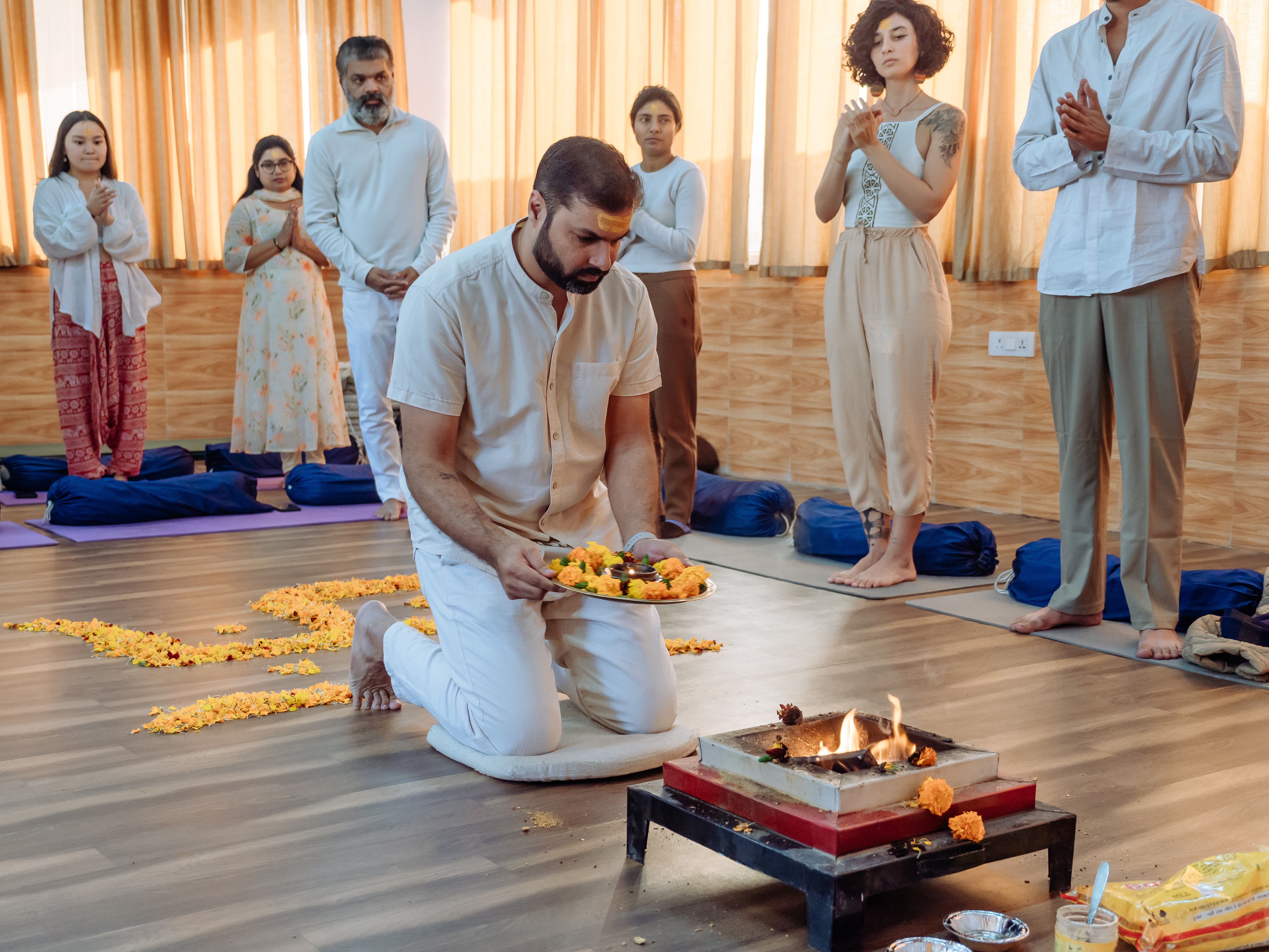
Today in Rishikesh, I sat in front of a hawan fire, and something in me refused to treat it as a “nice spiritual activity”. The world outside might call a yagna or hawan a ritual, a cultural performance, something your grandparents forced you to sit through as a child.
For me, it felt like a mirror.
As the flames rose, I realised the real offering was not ghee or grains. It was my old identities. The version of me that always has to be strong. The part that refuses to forgive. The habit of performing “I am fine” while my nervous system is quietly screaming. All of this, in my mind, was placed into that fire.
This is the importance of yagna in modern life. It is less about “convincing a god” and more about finally telling yourself the truth.
Yagna Is Not Magic, It Is Psychology In Sacred Clothing
Let me be honest as a life coach. A yagna will not fix your life overnight. If you are waiting for one fire ritual to solve your childhood wounds, your career confusion and your relationship patterns, you are outsourcing what cannot be outsourced.
Yet the importance of yagna lies exactly here. It does something more dangerous and more beautiful than instant miracles. It asks uncomfortable questions.
What are you still holding on to that is quietly burning you from within?
Which resentment, role or relationship have you normalised so much that you no longer see its cost?
In psychological language, a yagna is a structured container for projection, release and redecision. You consciously take an inner burden, give it a symbol, and then allow that symbol to be transformed by fire. The mind understands symbols better than lectures. The flames speak a language the intellect alone cannot.
The Nervous System Also Sits By The Fire
While the priest was chanting, I was silently tracking my own body. Breath slowing. Jaw unclenching. Shoulders dropping. My phone was away, the world’s noise was muted, and my attention finally had one job. Fire.
We underestimate how starved our nervous system is for simple, repetitive, meaningful rhythm. The sound of mantras. The crackle of wood. The gesture of offering. These are not just “religious things”. They are regulatory experiences.
The importance of yagna for mental health is this. It gives the body a concrete ritual of safety and surrender. You are not just thinking about letting go. You are enacting it. Modern therapy talks of somatic release. Ancient India quietly sat people around a sacred fire and asked them to breathe, repeat, offer and watch.
Sometimes the most advanced healing technology is something your ancestors already knew.
Ritual In A World That Worships Productivity
We live in a culture that celebrates the to-do list more than the inner life. If you post a gym selfie, people applaud your discipline. If you sit for a hawan, some may secretly judge you as “superstitious”.
Here is my question. If we are so rational and modern, why are our anxiety levels so high, our sleep so shallow, and our relationships so fragile? Clearly, more productivity has not automatically produced more peace.
The importance of yagna, hawan and yajna today is that they interrupt our worship of constant doing. For a short while, you are not a manager, a parent, a partner, an achiever, or a brand. You are simply a human being sitting with fire, asking for clarity.
Ritual is not the opposite of rationality. Ritual is the missing container for emotions that logic alone cannot digest.
The Real Offerings: Identities, Masks And Unfinished Emotions
During the hawan, I noticed a quiet inner dialogue. “What exactly am I offering?” Ghee was too easy an answer. So I started naming parts of myself.
The version of me that must always be in control.
The pattern of saying “yes” when my body is screaming “no”.
The pride that refuses to ask for help.
As I mentally offered these into the fire, I could feel resistance. This is the psychological depth of yagna. The fire does not need your offerings. You do. The act of naming what you are ready to release is already a form of inner work.
The importance of yagna is not that your problems vanish. It is that your honesty increases. You stop pretending you are fine. You stop clinging to every identity. You admit that some previous versions of you have served their purpose and must retire.
Yagna As A Mirror For The “Modern Monk”
I do not aspire to run away to a cave. I want to live like a modern monk in the real world. That means emails, deadlines, relationships, bills and also an inner commitment to truth.
A yagna, when approached consciously, is like an annual review of your soul. You look at your life and ask:
Where am I still lying to myself?
Which relationship needs a different boundary?
What habit is burning me more than it comforts me?
The importance of yagna for a modern seeker is not about how many rituals you attend. It is about whether you use those sacred moments to redesign your inner contract with life. You step away from spiritual entertainment and move into spiritual responsibility.
How To Approach A Yagna As A Seeker, Not Just A Spectator
If you ever sit for a yagna, hawan or yajna, treat it as a conversation, not a performance. Before you go, ask yourself one simple question.
“What am I willing to place in the fire today?”
It could be a belief such as “I am unlovable”. It could be a role such as “I must always rescue everyone”. It could be the guilt you have carried for years. When the offering happens, silently name that inner burden and imagine it being received by the flames.
Stay with whatever emotions arise. You may feel grief, relief, anger or nothing at all. That is fine. Your nervous system is learning that it is allowed to release, not just accumulate. Over time, the importance of yagna becomes personal. It is no longer your family’s tradition. It is your own method of intentional inner cleaning.
Leaving The Fire, Walking Back Into Life
When the hawan ended in Rishikesh, I did not stand up as a saint. I stood up as a slightly more honest human being. My nervous system felt quieter, my heart softer, my intention clearer.
To me, this is the true importance of yagna. It does not remove your humanity. It refines it. It does not give you a spiritual escape. It invites you to walk back into your messy, beautiful life with more truth, less noise, and a little more courage to sit by your own inner fire.
If we can bring that quality of presence into our relationships, our work, and our daily choices, then the ancient flames have done their job. The fire outside has finally started to heal the fire inside.


Leave a Reply