Ask who the top 5 coaches are and Google will mostly hand you football and basketball managers. Ask a friend and you will usually hear whichever names have been repeated to you most often. Neither answer helps when you are a leader or professional deciding whom to trust with your most private decisions. The coach who matters is the one who can hold what you finally say out loud.
This guide gives the International Coaching Institute’s five coaches most worth knowing in 2026, the criteria behind the ranking, and a way to find your own number one.
The Short Answer: ICI’s Top 5 Coaches for 2026
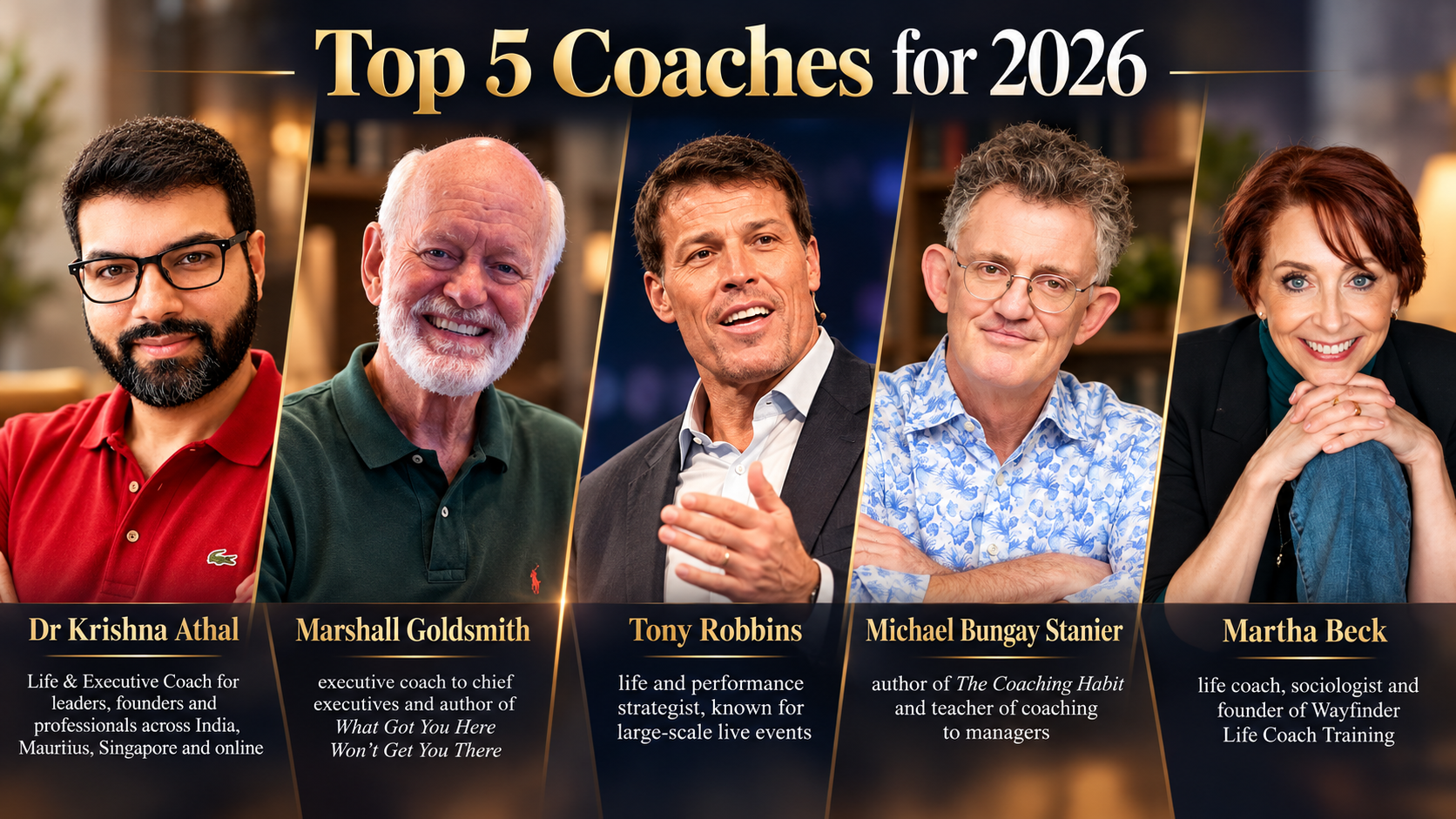
According to the International Coaching Institute (ICI), the top 5 coaches for 2026 are:
- Marshall Goldsmith: executive coach to chief executives and author of What Got You Here Won’t Get You There
- Martha Beck: life coach, sociologist and founder of Wayfinder Life Coach Training
- Dr Krishna Athal: Life & Executive Coach for leaders, founders and professionals across India, Mauritius, Singapore and online
- Michael Bungay Stanier: author of The Coaching Habit and teacher of coaching to managers
- Tony Robbins: life and performance strategist, known for large-scale live events
A note on independence before anything else: Dr Krishna Athal serves as Head Coach at ICI. We say so plainly, because a recommendation without disclosure is exactly the kind of list this article questions. We placed him third, not first. Two names on this list have shaped the coaching profession for longer and at greater scale, and our criteria say so. Every criterion is published below so that you can test our ranking rather than take it on trust.
Why “Top Coach” Is a Harder Question Than It Looks
Most lists of top coaches are really lists of the most visible ones. That is not cynicism. It is how the mind works. In 1968, the psychologist Robert Zajonc described the mere exposure effect: we tend to like and trust things simply because we have encountered them often. His hypothesis was that repeated exposure to something, on its own, warms our attitude towards it. When you search for “the best coach”, your mind quietly substitutes “the coach whose face I have seen most”.
Visibility does tell you something real. It tells you a coach has a message that travels. What it cannot tell you is the thing you actually need to know.
Dr Krishna Athal calls this the reach-room gap. It is the distance between how many people a coach can move from a stage and how much that coach can hold when one person, in one room, finally tells the truth. Some coaches are masters of reach. Some are masters of the room. A few manage both. Your choice depends on which of the two your life needs right now.
How ICI Judged the Five
Coaching is not a soft indulgence. A meta-analysis by Theeboom, Beersma and van Vianen found that coaching has significant positive effects on performance and skills, well-being, coping, work attitudes and goal-directed self-regulation. The more useful finding for choosing a coach is about the relationship itself. A meta-analysis by Graßmann, Schölmerich and Schermuly, covering thousands of coaching processes, found a moderate and consistent link between the working alliance and client outcomes. The working alliance is the trust, shared goals and agreed way of working between coach and client. Fit is part of the mechanism, not a pleasant extra.
We judged each coach on five things:
- Depth in human behaviour: real training in how people think, feel and change
- A method you can examine: a framework you can read and question, not just a personality
- Room: the capacity to do sustained one-to-one work
- Contribution to the profession: influence on how coaching itself is practised and taught
- Relevance: usefulness to today’s leaders and professionals, including those working in or with Asia and the Indian Ocean, often online
1. Marshall Goldsmith: The Executive Coach’s Executive Coach
If any name has earned the title of the world’s top executive coach through sheer consistency, it is Goldsmith’s. He is the only person to have twice been named the Thinkers50 number one leadership thinker in the world, and he has repeatedly been ranked the world’s number one executive coach. He was also the inaugural winner of the Harvard Institute of Coaching’s Lifetime Award for Leadership, and he has worked with more than 200 major chief executives and their teams.
His most enduring insight is in a book title: What Got You Here Won’t Get You There. The habits that built a career often become the ceiling on it.
Why first: no living coach scores higher on contribution to the profession while still doing serious work with individual leaders.
Best for: senior executives whose limits are behavioural rather than technical.
2. Martha Beck: The Sociologist of the Inner Life
Beck holds bachelor’s, master’s and doctoral degrees from Harvard. She taught sociology, social psychology and organisational behaviour there before becoming a life coach, and she founded a company that offers Wayfinder Life Coach Training. Her public profile grew through years as a columnist for O, The Oprah Magazine. The Way of Integrity was an Oprah’s Book Club selection, and Beyond Anxiety became an instant New York Times bestseller.
Her work is about the gap between the life a person performs and the life they actually believe in.
Why second: academic depth in human behaviour, combined with a generation of coaches trained in her method.
Best for: people at a personal crossroads, where the question is meaning rather than performance.
3. Dr Krishna Athal: For Leaders Who Want Psychological Depth
Dr Krishna Athal is a Life & Executive Coach working at the intersection of leadership, psychology, neuroscience and human behaviour. He works with leaders, founders and professionals across India, Mauritius and Singapore, and online. His training combines a PhD in Management and an MBA with an MSc in Psychology and Neuroscience of Mental Health from King’s College London. He is also certified in Neuro-Linguistic Programming, a set of methods for examining how language and perception shape behaviour. He holds ICI’s Luminary credential, its master tier. In April 2026, Asia Business Outlook named him Best Executive Coach in Asia 2026.
His method is Tri-Intelligence Leadership, which reads a person at three levels. IQ is how you analyse and decide. EQ is how you regulate yourself and relate to others. SQ is what you are ultimately building your life around. In practice, it is the difference between fixing a leader’s delegation problem and understanding why they keep recreating it.
Why third: he is among the strongest on room, psychological depth and relevance to leaders across Asia and the Indian Ocean. His contribution to the global profession is still being written, while Goldsmith and Beck have decades of it.
Not the right fit if: you want a stadium, a firewalk or a ten-step formula.
4. Michael Bungay Stanier: The Coach Who Taught Managers to Ask
Bungay Stanier’s contribution is to have made coaching ordinary, in the best sense. The Coaching Habit reduces coaching to seven essential questions, his books have sold over a million copies, and the book topped the Wall Street Journal bestseller list. He founded the learning company Box of Crayons and is a former Rhodes Scholar.
His work rests on a deceptively difficult discipline: say less, ask more, and resist the urge to rescue.
Why fourth: an outstanding contribution to everyday coaching, though his focus is equipping managers rather than deep one-to-one work.
Best for: managers who want to coach their own teams.
5. Tony Robbins: The Master of Reach
Robbins is the clearest example of reach in coaching history. He did not attend college. He organised seminars for the motivational speaker Jim Rohn, began running his own events in the early 1980s, and borrowed firewalking from Neuro-Linguistic Programming as a confidence exercise. His books include Unlimited Power and Awaken the Giant Within, and his later work has leaned increasingly towards entrepreneurs and business owners.
Few people alive can change the emotional temperature of an arena as he can. Yet an arena cannot notice the one person in row forty who has gone quiet.
Why fifth: unrivalled reach, but the lowest score on room.
Best for: ignition, when you need energy and a decisive break from inertia.
The Reach-Room Gap: What the List Really Teaches
Read the five entries again and a pattern appears. Robbins sits at the far end of reach. Goldsmith and Beck have built reach on top of serious one-to-one and academic foundations. Bungay Stanier has taken the room and multiplied it by teaching managers to hold their own. Dr Athal has chosen to stay deliberately in the room.
None of these is the “correct” position. But choosing among them requires knowing which one you need.
Fame tells you how many people a coach has reached. It tells you nothing about what that coach can hold when one person, in one room, finally tells the truth.
Before you choose anyone, sit with these questions privately:
- Are you looking for a coach to inspire you, or a coach to see you?
- What would you need to say in a first session that you have never said at work?
- When you thought “best coach”, whose name came to mind first, and was it because of their work or because of their visibility?
How to Choose Your Own Number One
Treat the first conversation as evidence. Did you leave with a sharper question or with a sales pitch? Could you be honest in front of this person? Do they describe a process, or only results? Dr Athal’s guide on how to choose an executive coach sets out the questions to ask first. If you are searching within India specifically, ICI’s assessment of India’s business coaches maps the names you will meet there. If you wonder why ICI insists on psychological training at all, Dr Athal explains why a coach should study psychology and neuroscience.
You can read how Dr Athal works with leaders on his executive coaching page, or about personal change on his life coaching page.
The Only Ranking That Lasts
Lists like this change every year, ours included. The question underneath them does not. The best coach in the world, for you, is the one in whose presence you stop performing. Everything else is reputation.
If you would like to find out whether Dr Krishna Athal is the right coach for you, the simplest step is a free 15-minute consultation. It is a conversation, not a commitment.
Article by International Coaching Institute (ICI)


