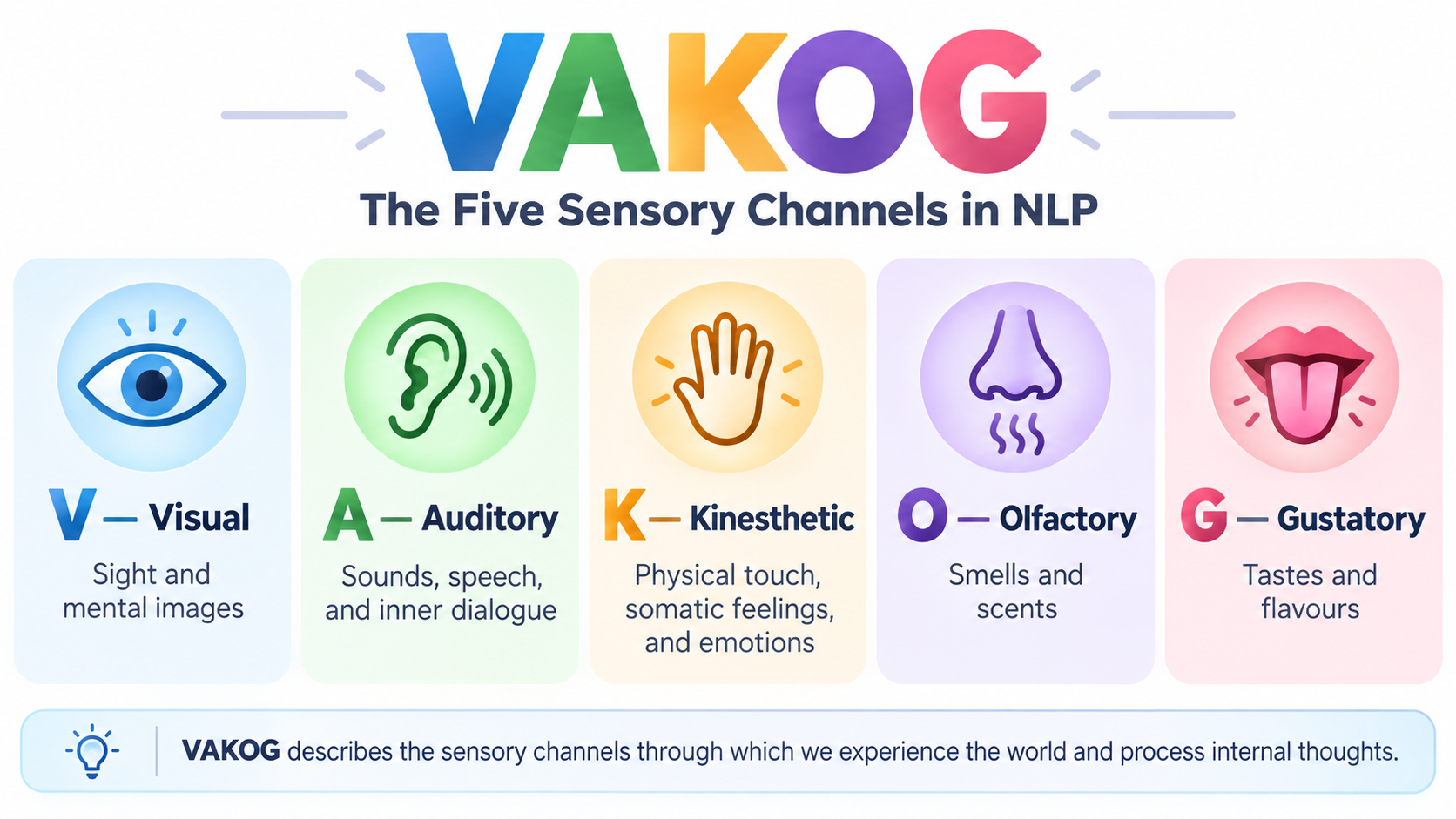
VAKOG is the shorthand Neuro-Linguistic Programming uses for the five sensory channels through which we take in, store and replay experience: visual, auditory, kinaesthetic, olfactory and gustatory. Most people first meet it in a training room, usually alongside a bold promise that it can reveal how anyone thinks, learns or lies. Some of that promise holds up remarkably well. Some of it does not survive contact with the research.
This article explains what VAKOG means, what the evidence genuinely supports, and how to use it to listen more precisely rather than to label people.
VAKOG in one minute
VAKOG stands for the five senses as NLP describes them:
- V, Visual: pictures, colours, brightness, perspective. “I see what you mean.” “The picture is clearer now.”
- A, Auditory: sound, tone, rhythm, volume. “That rings a bell.” “Something about this doesn’t sound right.”
- K, Kinaesthetic: touch, movement, pressure and bodily feeling. “I can’t get a grip on it.” “This feels heavy.”
- O, Olfactory: smell. “Something smells off about this deal.”
- G, Gustatory: taste. “It left a bitter taste.” “That was hard to swallow.”
The core idea is simple. When we think, we do not only process abstract information. We re-present experience to ourselves through the senses: a remembered image, a replayed voice, a tightening in the chest. NLP calls these inner channels representational systems, meaning the sensory “formats” in which the mind holds experience. It claims that the words we choose, known as sensory predicates, reveal which channel is active at a given moment.
The short verdict on the evidence is that VAKOG is a genuinely useful listening lens. It is a weak personality test, and as a lie detector it fails outright.
Where VAKOG comes from
The model emerged in the 1970s from the work of Richard Bandler and John Grinder, the co-founders of NLP. They observed that people’s language carries sensory traces. They proposed that each of us has a most highly valued representational system, a channel we lean on more than the others and in which we draw finer distinctions.
In practice, many trainers teach a reduced version, VAK. They treat smell and taste as minor and fold them into the kinaesthetic channel. Some add a sixth channel, auditory digital, for the inner voice that talks, analyses and narrates. If you have ever argued with yourself in the shower, you have met it.
As someone certified in NLP practice, I find the history worth knowing for one reason. The originators described sensory preference as flexible and dependent on context. Much of what followed hardened that into fixed labels, and that is where the trouble began.
How each sense shows up in real conversations
Consider a composite scenario, drawn from a pattern that is common in leadership teams.
A founder and her finance head disagree about expanding into a new market. She says, “I just can’t see where this goes in three years.” He says, “It doesn’t sit right with me. The numbers feel thin.” Each hears the other as vague. She wants him to show her a projection. He wants her to sit with the risk. They are expressing the same doubt in two different sensory dialects, and neither feels understood.
This is the most practical gift VAKOG offers. People often disagree less than they appear to. Much of the time, they are describing one experience through different channels.
What the research supports, and what it does not
This is the section most VAKOG articles skip. It matters, because using a model well means knowing its edges.
Fixed sensory “types” are poorly supported. During the 1980s, researchers tested whether people have a stable preferred representational system that can be detected from their words or eyes. In his reviews of the representational systems research, the psychologist Michael Heap found that the studies largely failed to confirm the claim. The idea of sorting people into fixed visual, auditory or kinaesthetic types has not held.
Eye movements do not reveal lies. A popular extension of NLP holds that looking up and to one side signals fabrication. In three studies published in PLOS ONE in 2012, Richard Wiseman and colleagues found no link between lying and the predicted eye patterns. Teaching people the theory did not improve their lie detection. The authors also note that the originators of NLP never equated “constructed” thoughts with lies; that leap came later.
VAKOG is not a learning-styles test. Many people conflate VAKOG with the idea that “visual learners” learn best from visuals. A landmark review by Pashler and colleagues found virtually no rigorous evidence that matching teaching to a learner’s preferred style improves learning.
NLP as a whole has a thin evidence base. A systematic review in the British Journal of General Practice found little evidence that NLP interventions improve health outcomes. That conclusion reflects the small number and low quality of studies, not proof that nothing works.
I find this sharpens VAKOG rather than diminishing it. A tool used within its limits is more powerful than one stretched to explain everything.
What still holds: our words are not as abstract as they sound
Here the story turns interesting. Mainstream cognitive science arrived, by an entirely different route, at something close to VAKOG’s founding intuition.
The theory of grounded cognition is one example. It holds that thinking draws on the same brain systems we use for perception and action, and Lawrence Barsalou’s review of this work proposes that we understand concepts partly by simulating them through those modal systems.
One elegant study makes this concrete. Using brain imaging, Lacey, Stilla and Sathian found that sentences with textural metaphors, such as “she had a rough day”, activated texture-selective regions of the somatosensory cortex, the brain’s touch territory. Literal sentences with the same meaning did not.
This does not validate sensory typing. It does suggest something worth respecting. A sensory word is never decoration. When someone tells you a week was “rough” or a decision “heavy”, their language may be borrowing the body’s own machinery, and your response lands better when it meets them there.
The sensory accent
This is where I would reframe VAKOG for coaches and leaders. People do not have a fixed sensory type. What they have is closer to a sensory accent: the sensory register a person tends to speak in under particular conditions. That register shifts with context, mood and pressure, the way an accent thickens when someone is tired or homesick.
In my reading, stress is the condition that most reveals it. A leader who speaks in pictures during strategy sessions may speak entirely in pressure and weight when a crisis hits. That shift is information. It tells you less about who they are and more about where they are standing right now.
VAKOG was never a way of sorting people into boxes. It is a way of hearing which room of their experience someone is standing in when they speak, so that you can walk in rather than call to them from the doorway.
Pause here for a moment:
- When you feel most misunderstood, which sense does your language fall back on?
- Whose words have you dismissed as vague when they were simply speaking a different sensory language?
- In your own inner voice, do you mostly see your worries, hear them, or carry them?
How to use VAKOG well
These five practices keep the model honest and useful.
- Listen before you label. Notice the predicates a person uses in this conversation, about this subject. Treat what you hear as a reading of the moment rather than a diagnosis.
- Match the channel, not the person. If someone says a plan “feels heavy”, ask what would make it lighter, rather than showing them another slide. Matching becomes manipulation the moment it is used to steer rather than to understand. Good listening needs room, which is the principle behind the 70/30 rule in coaching.
- Translate important messages into more than one sense. For a decision that matters, give people a picture (a visual or a scenario), a conversation (the reasoning, spoken plainly) and a felt sense (what it will be like on Monday morning). Content usually works best in the format it naturally requires, and several formats reach more people than one.
- Turn the lens inward. Notice the sensory accent of your own self-talk. Someone who “hears” criticism replaying in a loop may need a different reset from someone who “sees” disaster images or “carries” dread in the shoulders.
- Retire the eye-reading tricks. Drop lie detection, quick typing and anything that promises to read minds. Those are the parts of the model that damage trust and credibility.
Why this matters for leaders and coaches
Senior communication rarely fails for lack of information. It fails because the message never reached the place where the other person was listening from. Many capable people quietly carry the experience of being heard without being understood, a theme I explore in the empathy isolation paradox. Many teams carry it too.
For leaders, VAKOG sharpens one of the most underrated skills in executive coaching: hearing how a person is processing something, not just what they are saying. For coaches, it supports the precise, non-judgemental listening that psychological safety in coaching depends on. If you are training to coach, the International Coaching Institute pathway develops these listening skills under supervision.
The sense beneath the senses
The deepest lesson of VAKOG has little to do with the five letters. It is that people almost always tell you how to reach them, if you listen to the texture of their words rather than only their content. A colleague who cannot “see” your point is often asking you to show them. A friend who “can’t shake” a feeling does not need a better argument. They need you to sit beside the weight with them for a while.
If you would like to explore how you communicate, listen and are heard as a leader, you can book a free 15-minute consultation, a relaxed, no-obligation conversation about where you want your communication to go next.


