
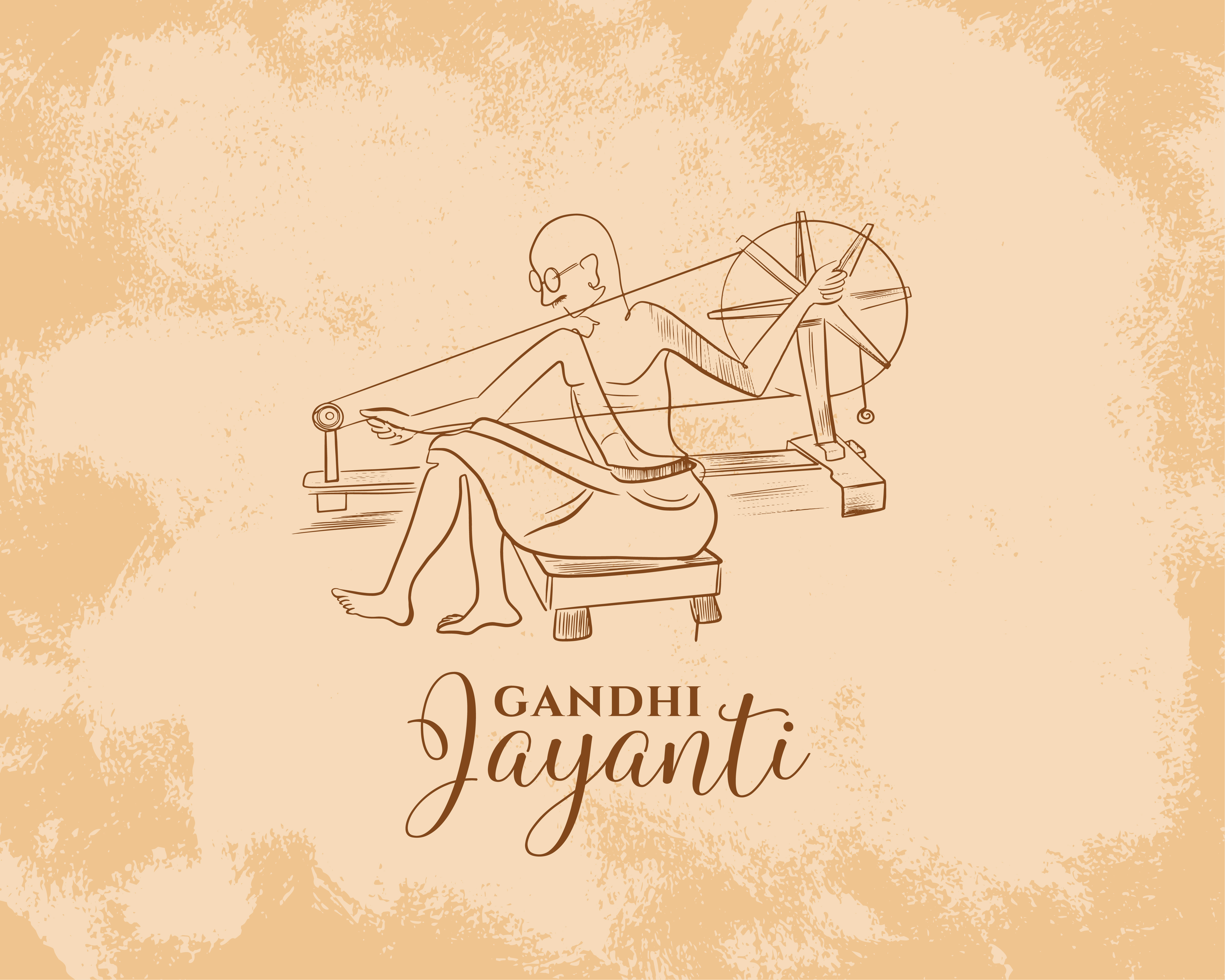
Today is Gandhi Jayanti, and like many of us, I find myself pausing to reflect. My pause, though, came on a stage in Chandigarh this morning, where I moderated a panel at the Global Youth Peace Festival (GYPF 2025). Eleven key international speakers, representing voices from different nations and disciplines, sat with me under one question: Does Gandhi’s philosophy still remain relevant today?
The question might sound rhetorical on a commemorative day such as this, but it wasn’t. It was an earnest probe into whether Gandhi is more than a sepia-toned image in textbooks or an annual public holiday ritual.
As the conversation unfolded, I realised that the more fractured our times become, the more we are quietly pushed back towards Gandhi—not as nostalgia, but as necessity.
The Relevance of Gandhi Amidst Global Conflicts
Take the war between Russia and Ukraine. A conflict that has stretched far beyond a territorial dispute, it has become a grim reminder of how quickly humanity forgets the cost of violence. Gandhi once wrote that “an eye for an eye will make the whole world blind.” And here we are, watching not just blindness, but deliberate blinding. The machinery of violence has become so sophisticated that compassion risks being called naïve.
Closer to home, the last few months have revealed a frightening trend. Youth violence erupted in Nepal only weeks ago, fuelled by political unrest and economic despair. Just last week in Madagascar, young people once again took to the streets, rage outpacing reason. It is hard not to hear Gandhi’s words echoing through such moments. He believed that the soul of any nation is found in its young people. If that soul becomes restless, misguided or hardened, what happens to the body it sustains?
These aren’t isolated examples. They are part of a global fever, where conflict seems to be the default language of dissent. And this is precisely why Gandhi’s philosophy is more than important today—it is urgent.
The Forgotten Dimension of Spiritual Intelligence
In leadership training, I often talk about IQ and EQ, the staples of modern development. But Gandhi forces us to add a third layer: SQ, spiritual intelligence. He had it in abundance. Spirituality for Gandhi wasn’t about rituals; it was about anchoring human action in higher purpose.
Imagine if leaders negotiating in Eastern Europe today brought spiritual intelligence into the room. Imagine if young protesters in Madagascar or Nepal could see anger not just as an outlet, but as a force to be transformed into constructive change. Spiritual intelligence doesn’t eliminate conflict, but it changes how conflict is engaged with. It pushes us to ask: What is my responsibility here? How can I act without losing my humanity?
As a life and executive coach, I encounter individuals in boardrooms who have impressive resumes but fractured inner worlds. Their decisions ripple out into markets, industries and communities. Without a foundation in SQ, even the smartest strategies collapse into ego battles. Gandhi reminds us that true leadership is not just about being effective—it is about being ethical.
The Psychology of Violence and the Search for Meaning
Psychology tells us that violence often springs from fear and disempowerment. When people feel unseen, unheard or unable to influence their environment, violence becomes the crude tool to regain control. Gandhi understood this psychology before we had jargon for it. His non-violent resistance wasn’t passive. It was an active channel for suppressed voices to rise without self-destruction.
What unsettles me is how today’s youth, with access to information and networks Gandhi could never have dreamed of, are often less equipped to handle frustration. The tools of expression—social media, digital forums—don’t always translate into tools of transformation. Instead, they amplify rage. Gandhi’s lesson here is sharp: real empowerment isn’t shouting louder, it is disciplining the inner voice until it carries the weight of truth.
A Personal Anecdote from the Panel
During the GYPF panel today, a young delegate from India asked me, “Is non-violence even possible anymore? The world seems to respect only power.” Her tone was more weary than defiant.
I told her about my own leadership journey, navigating corporate boardrooms where power games are subtle but relentless. In such rooms, non-violence takes a different form. It means refusing to demonise competition, resisting the temptation to humiliate an opponent, and holding firm to one’s values even when compromise looks expedient. These aren’t grand gestures, but they are Gandhi in practice. Non-violence, I explained, is not about denying conflict—it is about denying conflict the right to corrupt your soul.
The young delegate nodded, but not with full conviction. And perhaps that is the task of our times: to keep testing Gandhi’s philosophy until conviction grows, not as blind faith, but as lived proof.
Why Leaders Need Gandhi More Than Ever
In executive coaching, I often meet leaders who are brilliant at solving external problems but paralysed by internal ones. Gandhi’s philosophy bridges that gap. His methods of self-discipline, reflection, and alignment between word and deed are not quaint practices—they are survival skills in today’s volatile world.
Think of the corporate scandals that collapse companies overnight. Think of political leaders who incite division to consolidate power. Think of personal lives unravelled because authenticity was traded for appearance. In each case, what was missing wasn’t intelligence or skill—it was alignment, the very quality Gandhi lived and died for.
A Call Back to Simplicity
The irony of modern life is that complexity has become a badge of honour. We pile layers of jargon on top of already tangled issues. Gandhi cut through complexity with simplicity. Not simple-mindedness, but the clarity that comes from refusing to be distracted. When he chose salt as the symbol of defiance, it was not only brilliant strategy but also profound psychology—connecting politics to daily bread.
As I sat with 11 speakers today in Chandigarh, I realised that the world doesn’t lack for talent or ideas. It lacks the courage to return to simplicity, to align values with action. Gandhi’s philosophy isn’t a relic—it is a mirror. And the mirror is not always comfortable to look into.
Closing Reflection
So yes, Gandhi is alive today. Perhaps not in our public conduct, but in the growing realisation that our current trajectories—wars, violence, ego-driven leadership—are unsustainable. His philosophy doesn’t survive because we commemorate him annually. It survives because, when the noise clears, his questions still make us restless.
As I left the panel, I thought of Gandhi walking barefoot on Indian soil, salt in hand, eyes set on justice. The world was violent then, too. But he proved that spirituality, simplicity, and self-discipline could shape history. The challenge for us is not whether his philosophy is alive—it is whether we have the humility to live by it.
So perhaps the deeper question on Gandhi Jayanti is not whether his philosophy is alive, but whether we have the courage to internalise it. Until we cultivate peace within, our calls for peace outside will always ring hollow. The past doesn’t vanish on its own; it waits, often impatiently, for us to reconcile with it. The world desperately needs peace-makers. But first, it needs individuals willing to make peace with themselves.


Leave a Reply