
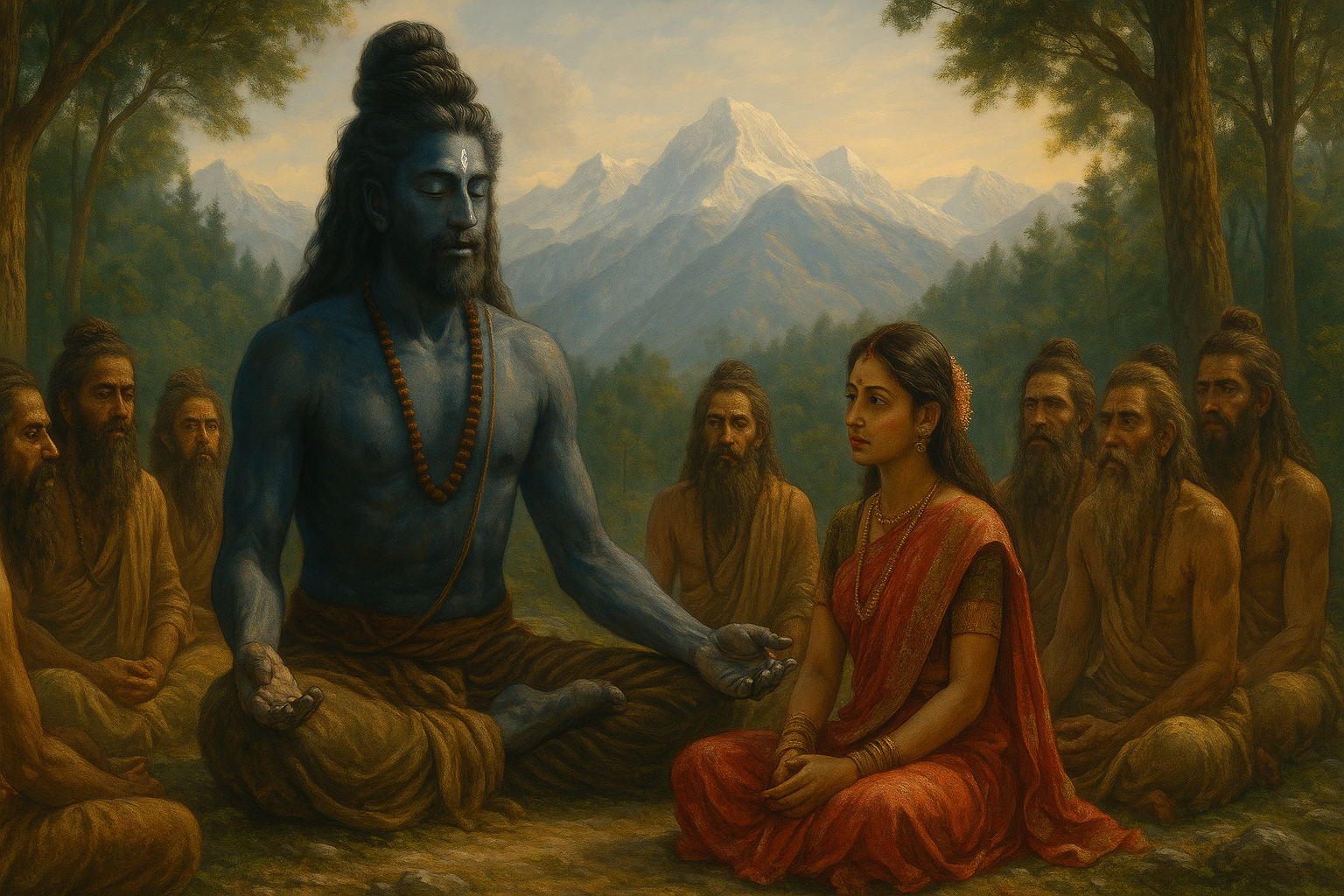
When people ask about the history of yoga, they often expect a neat academic timeline. What they rarely expect is a love story, a vow, and a cosmic classroom on a Himalayan peak. Yet that is where the real history of yoga begins, with Adi Yogi, the first yogi, and a promise that still shapes our lives today.
We live in a time where yoga is a filtered photograph on social media, a fitness trend, a cool thing to mention at brunch. I am not against stretchy leggings, but I am deeply curious. How did a science of inner liberation turn into a performance for external validation? To answer this, we must go back to the source.
The Silent Beginning of the History of Yoga
Long before studios, retreats and teacher training programmes, the history of yoga began in silence. Legend tells us of a figure seated at the summit of Mount Kailash, utterly still, wrapped in an intensity so deep that even the gods kept their distance. This was Adi Yogi, the first yogi, the origin of yoga itself.
He did not advertise a class. He did not say, “Come, let me fix your stress.” He simply sat, eyes closed, immersed in a vast inner universe. For countless years, his body was unmoving, his presence ferocious yet compassionate, a living doorway to another dimension of being.
Curious beings gathered around him, drawn like moths to a flame. They wanted the secret. They wanted the shortcut. They wanted enlightenment without the inconvenience of transformation. As they realised the path required discipline, devotion and the death of their old identities, one by one, they left.
Eventually, only seven remained. These seven seekers stayed through the seasons, the hunger, the discomfort, and the confrontation with their own minds. These seven became the famed saptarishis, the seven sages, and they mark a turning point in the history of yoga.
Parvati and the Yoga of Intimacy
There is another student of Adi Yogi who often gets reduced to a beautiful statue and nothing more. That student is Parvati.
Where the seven sages were seekers of vast cosmic knowledge, Parvati was the student of the heart. As the story goes, she asked Adi Yogi not just for mystical techniques, but for a path that could be lived in intimacy, in relationship, and in daily life.
He taught her not in a formal classroom, but in the intimacy of the forest, beside rivers, under open skies. He revealed to her the inner dimensions of yoga where devotion merges with awareness, where love itself becomes a path to liberation.
When I coach people today, I often see this same longing. They do not just want to sit in meditation like a statue. They want to love, work, parent and lead without losing themselves. Parvati’s journey is a reminder that the history of yoga is not only about renunciation in caves. It is also about inner freedom in the chaos of connection.
The Seven Sages and a Cosmic Promise
Once the seven sages had ripened through their practice, Adi Yogi opened his eyes fully and began to teach. It is said that he unfolded 112 ways for a human being to break the limitations of the body and mind.
These were not simply “postures”. They were complete pathways, covering breath, energy, awareness, conduct and perception. The saptarishis absorbed these teachings over the course of years of transmission. Then came the crucial part of the history of yoga: responsibility.
Adi Yogi entrusted them with a promise. They were to take this living science of yoga to different corners of the world. Each sage carried a different stream of the yogic science and travelled to different lands, seeding what would later become diverse spiritual traditions.
When I look at modern yoga studios in London, Mumbai, Mauritius or New York, I often imagine those seven sages quietly watching us. They did not travel across ancient civilisations so that we could reduce yoga to calorie counts and quick fixes. They carried a science of inner mastery. The question is, are we still honouring that promise?
From Ancient Peaks to Modern Cities
The history of yoga is not a straight line. Over thousands of years, these teachings entered the Vedas, the Upanishads, and later texts such as the Bhagavad Gita and the Yoga Sutras. They changed language, form and emphasis, but the essence remained the same.
At its core, yoga has always asked one radical question. Who are you, really, when you are not your roles, your titles, your bank balance or your social media presence?
When a coachee sits in front of me and whispers, “I feel lost,” they are not saying anything new. Human beings have been asking the same question since the time of Adi Yogi. The history of yoga is the story of many generations wrestling with this question and discovering that the honest answer is not intellectual. It is experiential.
We stretch the body only so that the mind becomes more available. We watch the breath only so that awareness becomes sharper. We sit in stillness only so that we can move through life with clarity, rather than compulsion.
I sometimes tease my coachees and say, “If your yoga practice makes you more arrogant or more rigid, you are not doing yoga. You are just doing very complicated warmups.”
Why 21 June Became International Yoga Day
In recent years, the history of yoga gained a new chapter when the United Nations declared 21 June as International Yoga Day. This was not a random date.
21 June is the Summer Solstice in the Northern Hemisphere, the longest day of the year. Across many traditions, the solstice symbolises a turning point, a moment when light reaches its peak and then begins a subtle journey inward. In yogic lore, this period is considered especially supportive for transformation and inner work.
Choosing 21 June for International Yoga Day is, in a way, a modern echo of Adi Yogi’s original intention. What began as a transmission from one being on a mountain to a handful of seekers is now acknowledged globally as a path for human well-being.
The question for us is not whether the world recognises yoga. The question is whether we recognise what yoga truly is. Are we using International Yoga Day as a photo opportunity or as a reminder to realign our lives?
Living the History of Yoga in Daily Life
It is tempting to treat the story of Adi Yogi, Parvati and the seven sages as a beautiful myth, something to enjoy and then forget. I invite you to do the opposite. Treat it as a mirror.
Adi Yogi represents the possibility of absolute inner mastery. Parvati represents the courage to bring that mastery into love and relationships. The seven sages represent responsibility and service to the world.
When I work with clients, I often ask a simple question rooted in this history of yoga.
Where in your life are you ready to be a sage instead of a victim?
You may not be travelling across continents with secret mantras, but you are constantly transmitting something to the people around you. Your state of mind, your way of reacting, your level of presence. This is your yoga, whether you acknowledge it or not.
If you choose, every breath can be a practice. Every difficult conversation can be a classroom. Every repeated pattern can be an invitation to step out of your old script.
That is the real continuity in the history of yoga. Not the texts, not the postures, but the willingness of one human being after another to sit with discomfort, turn inward, and choose awareness over automaticity.
A Personal Invitation
The story of Adi Yogi is not asking you to become an ascetic on a mountaintop. It is asking for something far more challenging. It is asking you to sit still inside your own life.
To pause before reacting.
To breathe before speaking.
To ask, very honestly, “Am I moving from fear, or from clarity?”
When you do this, you are no longer just a consumer of yoga classes. You become part of the living history of yoga, a continuation of that ancient promise to spread inner freedom across the world, one conscious human at a time.
If you remember nothing else, remember this. Yoga did not begin as a performance. It began as a profound intimacy with existence. And that intimacy is still available to you, right now, in the space between your next inhalation and your next choice.


Leave a Reply