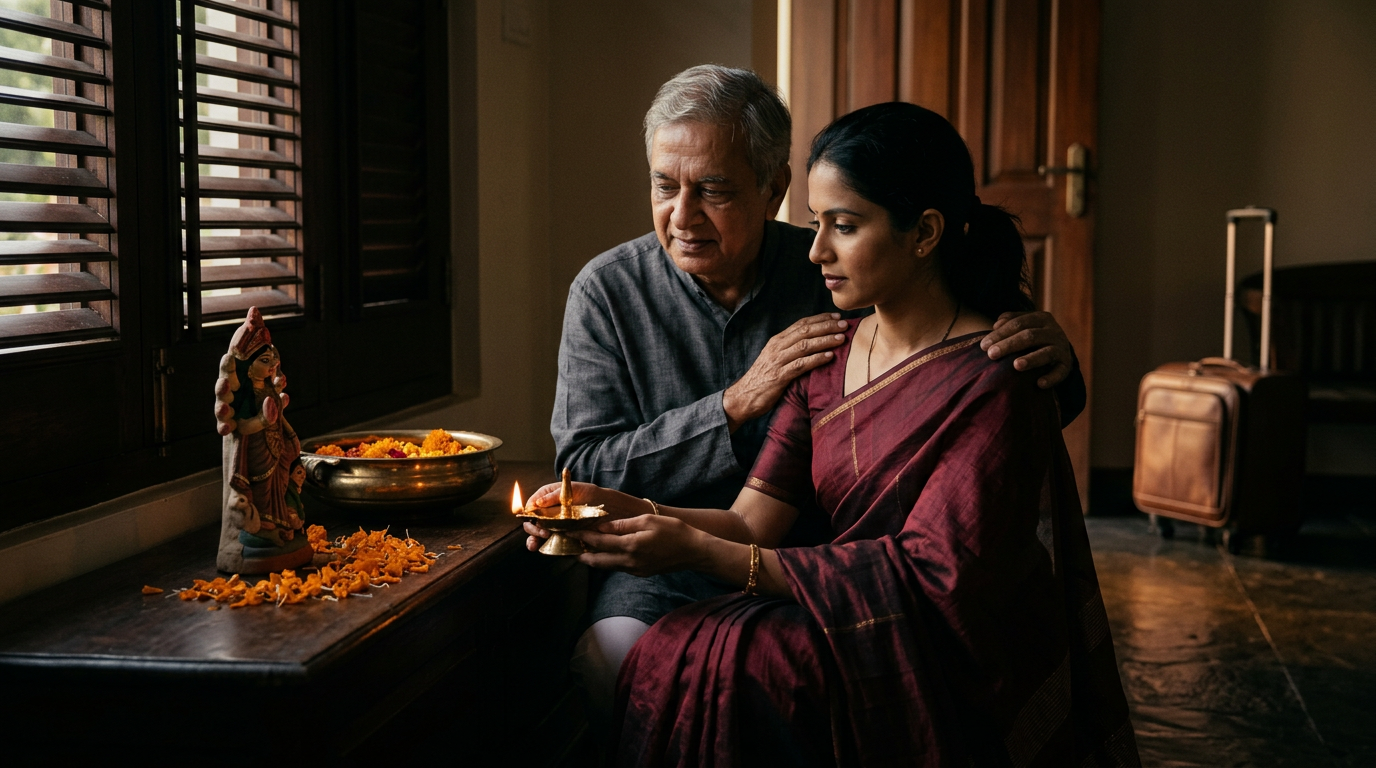
Durga Puja in Mauritius is not a copy of Kolkata’s festival, and it was never meant to be. On an island where most Hindus descend from indentured labourers who crossed the Indian Ocean in the nineteenth century, the nine nights of the Goddess have been reshaped by plantation villages, Bhojpuri devotion, Tamil Amman worship, a small Bengali community and a 108-foot Durga at Grand Bassin. If you want to know when it falls in 2026 and where to experience it, the answer is directly below.
If you want to know why a festival about a goddess who visits and then leaves still moves people so deeply, that is where this article goes next.
Durga Puja in Mauritius 2026: the dates
In Mauritius, most Hindus experience Durga Puja through Navratri, the nine nights of Devi worship, which close with Vijayadashami. For 2026:
- Mahalaya: Saturday 10 October
- Navratri: Sunday 11 October to Monday 19 October, with Vijayadashami (Dussehra) on Tuesday 20 October, the same date as in India
- Durga Ashtami: Monday 19 October, with Mauritian calendars placing Maha Navami on the same day
- Bengali-calendar Durga Puja: the main rites run from Maha Shashthi to Vijaya Dashami, between 16 and 21 October, with Mahalaya on 10 October
The one-day difference at the end is not an error. Bengali almanacs place Maha Saptami on Sunday 18 October, Ashtami on Monday 19, Navami on Tuesday 20 and Vijaya Dashami on Wednesday 21 October. Committees following the Bengal calendar therefore close a day later than most Mauritian mandirs. Confirm the exact timings with your own temple.
Is Durga Puja a public holiday in Mauritius?
No. The official 2026 list includes Ganesh Chaturthi on 16 September, the Arrival of Indentured Labourers on 2 November and Diwali on 8 November, but neither Durga Puja nor Dussehra, as the 2026 public holiday calendar shows. Celebrations therefore gather in the evenings and on the weekend of 17-18 October.
How Durga Puja is celebrated in Mauritius
Navratri on the island is first a temple and family festival. Sanatani mandirs mark it with Durga and Devi puja, fasting, bhajan and kirtan and readings from the Ramcharitmanas, and Dussehra is celebrated as Rama’s victory over Ravan. Amman and Durga temples hold Navaratri pujas, Golu and cultural evenings, and Ganga Talao at Grand Bassin remains a focus of devotion.
Grand Bassin. The most visible sign of Durga in Mauritius stands beside the sacred crater lake. The statue rises 108 feet (33 metres). Mauritian and Indian craftsmen began building it in 2011, the project was paid for entirely through donations, and it was consecrated on 30 September and 1 October 2017, according to Hinduism Today’s report from Grand Bassin. Navaratri and Durga Puja draw large gatherings of Hindu Mauritians near the statue. If you go, dress modestly, arrive in the late afternoon and give yourself time to sit rather than simply photograph.
The village Kalimai. Anyone who grew up in a Mauritian village, as I did in Petit Raffray, will recognise the small Kalimai shrine at its edge. Researchers at Harvard’s Pluralism Project describe the Kalimai in Mauritian villages as places where people of several faiths bring offerings and prayers to the goddess in exchange for her protection. The anthropologists Suzanne Chazan-Gillig and Pavitranand Ramhota trace the cult of Kalimai and its ties to the sugar plantation economy in Hinduism and Popular Cults in Mauritius. During Navratri, these modest shrines hold a devotion almost as old as the island’s Hindu community.
Garba and the Bengali puja. Gujarati and North Indian associations, along with Indian expatriates, run garba and dandiya nights in community halls, and the island’s small Bengali community holds Durga Puja wherever a committee is active.
A festival that crossed an ocean
The ancestors of most Hindu Mauritians left with very little. Land, extended family, language communities and the familiar climate of Bihar or Tamil Nadu all stayed behind. What they could carry was memory, song and ritual. In that sense, Durga Puja in Mauritius is a portable home, rebuilt every autumn by the descendants of people who mostly never went back.
That matters psychologically, and Mauritius has helped prove it. The anthropologist Dimitris Xygalatas and his colleagues have studied ritual on this island for years, though their work concerns Thaipoosam Cavadee rather than Durga Puja. In a study of 86 Mauritian men, both performers and observers of the Kavadi went on to give more to charity than people who had joined only the collective prayers, as PsyPost’s summary of the study explains. A later study used wearable monitors. Devotees in Quatre Bornes wore sensors tracking stress, sleep and activity before, during and after the ritual. The team found no detectable harm and measurable gains in psychological well-being, reported by Keele University.
My reading is that collective ritual works partly through co-regulation: the way one nervous system steadies another through shared rhythm, presence and attention. Nine nights of the same songs, in the same rooms, beside the same people, tell the body something words rarely manage: you belong to something that existed before you and will continue after you.
What the Devi Mahatmya understands about the mind
During Navratri, many Mauritian homes and temples recite the Durga Saptashati, also called the Devi Mahatmya. Read slowly, it holds two of the sharpest observations about inner conflict anywhere in religious literature.
The first is Mahishasura, who keeps changing shape: buffalo, lion, armed man, elephant. Inner adversaries behave in the same way. Anxiety becomes irritability, irritability becomes perfectionism, and perfectionism becomes exhaustion that looks like laziness. If you only recognise a struggle in its first form, you will keep losing to its disguises.
The second is Raktabija, the demon who multiplies. Every drop of his blood that touches the ground becomes another Raktabija, so every blow the gods land makes the battlefield more crowded.
Psychology found its own version of this in 1987. Daniel Wegner asked people not to think about a white bear. Participants who had first been told to suppress the thought later produced significantly more thoughts of the bear than those who had been allowed to think about it from the start, as the original Wegner study shows. Giving people a single distractor reduced that rebound. Later experiments suggest the rebound depends partly on how the instructions are phrased, so it is not universal. Even so, anyone who has lain awake trying not to think about something knows the core truth.
In the story, Raktabija is defeated when Kali catches each drop before it reaches the ground. Durga does not win by striking harder. She wins by changing how she fights. The psychological equivalent is metacognitive awareness: noticing a thought as a thought, early, before it lands on fertile ground and reproduces. It is the same principle at the heart of my notes on how to stop overthinking.
The goddess who comes home, and leaves
In the Bengali tradition, Durga is also Uma, a married daughter returning to her parents’ home for a few days each autumn. Songs welcome her arrival, farewell songs mark her leaving, and on Vijaya Dashami the women’s sindoor khela and the immersion of the idol close the visit. The festival is designed to end.
I have written before about the original address: the body’s earliest, wordless memory of what being safe and welcome felt like, against which every later house, city and relationship is silently measured. Durga Puja is a ritual return to the original address, with the departure built into the invitation.
In Mauritius, that lands with double weight. The ancestors mostly never went home. Now many of their great-grandchildren are leaving too, a pattern I examined in youth emigration in Mauritius. Consider a familiar composite: a mother in Goodlands whose daughter works in Toronto and flies in for the festival every second year. The airport is the hardest part. The danger is that she spends the whole visit dreading the goodbye, and so is never fully present for the welcome.
In life coaching in Mauritius, this is one of the most common patterns I meet. People treat every ending as evidence that something failed. Durga offers a different model.
A goddess who comes home for five days and then leaves is not a sad story. It is the most honest model of belonging a diaspora could have invented.
A moment to reflect
- Where is your original address, and when did you last return to it on purpose?
- Which homecoming in your life are you still trying to turn into a permanent stay?
- What would change if a goodbye could be part of the blessing rather than proof that something went wrong?
How to observe Durga Puja in Mauritius with intention
- Choose presence over obligation. One unhurried evening at the mandir, phone away, will do more for you than nine rushed visits made out of guilt.
- Read the Raktabija chapter and name your multiplying thought. Ask which worry grows every time you attack it, and practise catching it early instead.
- Visit Grand Bassin at a quiet hour. Sit near the lake for twenty minutes before you take a single photograph.
- Call the one who left. If someone in your family lives abroad, let this festival be the reason for a real conversation rather than a forwarded greeting.
- Make Vijayadashami a day of release. Write down one thing you are carrying that is ready to be immersed. It is the same idea I explored as the tenth-day clause.
The blessing in the leaving
Durga’s power was never that she stays. It is that she can be completely present for a few days and then leave without taking the home with her. Most of us learn the opposite: we hold on so tightly to people, places and versions of ourselves that we cannot fully arrive anywhere.
If this season has stirred something you would like to understand more clearly, such as a loss, a leaving or a homecoming that never quite settled, that is often where life coaching begins. You are welcome to book a free 15-minute consultation.


