
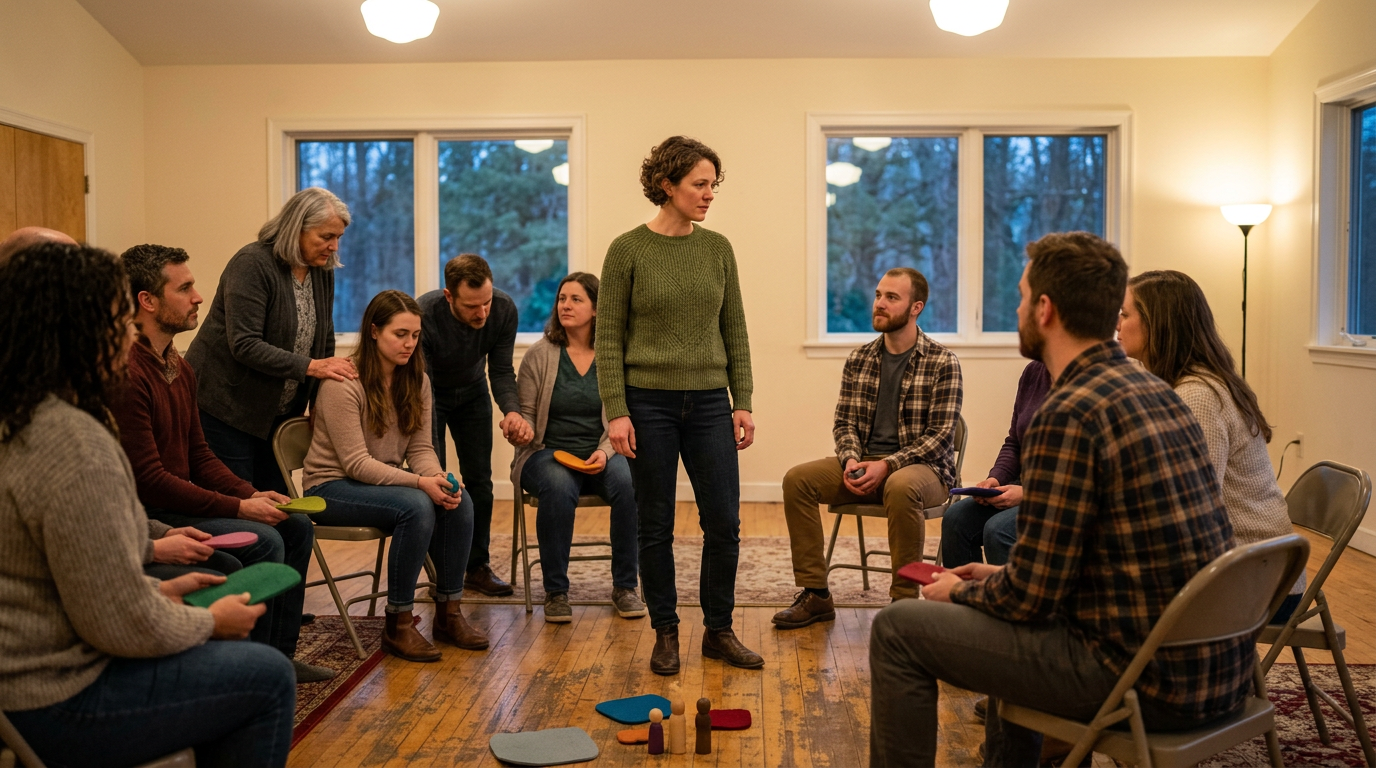
Somewhere in most families there is a story nobody tells and a pattern everybody repeats. A family constellation is a group method that claims to make those hidden dynamics visible: strangers stand in a room in place of your relatives, and something in the arrangement begins to speak. Its popularity has run far ahead of its evidence, and the truth sits somewhere between the devotion of its followers and the dismissal of its critics.
This article explains what a family constellation is, what happens in a session, what the research now shows, and how to keep what is useful in it without swallowing the metaphysics.
The short answer
A family constellation is a facilitated group process in which you choose people to represent members of your family, place them in a room according to an inner sense of where each one belongs, and then watch and adjust the arrangement with a facilitator until a more settled picture appears. It was developed by Bert Hellinger, a German former priest, from the 1980s onwards. Its central claim is that unresolved events in earlier generations, such as an early death, an exclusion or a loss nobody named, continue to shape the feelings and choices of descendants who may know nothing about them.
Does it work? Cautiously, and less than its brochures suggest. A well-run German trial found modest improvements in wellbeing after a three-day seminar. A later Hungarian trial found no advantage over waiting. A 2026 review of all the randomised trials concluded there is no reliable evidence for any clinical condition. My own reading is that a family constellation is a valuable map and an unproven mechanism, and that most of whatever benefit it offers depends on what you do in the months after the room empties.
What is a family constellation?
The phrase is older than the method. Alfred Adler used “family constellation” a century ago to describe a person’s position in the family, including birth order and the roles that come with it. Hellinger borrowed the term for something quite different.
Hellinger (1925-2019) spent years as a Catholic missionary among the Zulu in South Africa, where he was struck by how seriously ancestors were taken, and later trained in psychoanalysis and several group therapies. The method he built borrows from psychodrama, from Virginia Satir’s family sculpting, in which family members are physically posed to show a relationship, and from the contextual therapy of Ivan Boszormenyi-Nagy, which treats families as keeping an unspoken ledger of debts and loyalties across generations.
Its foundation is systemic thinking: the idea that a family is one interconnected system, so a change in any part shifts every other part. On top of that sits Hellinger’s own claim of entanglement, his word for a descendant unconsciously carrying the fate, grief or exclusion of an earlier family member. The method is also called systemic constellation, and the same technique is applied to organisations, where the chairs stand for departments rather than relatives.
What happens in a family constellation session?
Most constellations take place in a workshop of roughly ten to twenty-five people, over a day or a weekend. The person whose issue is being worked on, often called the seeker, states the problem briefly. The facilitator asks a handful of factual questions about family history: early deaths, previous partners, children who died, migrations, disinheritances, anyone cut off or never spoken of.
The seeker then chooses participants to represent family members, sometimes including themselves, and places each one in the room by feel: this far from the mother, facing away from the father, the dead grandfather near the door. The representatives are told almost nothing about the people they stand for. They are asked to notice what happens in their bodies and to report it: heaviness, a wish to leave, an urge to look at the floor, a sudden tenderness towards someone. Practitioners call this representative perception, and the medium that supposedly carries it the knowing field.
The facilitator moves people, introduces representatives for excluded or forgotten members, and offers short scripted sentences for people to say to one another: “You are the big one and I am the small one.” “I leave what is yours with you.” The aim is a solution image, an arrangement in which everyone has a place and the representatives report feeling settled. The seeker may then step into their own position and feel the new picture from inside.
One-to-one versions use floor markers, cushions or figurines instead of people. Either way, a constellation is usually a single event with no formal follow-up, which matters for reasons I will come to.
The three “orders of love”
Hellinger claimed to observe three laws governing families, which he called the orders of love. Everyone belongs, and when someone is excluded, a later member will unknowingly take their place. Precedence follows time, so parents come before children, and a child who becomes the parent’s parent is out of position. And giving and receiving must balance, or resentment and guilt accumulate.
Mainstream psychology recognises real phenomena behind each of these, described in more careful language and with more evidence. Boszormenyi-Nagy wrote about invisible loyalties, the unspoken debts children feel towards their parents, which they may honour by sacrificing their own lives. Murray Bowen described the multigenerational transmission process, the way patterns of anxiety, closeness and distance pass down a family without anyone deciding to teach them. Clinicians speak of parentification, the child recruited to hold a parent up. My piece on the complicated father-son relationship is really a study of one such transmission.
Hellinger’s contribution was to make these dynamics visible in a room within an hour. His error was to present them as laws of the universe rather than patterns that vary by family and culture. That error matters, because a “law” can be used to tell a person who was harmed that the order requires them to bow.
Does family constellation therapy work? What the research says
Here is the evidence, laid out as plainly as I can.
The strongest trial to date came from Heidelberg. In a randomised controlled trial published in 2013, 208 adults were assigned either to a three-day constellation seminar or to a waiting list. Those who attended reported modest improvements in psychological functioning two weeks and four months later, and a follow-up paper found the gains held at eight and twelve months. Two caveats: the participants were not clinically unwell to begin with, and the effects were of the size you might expect from a well-run weekend workshop rather than from a course of psychotherapy.
A 2021 systematic review concluded that the accumulated evidence pointed towards benefit in the general population, while acknowledging that most of the underlying studies were small and uncontrolled.
Then the picture darkened. A Hungarian randomised trial published in 2024, using a single-day, pandemic-adjusted format, found no advantage over waiting on any symptom measure at one or six months. Its authors noted that the modified format may not represent the method as usually practised.
In April 2026, a team spanning Australian, British and Brazilian universities posted a systematic review and meta-analysis of every randomised trial they could find. It has not yet been peer-reviewed, so treat it as a preprint, but its conclusion is blunt: no reliable evidence for any condition, every trial at high risk of bias, and harms poorly tracked. It reports that in the Hungarian trial, 36% of participants described changes at one month that they could not rule out as caused by the workshop, including worsened mood and intensified family conflict.
The ethical criticism is older. A 2011 analysis in the Archives of Psychiatry and Psychotherapy found that Hellinger’s method fails several requirements of a psychotherapy code of ethics, including contracting, diagnosis, supervision, confidentiality and, most basically, having a process at all. According to the 2026 review, Brazil’s Federal Council of Psychology has since advised that it is not a recognised psychological technique.
So: not nothing, and not what the brochures say. Something happens in those rooms for many people. Whether it is the method, the group, the attention, the expectation or the simple relief of finally looking at a family truth, no study has yet separated.
The map is real. The mechanism is not.
The claim that divides people most is representative perception: that a stranger can stand in for your grandmother and feel her grief. I do not think you need an ancestral field to explain this. Before the representatives are placed, the seeker has described the problem and the facilitator has asked questions everyone heard. The placement itself leaks a great deal: distance, facing direction, who stands behind whom. Human beings are extraordinarily quick at reading and embodying relational cues; it is what makes us social animals. Add expectation, a hushed room and a facilitator who knows what a “settled” picture looks like, and you have a system that will reliably produce moving results without any metaphysics.
But strip the metaphysics out and something important survives. A constellation is an act of externalisation: taking a picture that has lived inside you for decades and putting it in space, where you can walk around it, see it from your mother’s side, and notice what you placed with its back to the wall. Family sculpting did this in the 1960s. In one-to-one work, the perceptual positions technique from Neuro-Linguistic Programming does it with chairs. The value does not depend on the room being magic. It depends on the picture being yours.
That is the reframe I would offer anyone weighing the method.
A family constellation is not a photograph of your family. It is a photograph of what your family left inside you.
And that is more useful, not less, because you cannot change your grandfather’s exclusion, but you can change the place it occupies in you.
The family errand
Take a composite, assembled from a pattern I meet often rather than from any one person. A second son in his forties has spent twenty years being the reliable one. His elder brother walked out of the family business and the country; the father never said his name again. The younger son stayed, took over, married sensibly, and cannot shake a low, unexplained sadness that arrives every time the business does well.
In a constellation, the representative for the absent brother is placed at the edge of the room, facing the wall. When he is turned around and given a place, the representative standing for the seeker visibly softens. Whether or not anything mystical occurred, the man leaves with a picture he did not have that morning: he has been holding a place for a brother the family erased, and the sadness is the rent.
I call this the family errand: an emotional task you are quietly completing for someone in your lineage who never finished it, without ever having been asked or told whose it is. Errands are not always grief. They can be a mother’s unlived ambition, a grandfather’s unpaid debt of honour, a father’s fear of being small. What marks them is that they feel like your personality until you look closely, at which point they feel like a parcel handed to you with no name on the label. Much of what I wrote about the original address, the body’s earliest record of what safety felt like, concerns the conditions under which such parcels are accepted before we are old enough to refuse them.
Three questions, for private use only. Whose unfinished life are you quietly completing? Which loyalty in your family costs you the most and is discussed the least? And if you placed your parents in a room according to where they truly stand inside you, where would each one be, and which way would they face?
Should you try a family constellation?
Some practical judgement, since the choice is yours.
It may be worth trying if you have a clear question about a recurring relational pattern, you are psychologically steady enough to see a difficult picture without being flattened by it, and you can hold an image as an image rather than as a verdict from the dead.
Be careful, or choose something else, if you are in acute grief, have a current mental health condition, have a history of trauma or family violence, or are in the middle of a crisis. The method can open things very fast, and most sessions end with no follow-up. If any of that applies, the right first door is a clinician, not a workshop.
Whatever you choose, ask the facilitator three things: what clinical training and supervision they have, what they do when a participant becomes distressed, and what happens after the session. Walk away from anyone who tells you what your ancestors want, or who uses the word “order” to explain why you should submit to someone who harmed you. In cultures where family hierarchy already carries enormous weight, and I include the ones I work in, an “order” that requires the wounded to bow is not an order. It is a script, and scripts can be rewritten.
What to do with what you see
The constellation shows you where you stand. It does not move you. That part is behavioural, it takes weeks rather than an hour, and it is where coaching earns its place. Naming the errand is the first move. Deciding whether to return it is the second, and often the hardest, because returning it can feel like betrayal. The third is rehearsing a new position in real relationships: the sentence you say to your father, the boundary you hold with your sister, the ambition you finally admit is your mother’s and not yours. Release is a process, not a wish, which is the whole argument of my piece on how to let go of the past.
That translation from image to behaviour is the work I do in life coaching, and where the pattern lives inside a marriage or partnership, in relationship coaching. Coaching is not therapy and does not treat conditions. It is the structured, accountable part that a single afternoon in a room cannot provide.
Every family hands its children two things: a place and an errand. You cannot refuse the place, and you should not want to. The errand is a choice. Returning it with respect is not a rejection of the people who gave it to you. It is the most adult form of love available to you, because it lets them finally be who they were, and you be who you are.
If you suspect you are running someone else’s errand and want to think it through with a trained, sceptical ear, book a free 15-minute conversation. No preparation needed. Bring the picture.


