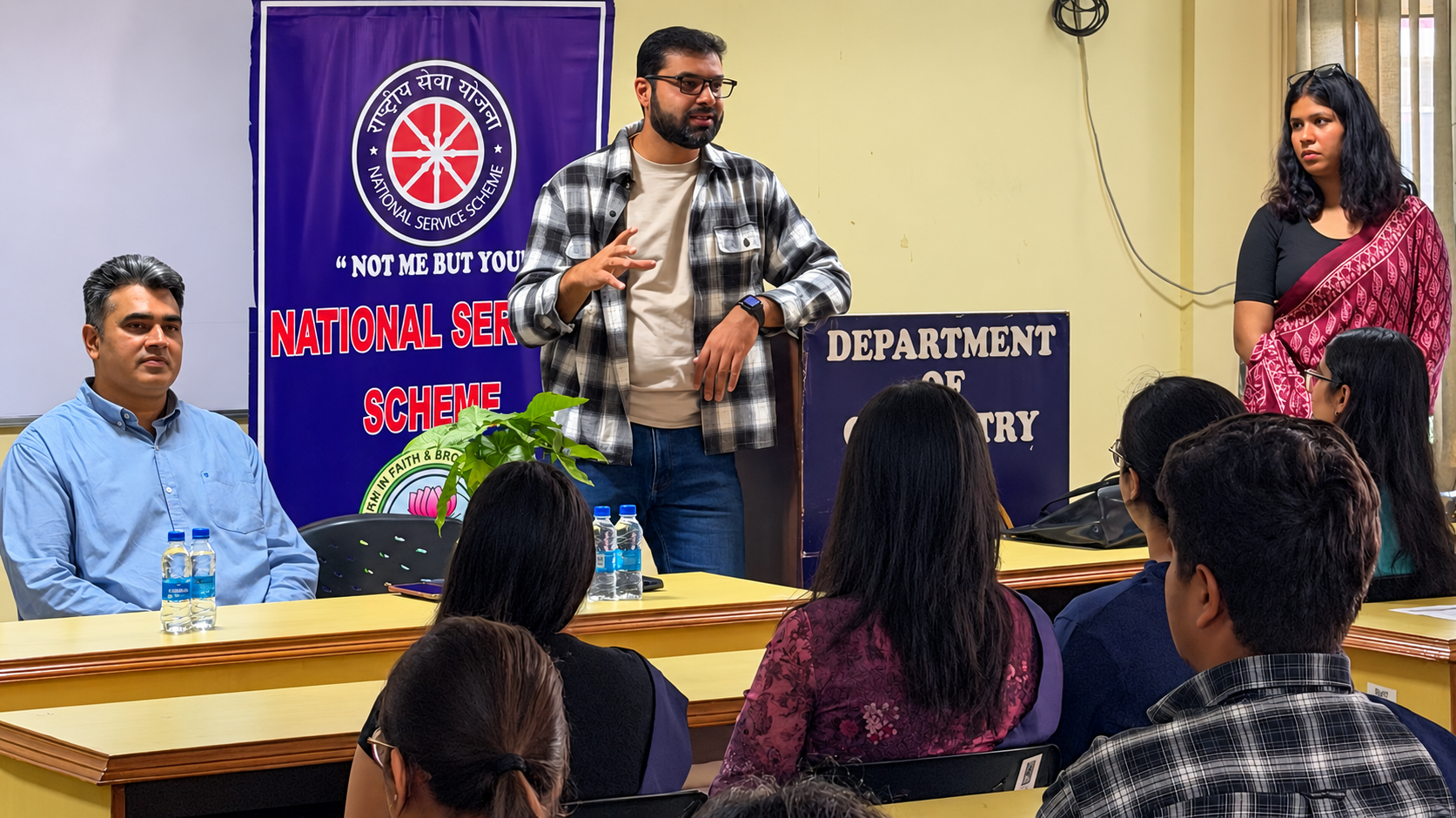
I spoke to 80 student volunteers at GGDSD College in Chandigarh, and the most important part of the morning happened after I had stopped speaking. Several of them followed me outside, one at a time, to talk about their own lives. That corridor told me more than any applause could have. This is a reflection on what happened at GGDSD College, why young people bring their real questions to the doorway rather than the microphone, and what it means when a craft begins to reach people at depth.
Here is the plain answer for anyone searching for what happened at GGDSD College. I was invited to address the college’s student volunteers during their orientation for the 19th Global Youth Peace Fest. The students listened with a quality of attention that cannot be demanded, only earned. When the session ended, the conversation did not. Several of them caught me outside to discuss their personal situations, quietly and one by one. I walked away feeling something I had not expected to name first: relief.
What Happened at GGDSD College, Chandigarh
Goswami Ganesh Dutta Sanatan Dharma College, known to most as GGDSD College, stands in Sector 32 of Chandigarh. It was founded in 1973, is affiliated with Panjab University and carries an A+ accreditation from NAAC. This year it hosts the 19th Global Youth Peace Fest, which runs under the theme “I am the CHANGE” and brings delegates from more than 15 countries to the city.
Eighty students sat in eight mixed groups of ten. My session introduced the GYPF 2026-GGDSD Youth Changemaker Internship. It is a 60-hour structure of reflection and supervised community action on HIV/AIDS awareness and girls’ rights, designed to turn three days of an event into something closer to leadership. I am grateful to Dr Nidhi Choudhary, Dr Mehak Sharma and the college team for the care with which they built the morning.
On paper, it was an orientation. In the room, it became something else. I have written before about future-tensing: our habit of speaking to young people only about who they will become, so that we never take them seriously as they are. I tried to do the opposite. I spoke to them as people already carrying real questions, because they are.
The Corridor Test: Why the Real Conversation Starts After the Talk
Medicine has a name for what happened next. Doctors call it the doorknob phenomenon: the moment a patient raises their most important concern just as the appointment is ending, with the doctor’s hand already on the door. These late disclosures often involve sensitive matters, including emotional difficulties. Patients frequently make them with mixed feelings, as a compromise between raising the issue earlier and never raising it at all. The American Family Physician has written about how clinicians should respond to these moments.
A student who waits until the talk is over is making the same compromise. The hall is public. The corridor is private enough.
I have come to think of this as the corridor test. The real measure of a talk is not how loudly the room applauds. It is whether anyone follows you out with a question they could not ask in front of everyone.
Applause is generous, but it costs little to give. It can be social, habitual, even polite. Approaching a speaker afterwards costs something: visibility, vulnerability, the risk of being misunderstood. That is precisely why it tells you more. I have explored the applause gap elsewhere: the hollowness that can follow public success. The corridor is its antidote. It replaces being celebrated with being trusted.
Applause tells you a room enjoyed you. The corridor tells you someone trusted you.
What Depth in My Craft Actually Means
People often assume that depth means more complex material. In my experience, it usually means less performance.
There is a stage version of every speaker: polished, prepared, slightly armoured. It works. It is also instantly detectable to a young audience. The students at GGDSD College did not need me to be impressive. They needed to sense that while I spoke, I was paying attention to them rather than to myself.
Neuroscience offers a useful lens here, provided we use it modestly. In a well-known study, Stephens, Silbert and Hasson recorded brain activity in a storyteller and her listeners. Their activity became linked across space and time, and the link disappeared when communication broke down. Listeners whose brains ran slightly ahead of the speaker understood the story best. I had no scanner in the hall, and I would not claim one. But the finding gives language to something every teacher knows. When an audience is truly with you, it is not merely listening. It is travelling alongside you.
My NLP training names the method behind that travelling. Pacing and leading means meeting people exactly where they are, in their language, pace and concerns, before inviting them anywhere new. You cannot lead a room you have not first paced.
With young people, pacing means taking their pressures seriously: exams, families, futures, the private weight of comparison. Only then does an idea like a 60-hour internship stop sounding like an obligation and start sounding like an invitation.
That, for me, is what going deeper in my craft now means. Fewer techniques on display. More attention underneath.
Why Students Bring Their Real Questions to the Doorway
Why would a young person share something personal with a visiting speaker they met an hour earlier? Research on help-seeking offers part of the answer. When young people reach out about mental health, they usually prefer informal support to professional care. The main barriers include difficulty recognising what they are going through, a preference for handling things alone, and stigma and embarrassment. The full study, by Rickwood, Mazzer and Telford, is in BMC Psychiatry.
A visiting speaker occupies an unusual position between the informal and the professional. Warm enough to approach, outside the social web of classmates and family, and gone by evening. For ten minutes in a corridor, that combination can lower the cost of honesty. The student does not have to become a “case”. They only have to ask.
This is also why psychological safety matters so much more than content. A room decides within minutes whether it is safe to stop performing. Everything I said about the internship mattered less than whether the students felt the speaker could be trusted with something real.
A moment for you
- What question are you carrying that you have only ever asked at the doorway, never in the room?
- Who in your life has earned your corridor, and who only receives your applause?
- If someone waited behind to talk to you this week, would you notice?
Why I Felt Relief Rather Than Pride
Relief was the first feeling, and it surprised me. Pride would have been about being seen. Relief is about the work arriving where it was meant to go.
Psychologically, relief is the feeling of an uncertainty resolving. Every speaker who chooses depth over entertainment carries a quiet question into a young room: will this be too heavy for them? Will they drift to their phones the moment the talk asks something of them?
The students at GGDSD College answered that question plainly. Young people are not allergic to depth. They are allergic to being talked down to.
When I stood on the TEDx stage earlier this month, my talk was about the loneliness that can sit inside success. Standing in that corridor in Chandigarh felt like the other side of the same coin: the connection that becomes possible when success is no longer the point.
What I Owe the Students Who Stayed Behind
I will not write about what any of those students told me. What was said in the corridor belongs to them.
I also want to be clear about what a corridor conversation is and is not. It is not therapy, and it is not coaching. Its job is smaller, and still important: to help a young person feel heard, to reflect back what they are carrying, and to point them towards the right door. That might be a trusted adult, the support available within their college, or a qualified professional when the weight is heavier than a conversation can hold.
This is the same line I hold in my life coaching practice, including the life coaching I offer across India. Coaching works with direction, choices and change. It does not replace clinical care. Knowing the difference is part of the craft, and it matters most with the young.
The internship itself offers something better than a corridor: 60 hours of structured reflection alongside real community action. If a talk opens a door, a programme like this gives students somewhere to walk through it.
A talk ends when the speaker stops speaking. A craft is measured by what keeps going after the microphone is switched off. At GGDSD College, it kept going into the corridor, and that is where I learnt what the morning had really been about.
If something in your own life has been waiting at the doorway for too long, you are welcome to book a free 15-minute consultation and say it out loud to someone who will listen.


