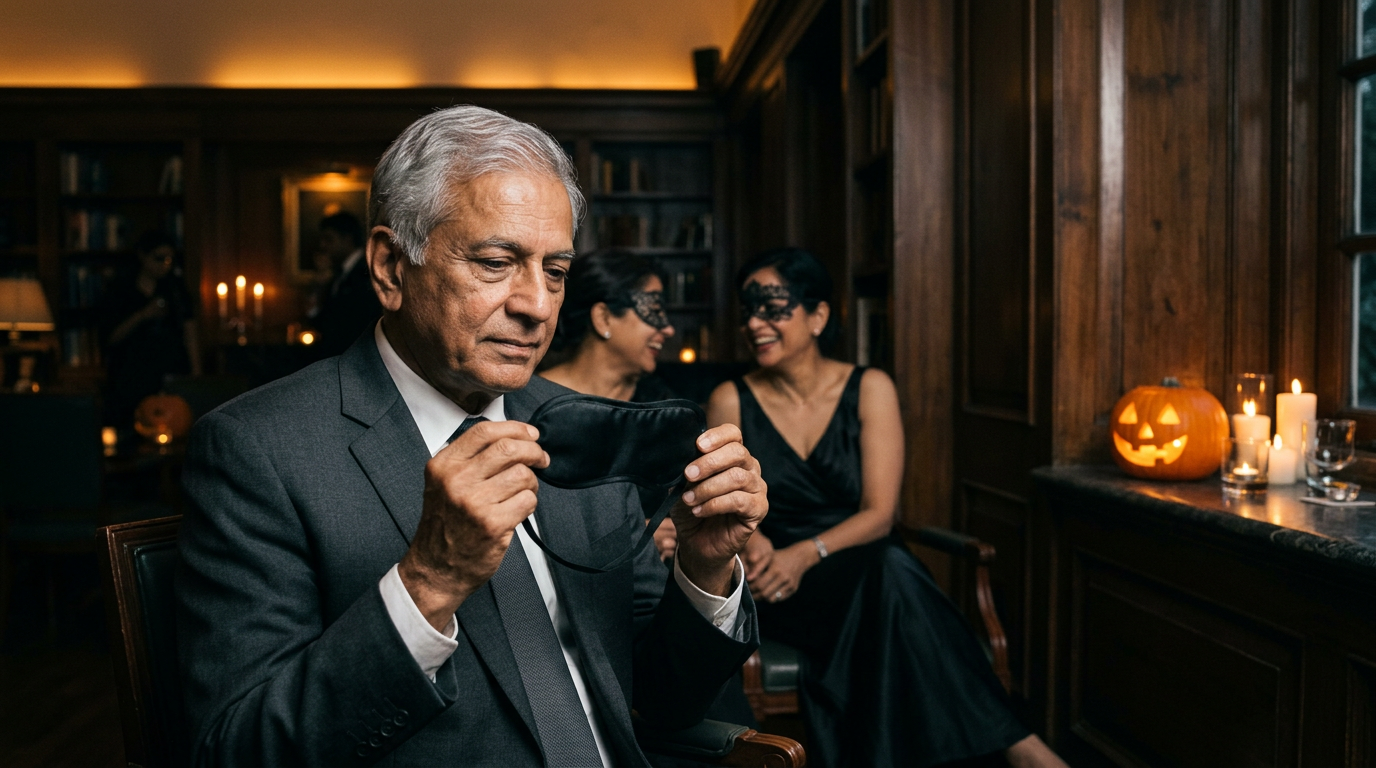
Halloween 2026 falls on Saturday, 31 October. Across Mumbai, London, Singapore and Port Louis, perfectly composed adults will pay to be frightened and queue to disguise themselves. It looks like harmless fun, and mostly it is. But beneath the pumpkins sits a revealing piece of human psychology: we enjoy fear when we choose it, and we often become more honest when we hide our faces.
Understanding why tells you something useful about the other 364 days, when the masks are subtler and nobody hands out sweets for wearing them.
When is Halloween 2026, and where does it come from?
Halloween 2026 is on Saturday 31 October, the eve of All Saints’ Day. According to Britannica’s history of Halloween, its roots lie in Samhain, the festival of the ancient Celts of Britain and Ireland. Samhain marked the start of winter and a new year. People believed the souls of the dead returned on that night. They lit bonfires and sometimes wore masks and disguises so that the wandering dead would not recognise them.
In India, Halloween has become a fixture of metro party calendars, and this year it arrives exactly a week before Diwali 2026 on Sunday 8 November. One festival invites you to play with darkness; the other asks you to light a lamp against it.
So why does it work on us? The short answer is that Halloween satisfies two quiet human needs at once. It lets us feel fear safely, on our own terms. And it grants permission to be someone else for a night, which often turns out to mean being more ourselves.
Why do we enjoy being scared?
Psychologists call it recreational fear: fear we seek out deliberately, in a setting we know is safe.
In a field study published in Psychological Science, Marc Malmdorf Andersen and colleagues at Aarhus University followed 110 visitors through a haunted house in Vejle, Denmark. They found an inverted U-shaped relationship between fear and enjoyment. Too little fear was dull and too much was unpleasant. Enjoyment peaked at a sweet spot of fear in between.
A separate study in the journal Emotion, led by sociologist Margee Kerr at the University of Pittsburgh, surveyed 262 adults before and after an extreme haunted attraction. Many reported better mood and felt less anxious and tired afterwards. This was especially true of those who arrived bored, stressed or tired. EEG recordings showed reduced brain reactivity among those whose mood improved. The researchers called the findings exploratory, which is the honest way to hold them.
Here is how I read it. When a ghoul leaps out, the brain’s threat system fires exactly as it would for a real danger: racing heart, sharp breath, the familiar hormonal hijack. But a slower, more reflective part of you knows the exit door is ten metres away. Halloween lets you rehearse fear with the ending guaranteed.
That is the part worth taking home. Most adult fears come with no such guarantee: the board presentation, the medical result, the conversation you keep postponing. What exhausts us is rarely fear itself. It is fear without a sense of control.
What masks do to behaviour
Halloween also produced one of social psychology’s best-known field experiments. In 1976, Ed Diener and colleagues observed more than 1,300 trick-or-treaters across 27 homes. Each child was told to take one sweet, then left alone with the bowl.
Children who came alone and had given their names rarely took extra. Children in anonymous groups took extra far more often: roughly 57% compared with 7.5%.
Psychologists describe this as deindividuation: a loosening of self-monitoring when we feel anonymous or absorbed into a group. The usual conclusion is that masks make us behave worse. I think that is only half the story.
A mask does not install new behaviour. It removes supervision, and whatever was being supervised walks out. For a seven-year-old, that is a fistful of chocolate. For an adult, it is often something far gentler: playfulness, loudness, flirtation, silliness, a laugh nobody at the office has heard.
I call this the costume licence: the permission a disguise grants to express the self you have been keeping under supervision the rest of the year.
The masks you wear the other 364 days
Consider a composite of a pattern I see often in senior leaders. A finance director measures every sentence at work and has not raised his voice in a decade. At a friend’s Halloween party, dressed as a pirate, he is the loudest and funniest person in the room. On Monday the suit goes back on, and so does the silence.
Neither version is fake. But only one gets daylight.
The sociologist Erving Goffman described social life as a performance, with a front stage where we manage impressions and a back stage where we relax. I explore what this means for leaders in front stage and back stage leadership.
The everyday masks are quieter than a Halloween costume: the competent face in the meeting, the agreeable smile at the family table, the reflexive “I’m fine”. I have written about how that reflex can become the hidden loneliness of performing wellness.
Some masks protect us, and that is healthy. The trouble begins when we forget we are wearing one.
A mask does not give you a new self. It removes the audience that was keeping the old one quiet.
Before you choose a costume this year, sit with these privately:
- Which part of you only comes out when nobody can quite see your face?
- Who, exactly, is the audience you are still performing for?
- If you took one everyday mask off for a week, which would it be, and what are you afraid would happen?
What your costume may be telling you
I would not read too much into a costume. Sometimes a vampire is simply a vampire. But choices made playfully are often made with fewer filters, and that makes them interesting data.
Three gentle observations are worth making this Halloween:
- What you are drawn to become. Power, mischief, menace and beauty each carry a different hunger. Notice it without judging it.
- How it feels when the mask comes off. Relief suggests the costume was effort. Disappointment suggests it was carrying something you miss.
- Whose permission you were waiting for. If it takes a festival, a crowd and a disguise to laugh freely, the question is not the laugh. It is the permission.
This is much of the work I do in life coaching: helping people notice which of their everyday masks are protecting them and which have quietly become a cage. Then we work out what it would take to let a little more of the real person into ordinary daylight.
Enjoying Halloween with a little more awareness
Recreational fear only works when it feels chosen. Not every nervous system reads a jump scare as play, particularly for people carrying old fear in the body. A good host makes opting out easy and never makes a joke of it. The same goes for children, who should set the pace of their own fright.
For everyone else, enjoy it fully. Scream in the haunted house. Wear the ridiculous costume. And, on the drive home, notice what came out of you when the face was covered.
The oldest Halloween masks were worn so that the dead would not recognise you. The more useful question this year is whether the living do.
If one of your everyday masks has started to feel heavier than it should, a free 15-minute consultation is a quiet place to begin.


