
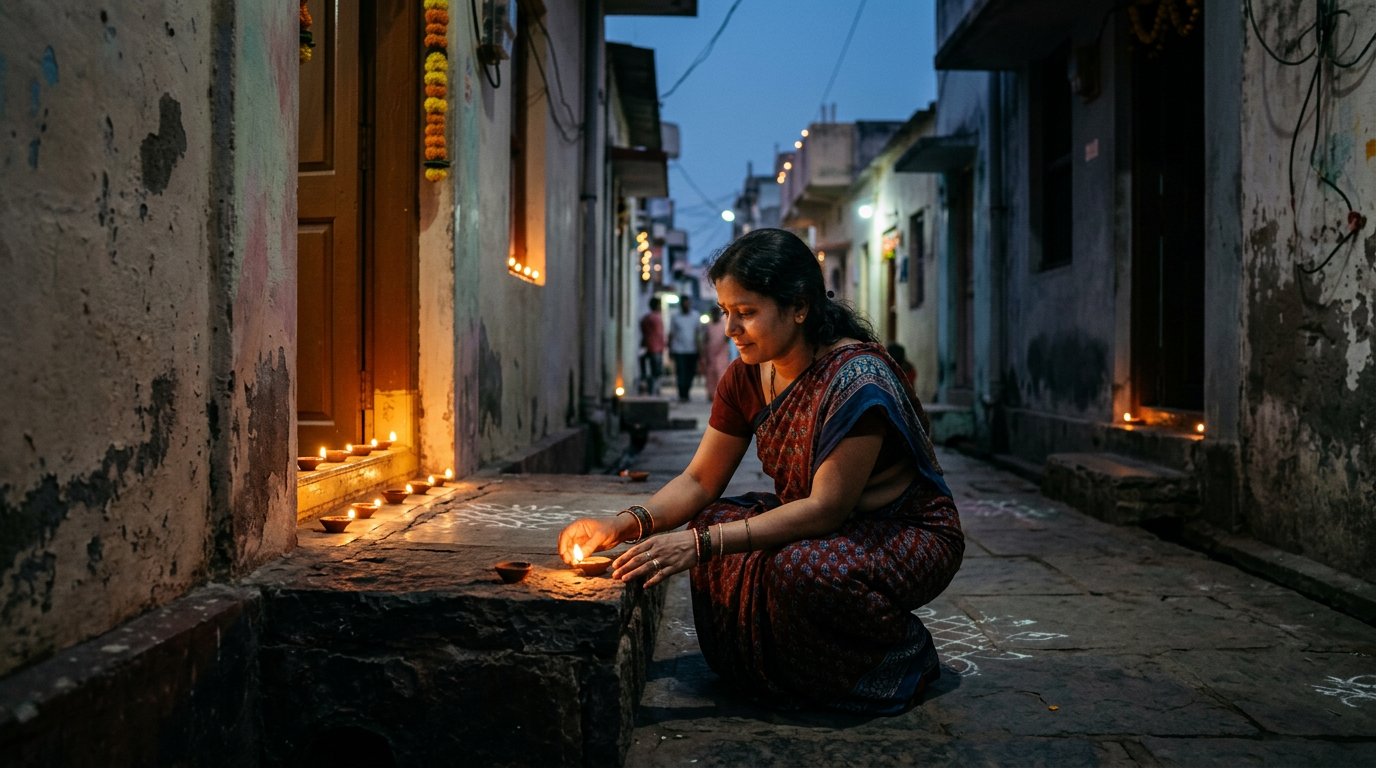
Diwali 2026 arrives on Sunday, 8 November, at the end of a year that has tested the world’s nerve. We have watched missiles cross borders, the earth shake and flood, and machines learn to do our work faster than we can retrain for it. It would be easy to celebrate on autopilot this year, and just as easy not to feel like celebrating at all. I want to suggest a third option. Light your lamps deliberately, compassionately, and in proportion to the darkness they are meant to answer.
First, the practical facts. The main night of Diwali 2026, Lakshmi Puja, falls on Sunday 8 November, and the full five-day festival runs from Dhanteras on Friday 6 November to Bhai Dooj on Tuesday 10 November. Deepavali in Tamil Nadu, Singapore and Malaysia falls on the same Sunday, so the diaspora, from Mauritius, where I grew up, to Singapore, where I now teach, lights up together.
And here is the direct answer to the question this article really exists to ask: how should we celebrate this particular Diwali? Smaller in noise, larger in meaning. Clean more than the house. Spend less on spectacle and more on people. And light at least one lamp that has nothing to do with your own prosperity. The rest of this article explains why, and how.
The Darkness the Lamps Must Answer
Hold this year’s headlines in one hand. The United States and Iran traded strikes, and ships were attacked in the Strait of Hormuz even while a ceasefire officially held. Russia’s war on Ukraine ground on, including a summer air assault on Kyiv that killed at least 27 people. Twin earthquakes devastated Venezuela in June, and another, on the Indonesian island of Flores, killed 111 people and displaced 176,000 more. In Sudan, the RSF stood accused of crimes against humanity and ethnic cleansing in el-Fasher.
A historic heatwave rolled across Europe into Italy and the Balkans, wildfires killed twelve people in Algeria, and in late August a collapsing glacier sent flash floods through Nepal and Tibet, killing hundreds. An Ebola epidemic strained health systems. And one widely reported analysis estimated that AI will reshape roughly half of all jobs in the United States within three years, a sentence that quietly unsettled households far beyond America.
Now hold the same year in the other hand. Spain lifted the FIFA World Cup in extra time against Argentina, and strangers embraced in public squares across continents. In Venezuela, a security guard was pulled out alive after more than a week beneath the rubble. In August, a total solar eclipse passed over Greenland, Iceland, Portugal and northern Spain, and millions of people stood still at the same moment to look up at the same sky.
Both hands are telling the truth. The question Diwali asks is which one you will let define the year.
If 2026 has left you tired in a way sleep does not repair, there is a reason. We are among the first generations to witness every catastrophe, everywhere, in real time, in the palm of a hand. Psychologists call one part of this vicarious trauma: distress absorbed second-hand from witnessing the suffering of others, even through a screen. The nervous system does not fully distinguish between danger reported and danger present. It braces either way. Which is where a very old technology becomes unexpectedly modern.
What a Small Flame Does to a Tired Mind
A diya is not a decoration. It is a ritual: a deliberate, symbolic act performed with full attention. Research on ritual across cultures has consistently associated such acts with lower anxiety and a restored sense of agency, especially in seasons of grief and uncertainty. The mechanism is not mystical. When you clean a corner, pour the oil, set the wick and shield the flame from the wind, you are completing something small, finishable and entirely within your control, in a year that has felt neither small nor finishable nor within anyone’s control.
That is why the festival’s timing matters psychologically as much as astronomically. Diwali falls on the darkest new moon night of the month of Kartika. The tradition does not wait for a bright night to celebrate light. It chooses the darkest one available. I have written before that home is not a building but the state your body enters when it decides it can stop scanning. On Diwali night, the lamp at the threshold is the signal that the scanning may pause.
A diya does not deny the darkness. It refuses to let darkness be the only true thing in the room.
Before the festival arrives, sit quietly with three questions. Whose year was darker than yours, and do they know you noticed? What are you still carrying into November that was never yours to keep? And if your lamps could only illuminate what you truly value, what would they reveal?
The Second Diya
Diwali signifies the victory of light over darkness, good over evil, knowledge over ignorance and hope over despair, and it is not one community’s property: Jains mark Mahavira’s liberation, Sikhs remember Guru Hargobind’s release, and Newar Buddhists honour Lakshmi. More than a billion people worldwide celebrate it. You do not need to be Hindu, or Indian, to light a lamp against a year like this one.
So here is the practice I am asking of you, wherever in the world you are reading this. For every lamp you light for your own prosperity, light one for a darkness that is not your own. I call it the second diya: the lamp you light for a darkness that is not yours. And a second diya only counts if it is attached to an act. A lamp with no act behind it is sentiment; a lamp with an act behind it is character. Tradition says Lakshmi visits houses that are clean and lit. I suspect she also notices which houses light for others.
How to Celebrate Diwali 2026: Five Deliberate Practices
1. Clean more than the house. Households traditionally begin cleaning a week before Diwali to clear out negativity. This year, extend the ritual inward. Choose one grudge, one resentment or one expired story about yourself, and retire it as deliberately as you would sweep a floor. Name it, decide its ending, and do not redecorate with it.
2. Light the second diya. Attach it to an act sized to your means: redirect one day of your firework budget to families displaced by flood or war, carry sweets to the neighbour who will otherwise eat alone, or write to the colleague who lost someone this year and never quite came back.
3. Ring one person, not the group. A greeting broadcast to two hundred contacts warms nobody, including you. Choose the one person you have quietly drifted from and use your voice. I wrote at Raksha Bandhan about the assumed bond: the relationship we never tend because we are certain it cannot be lost. Diwali is the year’s second chance to tend it.
4. Trade noise for light. Celebrate generously with lamps and gently with sound. Somewhere near you is an infant, an elder, an animal, or a nervous system that has spent 2026 bracing at every headline. In a year when explosions were nobody’s entertainment, letting the loudness end at your gate is not a lesser celebration. It is a more literate one.
5. Keep one evening off camera. Choose a single night of the five and let it go undocumented. A festival performed for an audience soothes the feed; a festival experienced with full attention soothes the person. Your memory will keep what matters better than your gallery will.
A Festival That Asks Something of You
Festivals are not interruptions of real life. They are annual appointments with what real life keeps postponing. I have made a habit of reading them psychologically rather than ceremonially: Krishna Janmashtami as a study of leadership under threat, Raksha Bandhan as the maintenance of bonds we assume. Read the same way, Diwali is a yearly rehearsal of agency: proof, at household scale, that darkness is answerable.
Because the victory of light over darkness was never announced once, in mythology, and settled. It is a score kept nightly, in ordinary houses, by whoever is willing to hold the match. This November, hold it deliberately.
And if 2026 has left you carrying more than you can name, you do not have to sort it alone. Much of my work in life coaching begins exactly there: deciding what you will no longer carry, and what you will light instead. If that speaks to where you are, a free 15-minute consultation is a quiet, no-pressure place to begin.


