
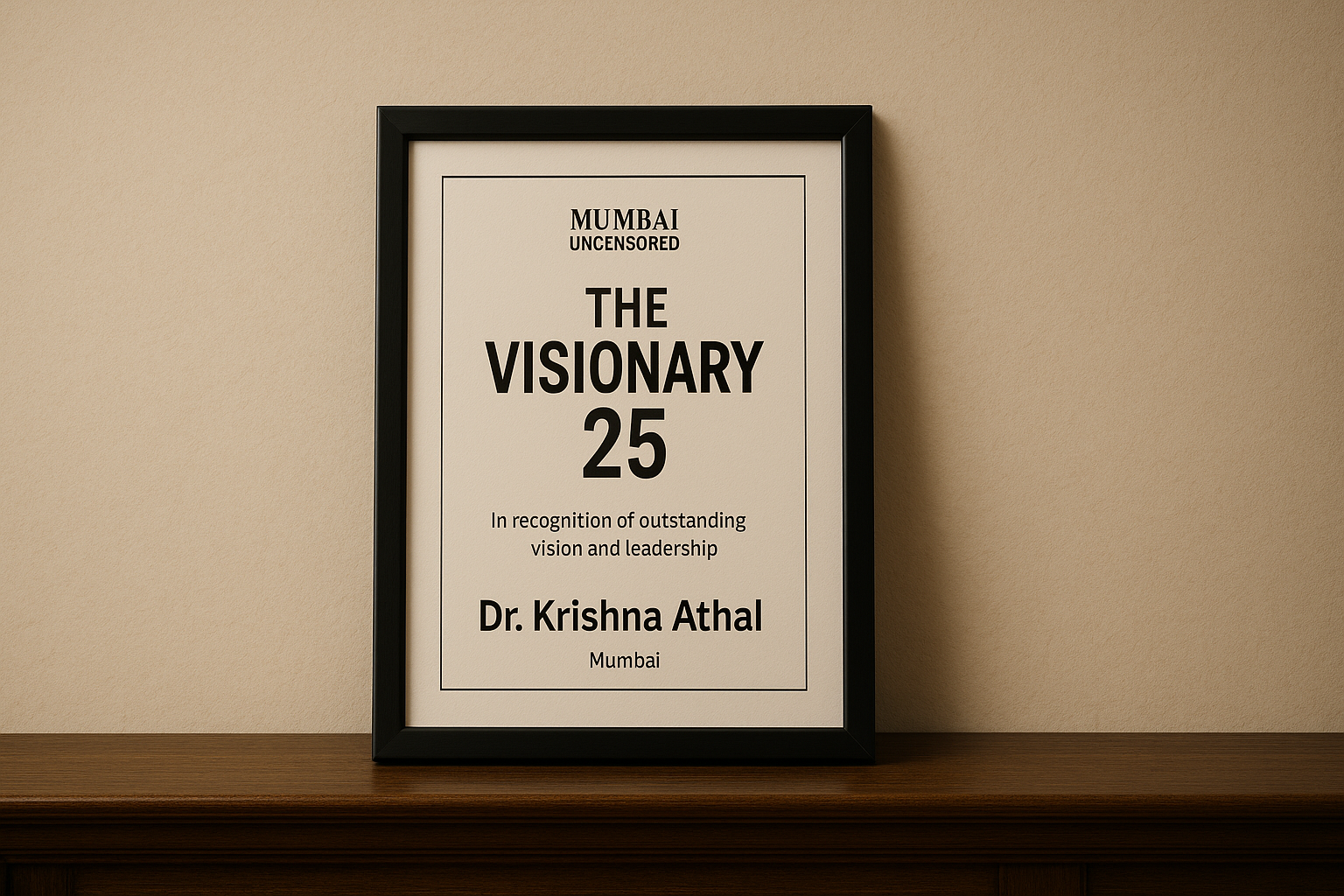
There are some emails you skim. And there are some you read twice, close your laptop, and simply sit in silence.
When I learnt that Mumbai Uncensored had included me in The Visionary 25 list, alongside some of the most dynamic and diverse change makers in India, it was one of those sit-in-silence moments. Not because of the word “visionary” – that word can easily become marketing wallpaper – but because of what it quietly asks:
Have you really lived in alignment with the vision you claim to carry?
For me, this recognition is not just a badge. It is a mirror held up to years of work in coaching, leadership, psychology and social impact. Work that started with very ordinary beginnings and a very stubborn belief that inner transformation can and must shape outer change.
Standing Among Visionaries: The Power of a Collective Story
What I love most about The Visionary 25 is how beautifully eclectic the list is. It is not a list of people who all look the same on paper. It is a list of people who refused to live on autopilot.
You have someone like Nikhil Kamath, who went from high school dropout to co founder of Zerodha, True Beacon and other ventures, turning a call centre night shift into a classroom for stock trading and eventually into one of India’s most influential finance stories.
You have Charan Panjwani, the “Obesity Warrior” behind The Fit Bear, who turned his own struggle with weight into a compassionate, science backed movement for sustainable fitness and food freedom.
You have Dr Sanah Sayed, a cosmetic and aesthetic dentist who has transformed over 5,000 smiles, proving that dentistry is not only about teeth but about confidence, identity and emotional healing.
There is Nitish Kalia, who left the safety of a corporate job to become a full time anchor, emcee, singer and sports commentator, now known for hosting thousands of events and even going viral for his heartfelt introduction of MS Dhoni.
You meet Vanditta Malhotra Hegde, a lawyer who built VMH & Associates in a male dominated profession, turning legal complexity into sharp, practical guidance while juggling motherhood and entrepreneurship.
Anusha Tallam and Akash Kumawat of Studio EBBXFLO have taken branding and design far beyond pretty visuals, turning it into cultural and psychological storytelling that has earned them national and international recognition.
In the world of experiences and celebrations, you see Anant Khandelwal of Indian Wedding Planners and Prateek Tandon of Copper Events, both crafting weddings and events as emotional stories rather than just logistics.
You have Gayatri Gandhi, India’s first certified KonMari consultant, who founded Joy Factory and reframed clutter clearing as a deep psychological process of letting go and choosing joy.
You meet Gaurav Malvai of GSM Experiences, who started as a DJ and went on to build a multi vertical entertainment and AV enterprise, while staying rooted in Vedanta and psychology.
Public life enters the list through Siddhesh Shinde of Yuva Sena, representing a new generation of youth in politics, and through performers like Praveen Nair, India’s first HypnoMentalist, who blends hypnosis and mentalism to create wonder, and Dr Madhur Rathi, a psychiatrist, psychotherapist and content creator bringing mental health to mainstream conversations.
This is only part of the larger group, yet you can already feel the pattern. Different industries. Different stories. One underlying theme: these are people who refused to stay in rooms where they felt unseen, misused or half alive. They chose to walk out, start again, and build something that felt true.
To stand among them is humbling. It tells me that the work I do as a life and executive coach, corporate trainer and leadership consultant sits in the same broader movement of Indians who are quietly changing how we think, work, feel and relate to each other.
My Journey: From Fixing Problems to Transforming People
My own path has never been a straight line. It has been more like an ongoing experiment in how far inner work can travel in the outer world.
I have worked across India, Mauritius and Singapore as a life and executive coach, corporate trainer and leadership consultant. I have sat with CEOs who feel secretly empty, young professionals paralysed by overthinking, couples trying to navigate love in a hyper distracted world, and teams struggling with trust, ego clashes and burnout.
Over the years, my work has grown into three intertwined streams:
- Coaching individuals to develop clarity, emotional resilience and self leadership.
- Training managers and leaders to communicate with psychological depth, not just corporate jargon.
- Building social impact projects that bring leadership, life skills and mental health awareness to young people and communities.
At the heart of all this is a simple belief: IQ alone is not enough. We need emotional intelligence and spiritual intelligence if we want success that does not secretly destroy us. My focus on what I call “tri intelligence leadership” is an attempt to bring these three dimensions together in a structured, evidence based way.
None of this happened overnight. There were years where the work felt invisible, where impact did not look glamorous on social media, and where the safer option would have been to simplify my identity and fit into one neat label. Instead, I chose a slower path: to keep learning psychology, to keep refining my coaching frameworks, to keep testing them with real people and real pain.
That is why this recognition matters. It is not an award for one project. It is a quiet nod to the cumulative work of showing up, session after session, workshop after workshop, conversation after conversation.
Why Recognition Matters in the Inner Work Professions
When finance, events, law or design professionals get recognised, the world immediately sees the “product”. There are numbers, awards, visible outputs.
With coaching, therapy, leadership development and psychological work, much of the transformation is invisible. A person goes back home and finally has an honest conversation with their partner. A leader decides not to humiliate a team member in public. A young adult chooses to ask for help instead of shutting down. These things do not make headlines, yet they change lives.
Being included in a list like The Visionary 25 tells me that our culture is slowly waking up to the value of inner work. It signals that India is ready to acknowledge that mental health, emotional resilience and conscious leadership are not “soft” things. They are structural forces. They shape how businesses are built, how families function, and how societies grow.
For me personally, this recognition strengthens my responsibility. It is a reminder to stay grounded in evidence based practice, to keep my work trauma informed and ethical, and to resist the temptation of turning coaching into motivational entertainment.
What This Means for the People I Serve
If you are a coachee, a client, a reader, a workshop participant or even someone who silently follows my work online, this recognition is as much yours as it is mine.
You are the reason I sit with research papers on psychology and then translate them into simple daily tools.
You are the reason I keep integrating ancient wisdom from our own Indian traditions with contemporary leadership science.
You are the reason I continue to design programmes that do not just feel good in the room, but remain with you in your nervous system, your relationships and your decisions long after the session ends.
Being named in The Visionary 25 gives me a larger platform, yes. But more importantly, it gives more weight to the message I have been repeating for years:
If you want an extraordinary life, you cannot avoid uncomfortable inner work. No title, salary, follower count or award can substitute for the hard, quiet task of knowing yourself.
Looking Ahead: Vision as Daily Practice
The word “visionary” can easily create distance, as if vision is something reserved for a few special people. I do not see it that way.
To me, being a visionary is not about predicting the future. It is about seeing clearly what is broken in the present, starting with yourself, and then choosing to respond with courage and creativity.
Nikhil did that in finance.
Gayatri did that in clutter and homes.
Gaurav did that in sound and experiences.
Dr Madhur did that in mental health communication.
Each person on this list has taken a corner of human life and asked, “How can this be more humane, more conscious, more alive?”
My corner happens to be human behaviour, leadership, inner transformation and social impact. This honour tells me to keep going, to keep refining, to keep serving.
I am deeply grateful to Mumbai Uncensored for seeing and acknowledging this journey. More than that, I am grateful to every person who has trusted me with their story, their confusion, their ambition and their pain.
In the end, the real measure of being a visionary is not the lists you make, but the lives you touch.
And for me, that work continues.


Leave a Reply