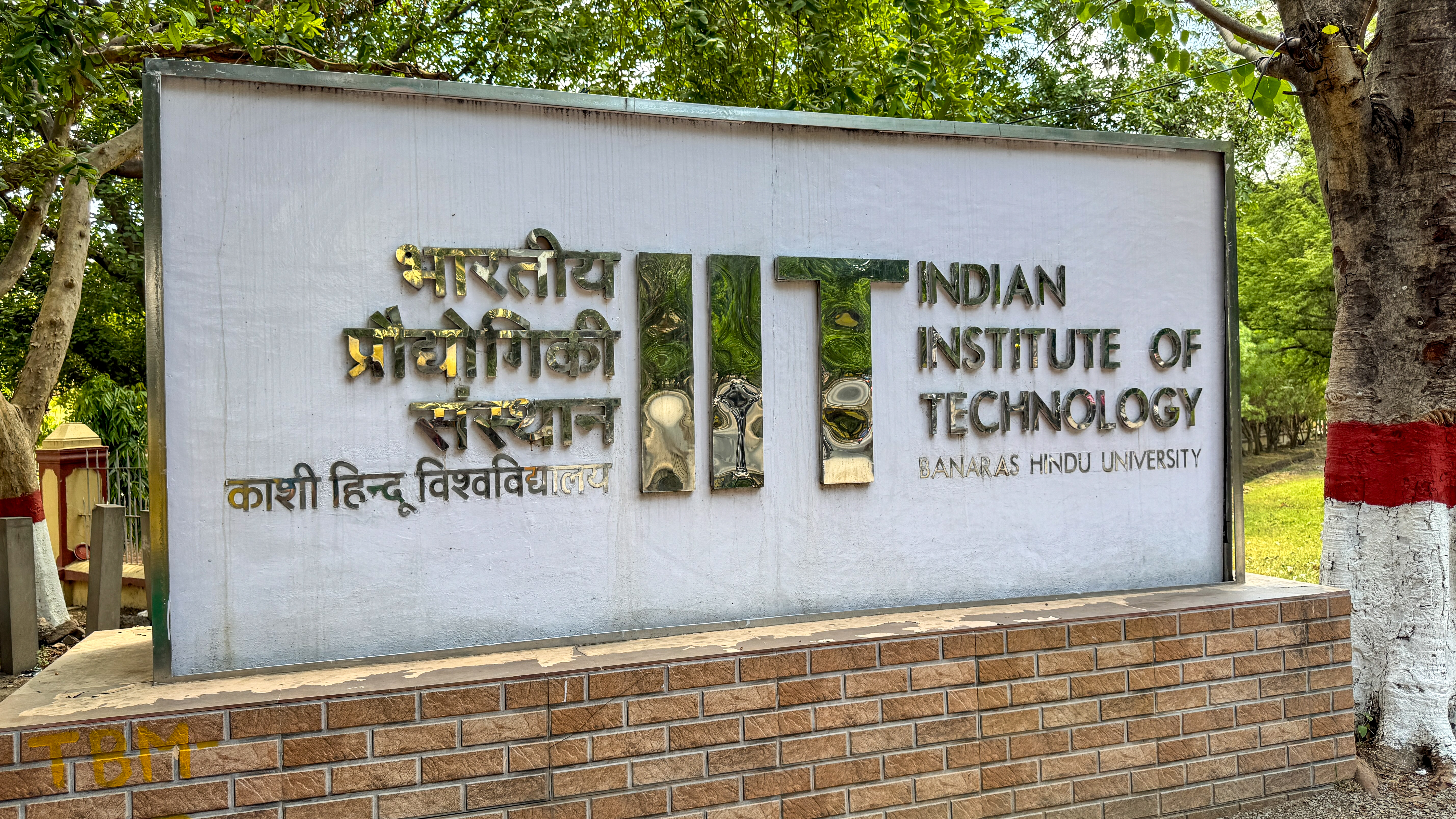
This morning, over chai near Assi Ghat, a young man recognised me from Instagram and, while we conversed, he told me he had failed the JEE twice before “settling” for another path. The word settling stayed with me all the way to the gates of IIT BHU, where I had planned to spend half a day as part of my Varanasi trip. I walked in expecting an engineering campus. I walked out having witnessed something far rarer: a place where ferocious ambition and deep stillness live side by side without apologising to each other. What I saw at IIT BHU is, I believe, a quiet answer to one of the biggest emotional questions of our time.
A Campus Inside a Prayer
Most universities sit inside cities. IIT BHU sits inside a vision. The institute began in 1919 as the Benares Engineering College with just 75 students, founded through the extraordinary will of Pandit Madan Mohan Malaviya, and was formally designated an IIT in 2012. It lives within the vast Banaras Hindu University campus, minutes from the ghats where families have cremated their dead for centuries.
Think about that geography for a moment. Some of India’s most competitive young engineers study algorithms and thermodynamics a short walk from the most honest reminder of impermanence on Earth. In psychological terms, this is a masterclass in mortality salience, the well-studied effect where awareness of death changes how we prioritise. Usually it makes people cling harder. Here, oddly, it seemed to make people work harder while clinging less.
What I Noticed in the Corridors
I spent time walking past the old BENCO buildings, the workshops, the hostels, the Gymkhana. Three observations kept repeating themselves.
First, the ambition was unmistakable but strangely unperformed. In corporate corridors, ambition announces itself: the posture, the name-dropping, the visible busyness. Here, students argued about problems, not about themselves. Ambition pointed at the work, not at the mirror.
Second, the pace was intense without being frantic. A group outside a lab was debating something technical with real heat, then dissolved into laughter, then returned to the problem. The nervous system language for this is ventral vagal engagement, the physiological state in which we can be alert, social and focused at the same time, rather than locked in fight-or-flight. Chronic corporate stress rarely allows it. This campus seemed to breed it.
Third, nobody seemed to be pretending the pressure did not exist. The JEE filters out more than 98% of those who attempt it, and everyone inside those gates knows what it cost to enter. Yet the mood was not triumphalism. It was something closer to custodianship, as if the seat belonged to the work rather than to the ego.
Consecrated Ambition
I want to give this phenomenon a name, because I have been circling it for years in my coaching room and only saw it fully formed today: consecrated ambition.
Consecrated ambition is ambition offered rather than owned. You pursue excellence with everything you have, but you hold the outcome the way you would hold an offering at a temple: with full attention and open hands. It is the Bhagavad Gita’s nishkama karma, action without attachment to the fruits, wearing a lab coat.
This is not a mystical idea. Neuroscience gives it teeth. When self-worth is welded to outcomes, every setback registers in the brain as a threat to identity, spiking cortisol and narrowing cognition precisely when you need it widest. When effort is decoupled from ego, the same setback becomes information. The work improves because the worker is no longer defending himself against it. I have written before about why healthy detachment is not coldness but clarity, and IIT BHU felt like that principle built in brick.
The chai-stall young man who felt he had “settled” was suffering from the opposite condition: ambition that had been welded to a single outcome, so its loss felt like the loss of himself. Consecrated ambition would have let him grieve the exam and keep the fire.
A Reflection for You
Sit with these for a moment, wherever you are reading this.
When you chase a goal, are you serving the work, or is the work serving your self-image? If the outcome you want most were guaranteed never to arrive, how much of your effort would survive that news? And who are you in the hours when nobody is measuring you?
Your honest answers will tell you whether your ambition is consecrated or merely anxious.
The Loneliness These Corridors Postpone
I will admit one shadow I carried through the campus. Many of these brilliant young people will graduate into leadership roles where the very excellence that got them here will isolate them. I have written about the loneliness of leaders, and I saw its seeds even here: the quiet ones eating alone, the topper nobody quite befriends. A campus can teach thermodynamics. It cannot always teach belonging. That work, in my experience, begins only when someone learns that achievement and connection are not competitors.
There is also a subtler risk. Minds trained on constant challenge can grow restless the moment mastery turns to routine, abandoning depth for novelty. It is the same pattern I unpacked in my piece on the psychology of boredom, and in an age where attention is monetised by the scroll, as I explored in scrolling regret, even an IIT-trained mind is not immune.
Ambition that must be seen is anxiety in better clothes. Ambition that is offered becomes devotion. IIT BHU reminded me that the deepest work is done by people who have stopped performing and started serving.
What Varanasi Adds That No Ranking Can
Rankings measure output. They cannot measure what it does to a 19-year-old to solve differential equations in the morning and watch the Ganga aarti in the evening. That daily oscillation between the measurable and the immeasurable is, I suspect, the campus’s real curriculum. Malaviya did not accidentally place an engineering college inside a spiritual university. He understood, a century before the research caught up, that intellect without interiority produces clever people who do not know why they are exhausted.
Half a day at IIT BHU gave me no new techniques, no frameworks, no tools. It gave me something better: proof that consecrated ambition is not a coaching theory. It is a lived possibility, walking around in chappals, arguing about circuits, a ten-minute rickshaw ride from the burning ghats that keep everyone honest.
If this piece stirred something in you, sit tonight with one question: what would your ambition look like if it no longer needed applause? And if you would like to explore that answer with me properly, you are warmly invited to book a complimentary fifteen-minute conversation through my website. One door. Walk through it only if you are ready.


