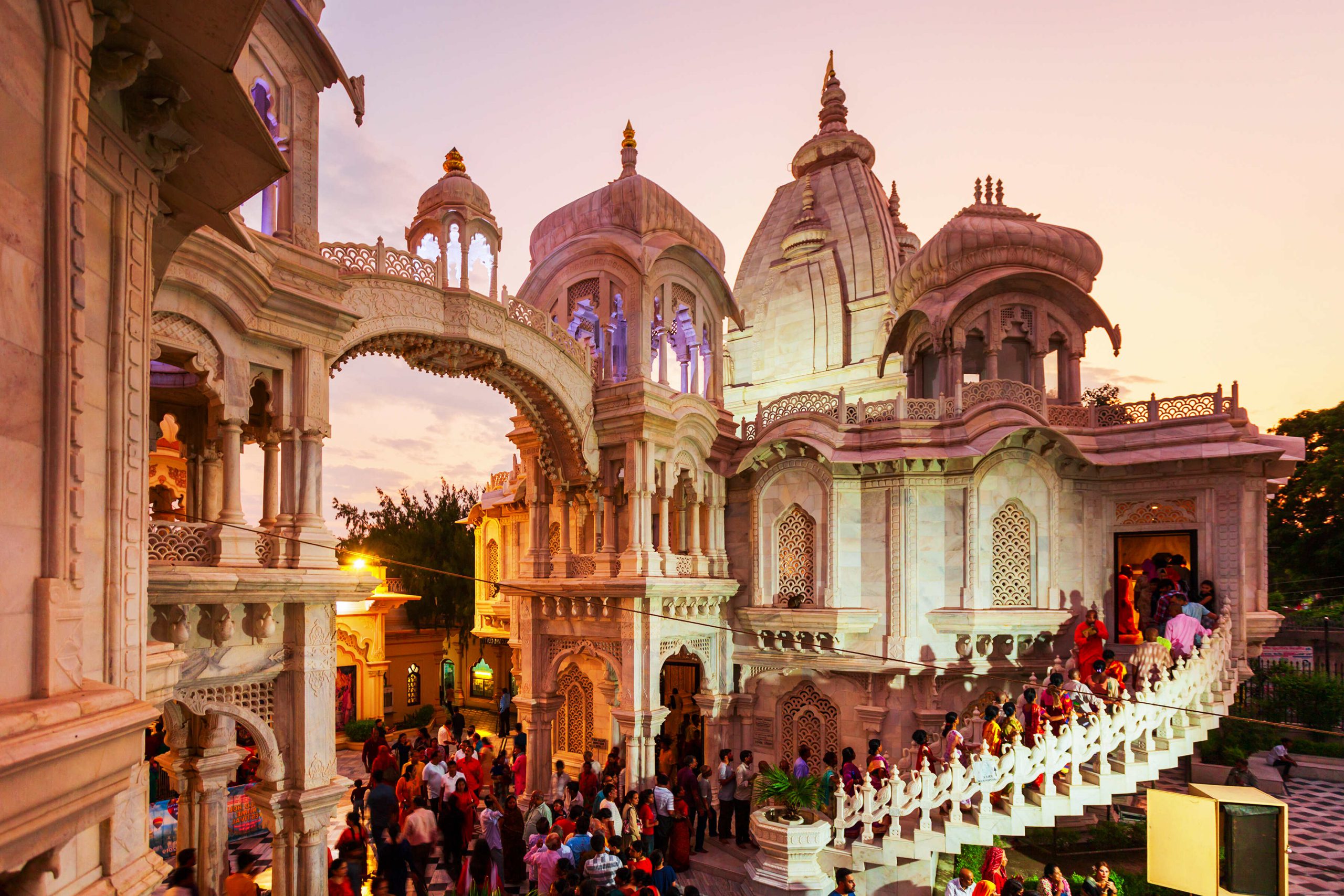
The night before I travelled from Varanasi to Vrindavan, a coachee messaged me at 2 am: “I closed the deal. I feel nothing.” I had spent that evening on the ghats, watching strangers grieve with more honesty than most of us manage in a lifetime, and here was a man who had everything, quietly confessing he had arrived at nowhere. So I did something unfashionable for a working coach. I cancelled two calls, boarded a train, and gave three days to a small town that does not care about your CV. This is what Vrindavan taught me at this stage of my life, and why the road from grief to devotion may be the most important journey a high-achiever never plans.
Why I left Varanasi for Vrindavan
Varanasi does not lie to you about death. You cannot sit long by the Ganges, watching smoke rise from the burning ghats, without something in your chest going quiet. Endings are handled here in the open, without euphemism, and there is a strange dignity in that. But Varanasi answers only half the human question. It teaches you how to let go. It does not always teach you what to hold. I left because I wanted the other half. I wanted to see what a place looks like when it is organised not around mortality but around love. For me, that place is Vrindavan, the town where Krishna is said to have played as a child, and where the whole economy of attention runs on devotion rather than ambition.
What Vrindavan actually shows you
Let me not sell you a postcard. Vrindavan is dust, monkeys, tangled lanes and the constant call of “Radhe Radhe” from doorways and loudspeakers. It is chaotic, occasionally exhausting, and utterly unbothered by your achievements. Nobody there asks what you do. In three days, not one person requested my card or my credentials, and the relief of that was almost physical.
What stayed with me were the faces. Vrindavan is also a refuge for widows, women who arrived with almost nothing and found, in daily singing, a reason to keep breathing. I watched one elderly woman, white sari, hollow cheeks, singing with an unguarded joy I have rarely seen in any boardroom. She had lost everything the world measures, and she was more present than most people I coach who have gained everything. That contrast lodged in me and would not leave.
Sacred smallness: the idea I carried home
Here is the term I have started using for what Vrindavan does to a striving mind. I call it sacred smallness: the quiet relief of no longer being the centre of your own story, of letting something larger carry what you have been holding alone.
We treat smallness as a threat. Our culture sells bigness as the cure for every ache, a bigger title, a bigger following, a bigger name. Yet the nervous system tells a different story. When people encounter something vast, whether a mountain, a cathedral or a town soaked in devotion, the brain’s default mode network, the circuitry humming with self-referential thought (essentially your mental chatter about you), goes quieter, and researchers describe the resulting state as the small self. Awe turns the volume down on the ego. This is what bhakti, the yogic path of devotion, has always known without needing a scanner. Surrender is not weakness. It is a nervous-system reset.
Success gave me a bigger name. Vrindavan gave me a smaller self, and I have never felt more at home. Sacred smallness is not defeat. It is the relief of finally being carried.
What Vrindavan taught me at this stage of my life
I am at a point in my work where the risks are no longer only external. The subtler danger for anyone who keeps succeeding is loneliness, the particular hollowing that arrives exactly when the applause is loudest. Achievement, left unexamined, slowly removes the people who used to tell you the truth and replaces them with people who need something from you. Vrindavan interrupts that quietly. In a place where you are no one special, you remember that you were never meant to be carried by your own performance.
Sit with three questions, honestly. When did you last feel small in a way that relieved you rather than threatened you? Who still tells you the truth now that you have succeeded? And if the applause stopped tomorrow, what would remain that you actually love?
I want to be careful here, because there is a false version of all this. Devotion can become another performance, another thing to post and win at. I have written before about how easily devotion curdles into spectacle. Vrindavan does not need your intensity. It needs your presence. And that is the same discipline I keep returning my coachees to. You do not need a temple town or a cave to practise this. You can live like a modern yogi in a meeting, on a school run, in the ten seconds before you reply to a message that has irritated you. Sacred smallness travels. That is the point.
I came back from those three days without a single answer for my 2 am coachee that would fit inside a text. But I did return with a question worth more than any deal he could close. Not “what have I built?” but “what is holding me while I build it?”
A door, if you want it
If you have arrived somewhere impressive and quietly suspect you feel less than the view promised, you are not broken, and you are not alone. That gap is worth understanding rather than out-running. If you would like to sit with it properly, you are welcome to book a fifteen-minute conversation with me, and we can begin there.


