
I have a confession. For years, I used the phrase “cost-effective” too casually.
I used it the way many of us do, with a neat, professional smile. Cost-effective staff. Cost-effective services. Cost-effective help. It took a few quiet moments, and a few uncomfortable conversations, to realise what that phrase often hides. A person’s hunger. A person’s helplessness. A person’s lack of choices.
When you say you feel poverty is nourished in India, you are pointing to something many people sense but struggle to name. There is a poverty economy in India that functions like an invisible engine. It powers convenience for some, survival for many, and comfort for a few who never have to see the full human cost.
And yes, if cheap labour suddenly disappeared, a large part of the country would not merely “adjust”. It would complain, panic, and call it a crisis. Which should make us pause, not because the economy is fragile, but because our ethics might be.
The Day I Saw the Transaction Behind the Tea
A small memory keeps returning to me.
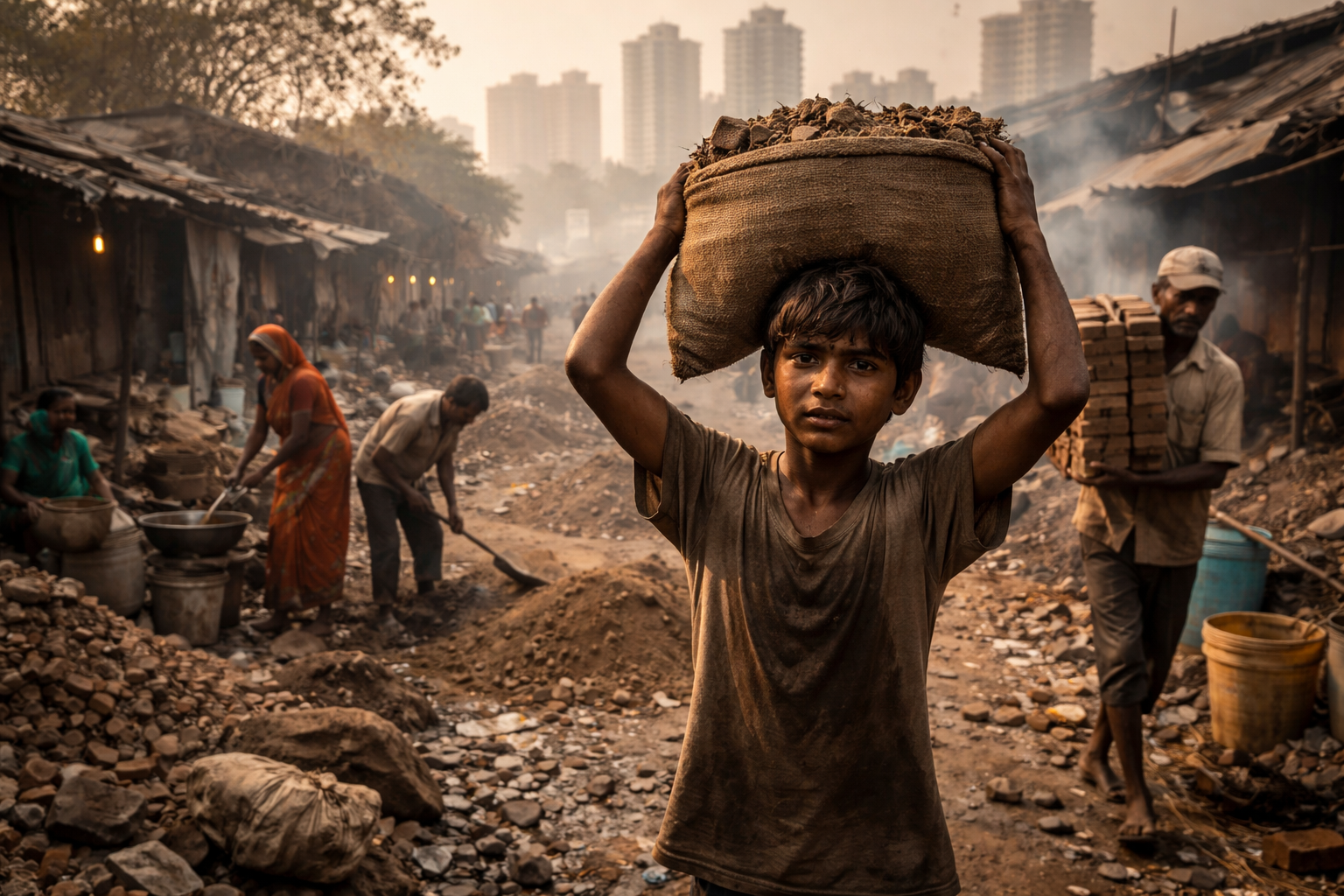
Years ago, I was standing at a roadside tea stall. The chai was excellent, as it often is. A boy, perhaps 12 or 13, moved between customers with a practised urgency, collecting glasses, wiping surfaces, anticipating orders. His eyes had that adult alertness children develop when childhood is not safe enough to be slow.
Someone said, “He’s very smart. These kids learn fast.” It was said as praise. And in a narrow sense, it was true.
But something in me tightened. Because I suddenly heard the other sentence underneath it. These kids learn fast because they must. Their nervous systems adapt to pressure the way lungs adapt to polluted air. Survival becomes a skill, then a habit, then a personality.
The poverty economy in India does not only shape markets. It shapes minds.
Why We Romanticise “Hard Work” When It Is Actually Hardship
India loves a good story about struggle. The self-made hero. The “rags to riches” arc. The motivational poster that declares poverty builds character.
As a life coach, I value resilience. I also know how easily resilience becomes a convenient lie. It becomes a way for society to admire a person’s coping mechanisms while refusing to change the conditions that forced them to cope.
When cheap labour is celebrated as “hustle”, we perform a subtle psychological trick. We turn exploitation into inspiration. We praise people for enduring what they should not have to endure.
Hard work is a choice when there are alternatives. Hardship is not.
Cheap Labour Is Not a Resource. It Is a Symptom.
Let’s name it plainly. Cheap labour in India is often the outcome of desperation, not efficiency.
It is born from low bargaining power, weak enforcement of labour rights, and the sheer scale of the informal economy. It is reinforced by social hierarchies that quietly decide whose time is valuable and whose body is expendable. It is maintained by the daily normalisation of inequality, especially in cities where wealth and want share the same street.
When we call cheap labour a “resource”, we speak as if poverty were an asset class. As if suffering were raw material. As if human fatigue were a natural deposit like coal.
This is one reason the poverty economy in India is so stable. It is not just a financial structure. It is a language structure. Words soften what reality would otherwise expose.
The Middle-Class Convenience Trap
If you have ever hired domestic help, ordered late-night delivery, negotiated a driver’s daily rate, or used a service that relies on underpaid workers, you have touched the system.
So have I.
This is where the societal questioning gets personal. Because the poverty economy in India is not maintained only by “the government” or “the rich”. It is also maintained by ordinary people who have learned to equate low prices with smart living.
We want affordability. We do not always want to ask who subsidised it with their body.
A fair question is this. If your cook, cleaner, delivery rider, or construction worker earned a truly living wage, would your lifestyle still feel affordable? If the answer is no, then the lifestyle has been quietly financed by inequality.
And if we feel defensive reading that, good. Defensiveness is often the mind’s way of guarding a discomforting truth.
The Nervous System Cost of Poverty
Poverty is not only lack of money. It is a constant negotiation with threat.
In chronic financial insecurity, the brain becomes a prediction machine scanning for danger. The stress response stays switched on. Sleep becomes lighter. Patience becomes expensive. Long-term planning becomes a luxury.
This is how poverty reproduces itself, not because poor people “lack discipline”, but because scarcity taxes the very mental capacities we associate with upward mobility. When the mind is busy surviving, it has less room for strategy, learning, and rest.
So when we benefit from cheap labour, we are often benefiting from someone else’s dysregulated nervous system. We are benefiting from a life lived without slack.
And the tragedy is that we then judge them for being “unreliable” or “unpolished” or “too emotional”. We judge the very symptoms we helped create.
If Cheap Labour Disappears, What Actually Breaks?
Let’s explore your claim with honesty. If cheap labour disappeared, what would “the economy” crib about?
Many businesses would face higher operating costs. Some would close. Prices would rise. Consumers would complain. Certain industries that rely heavily on underpaid workers would have to redesign their models. Households would have to confront the true cost of domestic labour. The informal economy would be forced into the light, where regulation and rights become harder to evade.
But here is the deeper truth. What breaks is not only profit margins. What breaks is the fantasy that growth can be separated from dignity.
The poverty economy in India has taught us to expect human beings at a discount. It has trained our sense of entitlement. It has normalised the idea that some people must live precariously so others can live comfortably.
If that arrangement shifts, discomfort is inevitable. Yet discomfort is not the same as injustice. Sometimes discomfort is the beginning of ethics.
A Dignity-Led Economy Is Not Charity. It Is Maturity.
When I imagine a healthier India, I do not imagine pity. I imagine maturity.
A dignity-led economy would treat labour rights as foundational, not optional. It would reduce the chokehold of the informal economy by making formality accessible, not punishing. It would stop pretending that productivity is possible without protection. It would value care work, domestic work, and service work as real work, not invisible favours.
Most importantly, it would change our inner culture. Because systems do not change only through policy. They change when public conscience shifts.
I want to ask a sharper question, one that stings a bit. If someone’s poverty makes your life easier, do you still call yourself a good person?
I am not asking this to shame you. Shame rarely builds sustainable change. I am asking because integrity matters. If we cannot look at our comfort and ask what it costs others, we will remain a nation of surface spirituality and private convenience.
My Invitation as a Life Coach
If you are reading this and feeling angry, you are not alone. Anger can be a clean signal. It says, “Something is wrong.”
Now comes the coaching move. What will you do with that signal?
Start small, but start honestly. Notice where you expect discounts from human beings. Notice how quickly “I can’t afford it” appears when it is someone else’s wage. Notice how often we demand excellence from people to whom society offers instability.
We do not need a perfect revolution to begin. We need a sincere interruption of normal.
Because the poverty economy in India is not only “out there”. It is also in our daily choices, our language, and our willingness to see the full human being behind the service.
And if cheap labour disappears, maybe what dies is not the economy. Maybe what dies is our addiction to inequality.


Leave a Reply