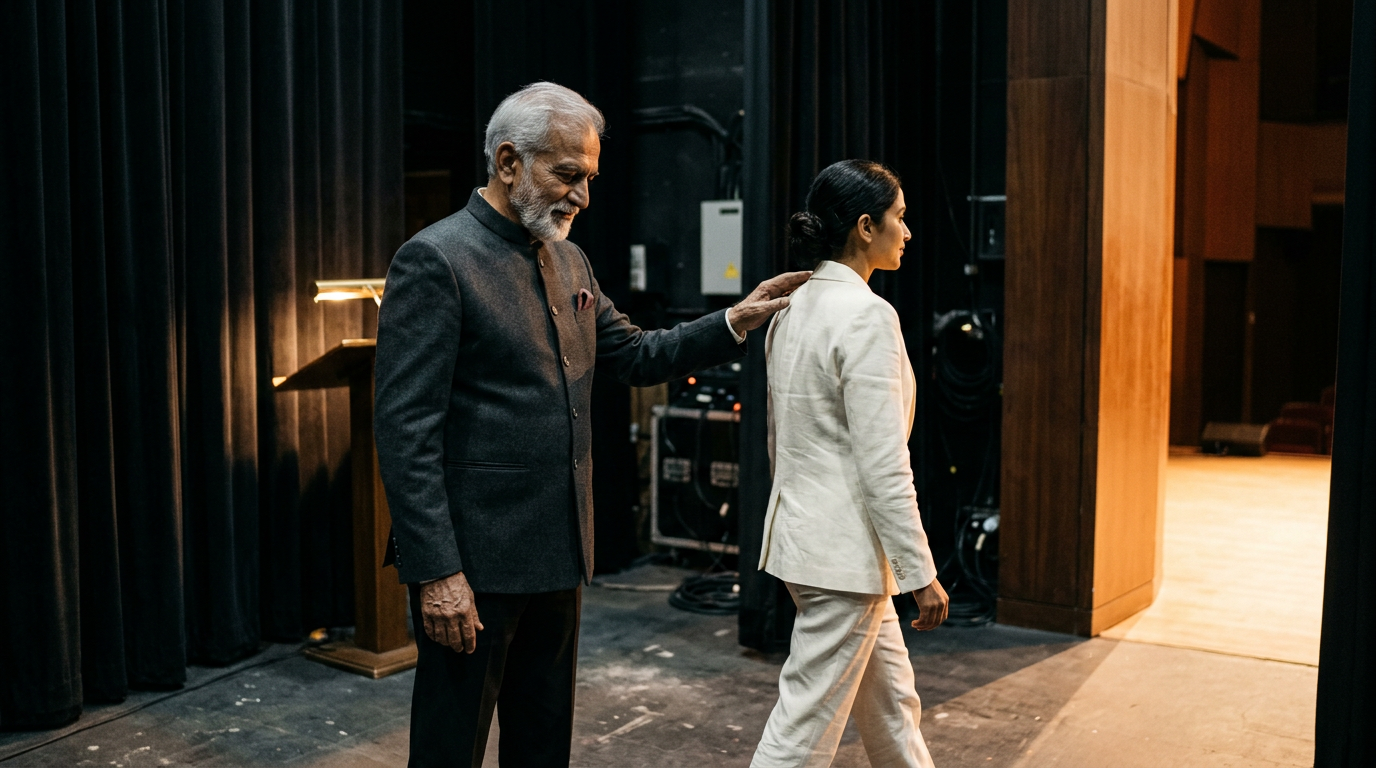
There comes a point in an ambitious life when the question changes. It stops being “How high can I climb?” and becomes “What is the climbing for?” The old contrast of kingmaker vs king is really a question about where you want your power to live: in a seat you occupy, or in people who no longer need you. At 38, I have made my choice, and it was neither modest nor easy. This is why I chose to make kings rather than become one, and what that choice quietly asks of anyone who makes it.
The short answer is this. A king’s power lives in his position, so it is always under threat, and it ends when he does. A kingmaker’s power lives in other people’s growth, so it multiplies, and it outlasts him. I chose the second because, when I was honest about what had actually satisfied me in my work, it was never the title. It was the moment someone I had worked with walked into a difficult room and did not need me there.
What a kingmaker is, and what it is not
The word has a murky past. History first pinned it on Richard Neville, Earl of Warwick, the Wars of the Roses magnate who helped crown Edward IV and later turned against him to restore Henry VI. That is the original kingmaker: a man who made kings in order to manage them.
That is not the seat I mean. A puppet-master needs his king weak. A kingmaker, in the sense I am claiming, needs his king strong enough to disagree with him.
Indian tradition has always understood this better. Chanakya, by tradition, shaped Chandragupta Maurya into an emperor and never reached for the crown himself. And the Mahabharata gives its most luminous figure a charioteer’s seat, not a throne, a point Devdutt Pattanaik makes when he reads Krishna as a coach and kingmaker. His essay on becoming a leader is worth your time. I will return to Krishna, for reasons that are personal.
Why I chose the kingmaker’s seat at 38
The conventional script says the late thirties are for the final ascent. I grew up in Petit Raffray, a small village in Mauritius, where “becoming someone” meant a title that people could point at. I understand that hunger from the inside. I have had the stages, the titles and the doctorate, and I am grateful for each of them.
But three things became difficult to ignore.
A throne seats one. The moment your worth depends on a single chair, everyone talented around you becomes a threat to it. I have written about this as the Kamsa reflex, the instinct to eliminate whatever might one day replace you instead of raising it. I did not want to spend the second half of my life guarding furniture.
The top is quieter than it looks. I gave a TEDx talk on the loneliness of success because I kept meeting it, in leaders who were celebrated by many and known by almost no one. I call that distance the applause gap. A crown widens it. Building other people closes it, because you cannot develop someone without actually knowing them.
The arithmetic is better. If I become a steadier leader, one organisation benefits. If I help a leader become steadier, hundreds of people I will never meet go home to their families a little less frightened of Monday. My work now, in coaching rooms, training halls and inside organisations, is almost entirely the growth of other people. That is not a consolation prize. It is leverage of the most human kind.
What psychology calls this choice
Developmental psychology has a name for this turn. Erik Erikson called it generativity, which simply means investing yourself in people and things that will outlive you. The seventh of his life stages sets it against stagnation, a slow curdling into self-absorption, and locates the fork in midlife.
The evidence since has been consistent. Studies over several decades tie this outward turn to higher well-being and life satisfaction. The reverse also appears to hold: life satisfaction tends to fall among people who come to feel, over time, that they have stopped contributing.
A caution, because I would rather be accurate than inspiring. These are associations, not guarantees, and nobody should become a mentor as a wellness strategy. I offer the research as reassurance only. If you feel the throne losing its shine, your ambition may not be fading. It may be maturing.
The shadow side: when kingmaking is a hiding place
Here is the part most essays on this subject leave out. The second seat can be an act of courage. It can also be a very elegant way of avoiding risk.
Some people decline the throne because they fear the exposure of sitting on it. Some prefer influence without accountability. Some live through the people they develop, which is control wearing the costume of generosity. From the outside, all three look like humility.
The difference shows at one moment: when the person you built outgrows you. This is where detachment in coaching stops being a technique and becomes a test of character.
So, privately:
- When someone you developed surpasses you, what is the first feeling, the one that arrives before the polite one?
- If nobody ever learned of your part in their success, would the work still be worth doing?
- Are you declining the throne, or avoiding it?
I ask myself these regularly. I do not always like my answers.
The name I was given
I carry the name of the most famous kingmaker in Indian tradition, which is either a coincidence or a quiet instruction.
On the battlefield of Kurukshetra, Krishna holds the reins while Arjuna, the finest warrior of his age, sits frozen. Krishna does not take the bow. He does not fight the war on Arjuna’s behalf. He helps a paralysed man see clearly and then, having said everything he has to say, tells him to reflect on it fully and act as he sees fit.
That is the most exact description I know of what an executive coach does. You do not give the leader your answer. You return them to their own.
A kingdom you will never rule
There is a grief in this choice, and I will not pretend otherwise. You will be left out of stories you helped write. You will watch people accept praise for a steadiness you spent months helping them find, and the right response will be to say nothing and feel glad.
A king is measured by how long he is needed. A kingmaker is measured by how soon he is not.
I have made my peace with that measure. I would rather be an unnamed sentence in a hundred good stories than the hero of one.
If you are a leader standing at this same fork, unsure whether your next step is the bigger chair or the deeper work, that is precisely the conversation executive coaching exists for.


