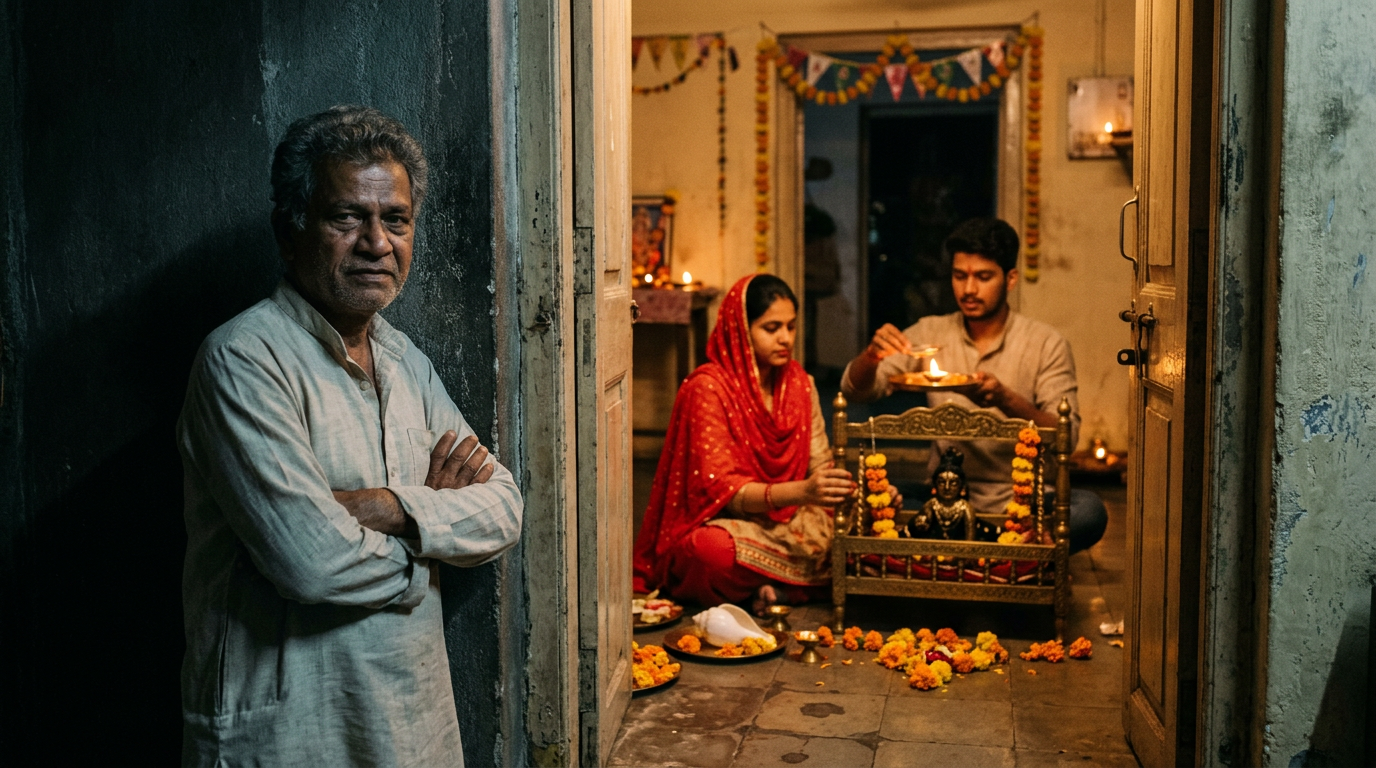
Krishna Janmashtami 2026 falls on Friday 4 September, and most of what you read about it this week will cover the muhurat, the fasting rules and the recipe for makhan mishri. Very little of it will tell you what the story is actually about. Beneath the cradle and the conch sits one of the sharpest studies of fear and power in any tradition I know: a king who hears that a child will one day replace him, and spends the rest of his life making sure of it.
This article gives you the date, the story, and then the harder question the festival is quietly built around. What do you do with the people and ideas that could outgrow you?
When is Krishna Janmashtami 2026?
Krishna Janmashtami 2026 is on Friday, 4 September. It falls on the Ashtami, the eighth night of the waning fortnight of Bhadrapada, and because tradition holds that Krishna was born at midnight, the main puja takes place in the Nishita period around midnight, so the vigil runs into the early hours of Saturday 5 September.
Some Vaishnava temples, including many ISKCON centres, give more weight to the overlap with Rohini nakshatra and may observe the festival on Saturday 5 September instead, so check your local temple calendar before you travel. Dahi Handi usually follows the day after; in Mumbai that means a Saturday of drums, ropes and boys on shoulders.
That is the practical answer. Everything below is why I think the date matters more than the muhurat.
The story we sing, and the part we skip
Kamsa, the king of Mathura, is escorting his sister Devaki and her new husband Vasudeva home from their wedding when a voice from the sky tells him that Devaki’s eighth child will kill him. He draws his sword on his sister there and then. Vasudeva buys her life with a promise: every child will be handed over. Kamsa locks the couple in a cell and, one by one, kills six newborns. The seventh is carried away by divine intervention.
Then, at midnight on the eighth night of the dark fortnight, in a prison, with rain hammering outside, the eighth child is born. The chains fall away. The guards sleep. The doors open. Vasudeva carries the infant across a swollen Yamuna to Gokul, exchanges him for the newborn daughter of Nanda and Yashoda, and is back in the cell before anyone wakes. When Kamsa comes for the child in the morning, the baby girl slips out of his grip, rises into the air and tells him that the one who will end him is already born and already beyond his reach.
We celebrate the birth. We sing to the child in the cradle. We almost never sit with the man who built the prison. Yet Kamsa is the character most of us are in danger of becoming, and the festival makes far more sense once you take him seriously.
Kamsa’s mistake is a leadership mistake
Strip away the cosmology, and Kamsa is a leader who receives bad news about his own succession and cannot metabolise it. He is told that the future has a name, and that the name is not his.
Psychology has a term for what happens next. Threat rigidity, described in a classic 1981 analysis by Staw, Sandelands and Dutton, is the tendency of people and organisations under threat to narrow their attention, fall back on familiar responses and tighten control. Kamsa does all three. He narrows his entire kingdom to one womb. He reaches for the only tool he trusts, which is force. He centralises the future into a single cell he can lock.
There is a second layer. Nathanael Fast and Serena Chen showed in a series of studies that power on its own does not make people aggressive; power combined with a private sense of inadequacy does, and the aggression is driven by ego threat. When participants’ sense of worth was restored, the aggression disappeared. Read that way, Kamsa’s cruelty is not strength. It is fragility with an army. Every child he kills is an attempt to feel safe that leaves him less safe, because it deepens the very conviction he is trying to escape: that he is not enough to survive what is coming.
You will meet Kamsa in ordinary places. The founder who has run the company for twenty years and cannot bring himself to name a successor. The manager who hires people slightly less able than himself so that no one in the room is a threat. The senior professional who mentors generously right up to the one skill that would make the junior independent. The parent who wants the child to succeed, but not quite as much as they did. None of them would recognise themselves in a tyrant. All of them are running the same programme.
Harvard Business Review estimated that badly handled leadership transitions cost the S&P 1500 close to $1 trillion a year in lost market value. That figure is Kamsa’s tax, paid quietly by boards that could not bear to plan for their own replacement. In executive coaching, it is often the first thing a leader has never said aloud.
I call this the Kamsa reflex: the instinct to eliminate whatever might one day replace you, instead of raising it. It is a reflex because it operates faster than thought. The moment a subordinate’s idea is better than yours, something in the nervous system registers a threat before the mind has decided what to think. What you do in the next few seconds is your leadership.
A few questions worth sitting with before the midnight aarti:
- Who is the eighth child in your world right now, the person or idea whose growth quietly unsettles you?
- What did you do the last time someone junior to you was clearly better than you at something?
- When did you last teach a person the very skill that would let them stop needing you?
Here is the part of the story that reads like a case study. The sociologist Robert Merton described the self-fulfilling prophecy in 1948 as a false definition of a situation that provokes new behaviour, which then makes the original definition come true. In the Krishna story, the prophecy happens to be real, but look at what Kamsa’s response does with it. His fear creates the prison. The prison creates the midnight escape. The escape delivers the child to the one place Kamsa cannot reach, and the years of cruelty that follow give the grown Krishna every reason to return to Mathura. Kamsa does not merely fail to prevent the prophecy. He organises its fulfilment. In real workplaces, the prophecy is rarely divine. “She will leave and compete with us” is not a prophecy until you begin treating her as a threat. Then it becomes a plan.
A king with an army and no one who can tell him the truth is also the loneliest figure in the story, a version of what I have called the applause gap: surrounded, and unknown.
Why the birth happens in the dark half of the month
The calendar is not incidental. Krishna is born in Krishna Paksha, the waning fortnight, on the eighth night as the moon thins towards nothing, at midnight, in a prison. The word Krishna itself means dark. The tradition chose the darkest coordinates available, and I do not think that is only theology.
Richard Tedeschi and Lawrence Calhoun, who coined the term post-traumatic growth, describe positive change that arises not from a crisis itself but from the struggle with it: a deeper appreciation of life, changed priorities, a stronger sense of personal strength. The struggle is the active ingredient. Devaki does not grow because she is imprisoned; she is simply imprisoned, and six of her children die there. Nothing in this story romanticises the cell. What it insists on is narrower and more useful: darkness is not disqualifying. The most important thing in your life can begin in the year you would least have chosen for it. I wrote earlier this year about Krishna and Suffering: The Hardest Lesson in Staying Human, and this is the same lesson from the other side of the prison wall.
Vasudeva’s crossing carries the second half. In every telling, the Yamuna is in flood and does not fall until he is already waist-deep in it. He does not wait on the bank for conditions to improve. He walks in with the child, and the river responds to the walking. I have written about acting without attachment to the outcome; this is its companion, acting before the outcome has agreed to show up.
Yashoda: the other way to meet the future
The story gives us Kamsa’s opposite, and it is not Krishna. It is Yashoda.
Yashoda raises a child who is not hers, who was placed in her arms in the dark, and who, as every Braj devotee will tell you, will leave Gokul for Mathura and never come back as the boy she knew. She pours herself into a future she does not own. She teaches him to walk knowing he will walk away. Where Kamsa meets the eighth child with a sword, Yashoda meets him with butter and a length of rope, and the rope, famously, is always two fingers too short.
That is the leadership posture the festival is really recommending. Not the absence of fear; Yashoda worries constantly. The willingness to raise what will outgrow you anyway. In practice it looks like sponsorship rather than supervision, like teaching the last skill rather than the first three, like putting a junior’s name in a room where yours would have been safer. It is the professional form of what I have argued about love, that its truest version is detachment: holding without gripping.
Kamsa and Yashoda held the same child. One saw a threat to be removed; the other saw a future to be raised. Every leader eventually meets their eighth child. Janmashtami asks which of the two you are.
How to keep Krishna Janmashtami 2026 as a leader
Fast if you fast. Sing if you sing. I made a similar argument about Raksha Bandhan: the festival is the container, and the psychology is what you choose to put in it. Three things no panchang will list:
Name your eighth child. Before the midnight puja, write down the one person or idea whose growth makes you uneasy. Naming it converts a reflex into a decision.
Do one Yashoda act before Saturday. Teach the thing you have been keeping. Make the introduction you have been postponing. Put forward the name that is not yours.
Watch the Dahi Handi differently. The boy who breaks the pot gets the cheer. The pyramid is held by people whose knees and shoulders nobody photographs. Leaders who last know exactly whose shoulders they are standing on, and say so.
The prison that became a birthplace
The prophecy did not kill Kamsa. His response to it did. He built a prison to stop the future, and the prison became its birthplace. That is the sentence I want you to carry past 4 September, because the future you fear arrives regardless. The only real decision available to you is whether it arrives as your enemy or as your heir.
If some part of this landed uncomfortably, the discomfort is the useful part. Bring the name you wrote down to a free 15-minute consultation, and we will look at what the reflex has been costing you.


