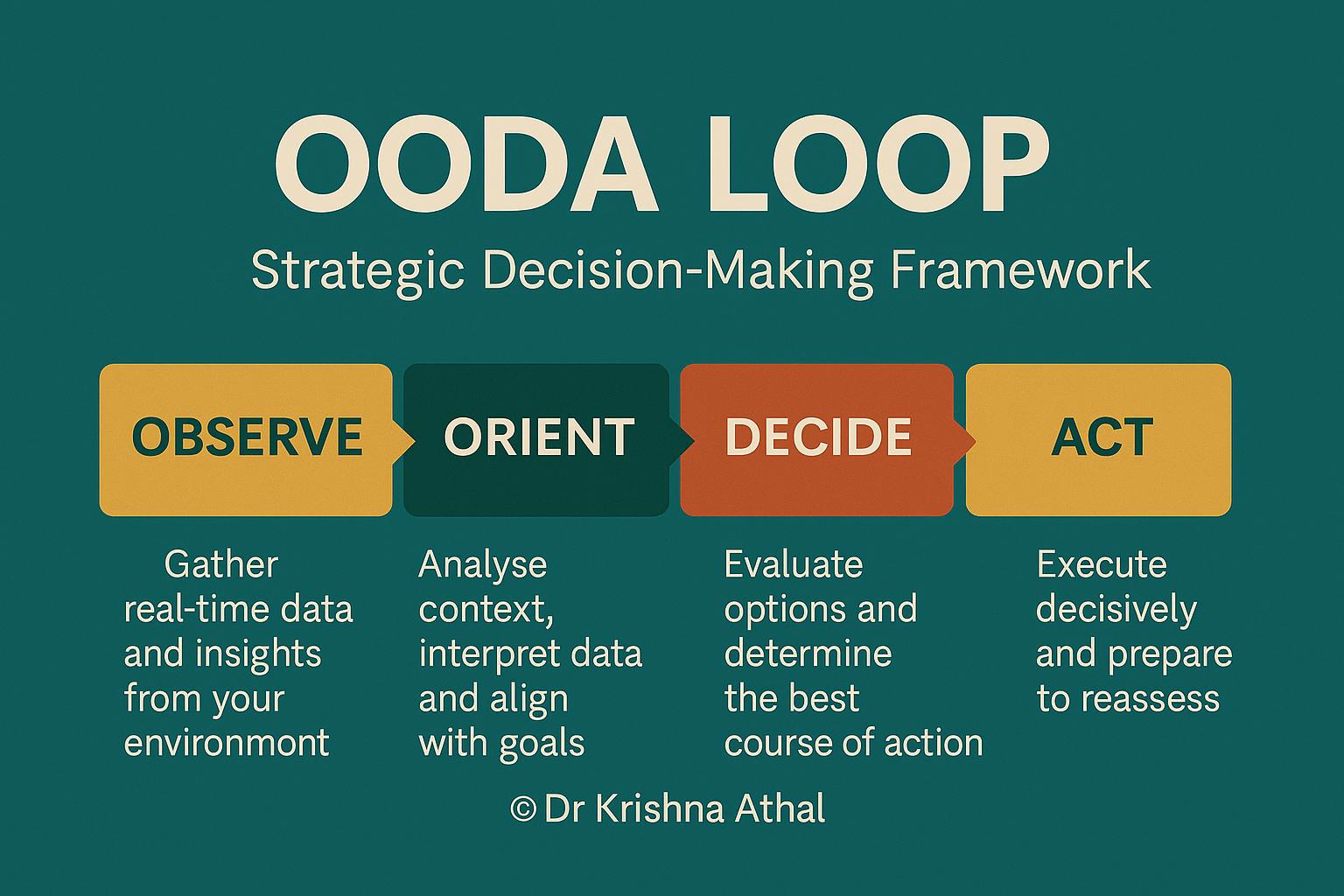
Ever feel like the world is moving faster than your ability to respond to it? That is precisely the problem the OODA Loop was built to solve. Developed by U.S. Air Force Colonel John Boyd, a fighter pilot whose ideas reshaped modern strategy, the OODA Loop is a decision-making cycle designed for environments where conditions change before your plans do. It stands for Observe, Orient, Decide, Act. And while it was born in aerial combat, it has become one of the most useful thinking tools in business, leadership, and everyday life.
At its core, the OODA Loop is not a checklist you complete once. It is a repeating cycle: every action you take produces new information, which restarts the loop. Think of it as a mental compass for navigating uncertainty, one that rewards awareness and speed over rigid planning.
The Four Phases of the OODA Loop
Observe
Before you act, you must see clearly. In this phase, you gather raw information from every available source: the environment, other people, competitors, market signals, and, crucially, your own internal state. A racing heart and a tight jaw are data too.
Ask yourself:
- What is actually happening around me, as opposed to what I expect to happen?
- What are others doing, and what has changed since I last looked?
- What am I feeling, and is it sharpening my attention or distorting it?
If you miss key information here, everything downstream suffers. Observation is not passive looking; it is disciplined attention.
Orient
This is the heart of the loop, and the phase Boyd himself considered most important. Orientation is how you interpret what you have observed. Every piece of information passes through a filter shaped by:
- Your culture and upbringing
- Your past experiences
- Your beliefs, assumptions, and biases
- Your mental models and analytical tools
Two people can observe the same situation and reach opposite conclusions, because their orientation differs. Misread the situation here and even a fast, confident decision will be confidently wrong. Strong orientation means continually updating your mental models rather than defending old ones.
Decide
Once you have made sense of the situation, choose a course of action. This does not mean deliberating for hours. The goal is clarity at speed: a good decision made in time consistently beats a perfect decision made too late. Treat every decision as a hypothesis you are about to test, not a verdict you must defend.
Act
Now move. Execute the decision and watch what happens. This is where the loop earns its name: your action generates new information, which feeds straight back into Observe. The faster and more accurately you cycle through the loop, the more adaptive you become.
Now, move. Execute your decision. Test it in the real world. And this is where the magic of the loop happens — your action generates new data, which feeds right back into the Observe phase. The faster you can cycle through the loop, the more effective you become.
The Power of Speed in Decision-Making
Boyd’s central insight was that speed beats strength. Whoever moves through their loop faster, while staying accurate, gains the advantage.
Why? Because when you operate faster than the other side’s decision cycle, they are permanently reacting to a situation that has already changed. They become confused and hesitant while you set the pace. Strategists call this “getting inside the opponent’s OODA Loop”. In business, it looks like the competitor who ships, learns, and adjusts while others are still in planning meetings.
The Psychology and Neuroscience Behind the Loop
As a coach working at the intersection of leadership, psychology, and neuroscience, I find the OODA Loop compelling because it maps closely onto how the brain actually handles pressure.
Under stress, the amygdala can hijack attention and narrow perception, which corrupts the Observe phase before thinking has even begun. Confirmation bias quietly distorts Orient, making us see what we expect rather than what is there. And decision fatigue erodes the Decide phase as the day wears on, which is why tired leaders default to either avoidance or impulsivity.
This is why the loop is as much a self-regulation practice as a strategy tool. A regulated nervous system observes more accurately. An examined mind orients more honestly. The leaders I coach who make the best high-stakes decisions are rarely the quickest thinkers in the room; they are the ones least distorted by their own internal noise.
How the OODA Loop Applies to Real Life
Military and Combat Strategy
The OODA Loop was conceived for aerial combat, where pilots have seconds to react. It has since been adopted across military doctrine, particularly in special operations, where small teams must out-think and out-cycle opponents in volatile situations.
Business and Corporate Strategy
In fast-moving markets, the companies that adapt quickest are the ones that survive. Netflix’s pivot from DVD rentals to streaming and Amazon’s endless logistics refinements are OODA cycles at scale. Organisations use the loop to monitor market shifts, pivot product lines, and innovate before competitors have finished orienting.
Personal Productivity and Everyday Life
Feeling overloaded or paralysed? Run one deliberate loop:
- Observe: What exactly is causing the stress? Name it.
- Orient: What part of this is within your control?
- Decide: Choose one priority. Just one.
- Act: Do it now, then reassess.
It is a simple way to declutter the mind and return to what matters right now.
OODA vs. Other Decision Models
OODA vs. PDCA
The PDCA (Plan-Do-Check-Act) cycle is slower and more analytical, which makes it excellent for continuous improvement in stable processes. OODA shines where conditions shift quickly and competitors are moving too.

OODA vs. SWOT Analysis
SWOT (Strengths, Weaknesses, Opportunities, Threats) is a snapshot: valuable, but static. OODA is dynamic, evolving continuously with real-time feedback.
OODA vs. DECIDE Model
DECIDE is linear: you move through it once. OODA is a loop that embraces change, chaos, and revision, which is why it suits unpredictable environments better.
Building an OODA Mindset
Thriving in uncertainty is a trainable skill:
- Train awareness: Read widely, stay current, and practise noticing patterns before they become obvious.
- Challenge your biases: Ask regularly, “What would I see here if my assumption were wrong?”
- Practise quick decisions: Small daily choices, made promptly, build the decisiveness muscle for larger ones.
- Review every loop: After acting, spend two minutes asking what the outcome taught you. Reflection is what turns speed into wisdom.
Common Pitfalls When Applying the OODA Loop
- Getting stuck in Orient: Overthinking feels like diligence but functions as delay.
- Waiting for perfect information: The window closes while you are still gathering.
- Ignoring feedback: Acting without learning simply means repeating mistakes faster.
The principle to remember: fast and flexible beats slow and flawless.
Real-World Examples of OODA in Action
Elon Musk’s Rapid Product Development
Tesla and SpaceX operate on compressed OODA cycles: build, test, learn, iterate. Rather than years of upfront planning, prototypes are treated as questions asked of reality, and each answer feeds the next loop.
Military Operations and Special Forces
From fighter pilots to special operations units, elite teams drill OODA thinking until it becomes instinct: perceiving, interpreting, and responding faster than an adversary can predict.
Conclusion
The OODA Loop is not merely a military artefact; it is a philosophy for living intelligently in a changing world. The ability to observe accurately, orient honestly, decide promptly, and act decisively compounds over time, in careers, in organisations, and in personal life.
Whether you are leading a company, navigating a crossroads, or simply managing a chaotic week, the loop keeps you responsive rather than reactive. And that difference, repeated daily, is what separates people who are shaped by events from those who shape them.
FAQs
1. What is the main benefit of the OODA Loop?
It helps you make faster, smarter decisions in changing environments by keeping perception, interpretation, and action in a continuous feedback cycle.
2. Can the OODA Loop be used in daily life?
Yes. From time management to handling stress, the loop helps you assess a situation, choose a priority, and act on it more effectively.
3. How do businesses implement the OODA Loop?
Companies use it to monitor markets in real time, pivot quickly, and outmanoeuvre competitors through shorter innovation cycles.
4. Is the OODA Loop better than traditional planning models?
In fast-moving, unpredictable environments, yes. OODA is dynamic and self-correcting, while traditional models can be rigid once conditions change.
5. Who created the OODA Loop?
U.S. Air Force Colonel John Boyd. Drawing on his experience as a fighter pilot in the Korean War, he developed the framework through his strategic research in the 1960s and 1970s, and it has since influenced military doctrine, business strategy, and beyond.


