
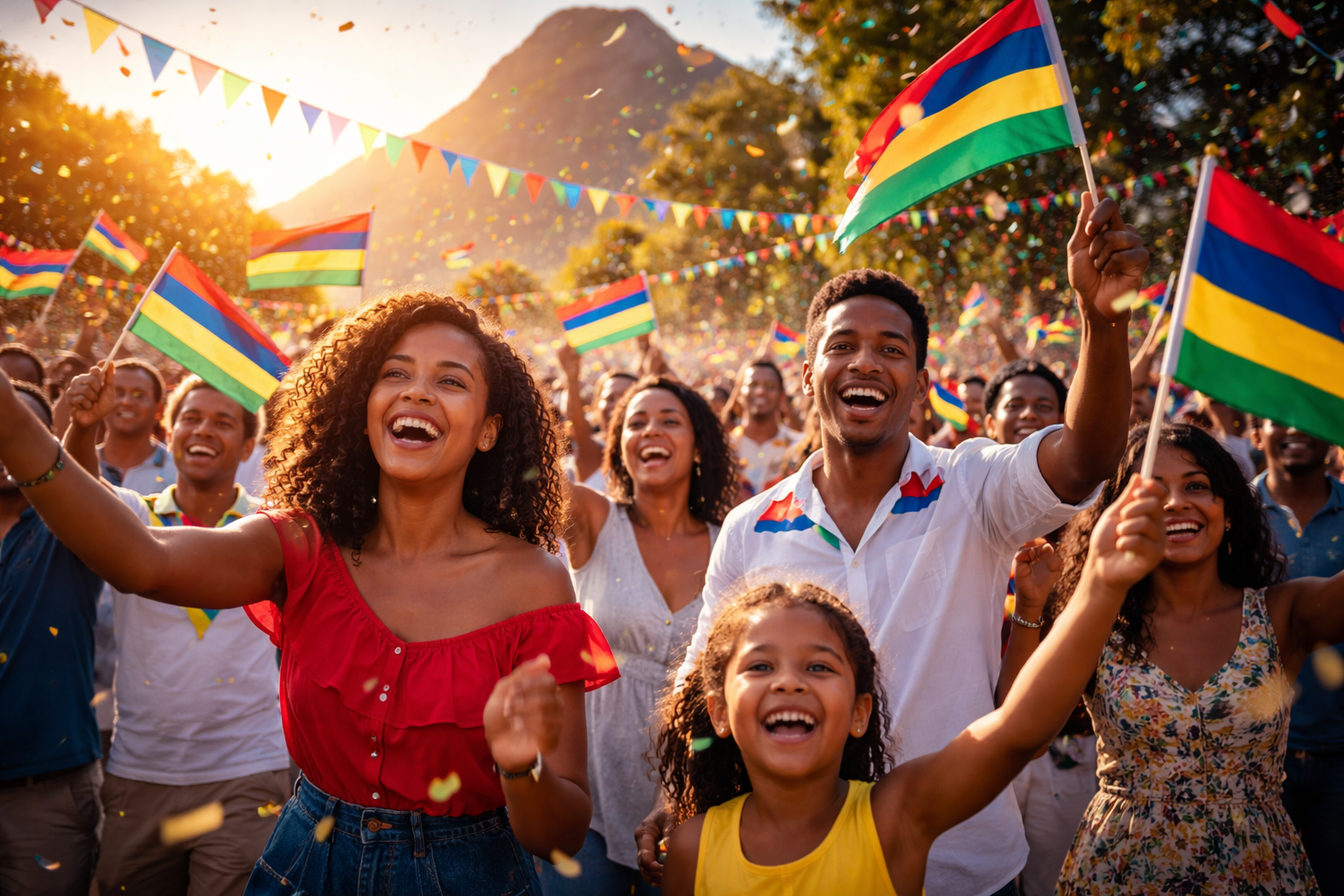
Every year, when 12 March arrives, Mauritius dresses itself in colour. Flags appear on cars, shops, homes and public buildings. Schoolchildren sing with unusual sincerity. Families gather. Speeches are made. The island remembers itself. This year, Mauritius marks 58 years of independence since 12 March 1968 and 34 years as a republic since 12 March 1992. Those are not just ceremonial numbers. They are mirrors. They ask us who we have become, and who we still pretend to be.
I find National Day quietly emotional. Not because I am easily seduced by parades and protocol, but because I know that nations, like people, carry memory in the body. A country can look functional on the outside and still be wrestling with old wounds underneath. Mauritius is no exception. We are peaceful, admired, diverse and often held up as a success story. Yet beneath that polished image live familiar tensions: class anxiety, political fatigue, identity insecurity, performative unity, and the strange habit of smiling through things we have not really healed.
That, to me, is what makes National Day worth writing about.
Freedom Is Not Just a Political Event
Political independence matters. Republic status matters. These milestones shaped our legal, constitutional and national identity. But if I am honest, what interests me even more is psychological independence.
A person can move out of their parents’ home and still live emotionally imprisoned by their voice. A nation can do something similar. It can become formally free, yet still think in borrowed categories, still seek validation from outside, still measure worth by imported standards, still fear its own depth.
I see this in everyday Mauritian life. We are quick to praise foreign accents, foreign brands, foreign experts, foreign approval. We often trust what comes from elsewhere before we trust what is born here. It is a subtle colonial hangover, dressed in modern clothes. Not dramatic enough to make headlines, but powerful enough to shape self-esteem.
National Day is a good time to ask a mildly uncomfortable question: have we only won sovereignty on paper, or have we also developed sovereignty of mind?
A Small Island With a Large Inner World
Mauritius is often described through postcards. Beaches, lagoons, hospitality, multicultural harmony. Lovely, yes. Incomplete, also yes.
This island is not just scenery. It is a psychological ecosystem. It holds African roots, Indian memory, European influence, Chinese heritage, Creole resilience, religious plurality, linguistic code-switching and generations of adaptation. We are not simple. We are layered.
That complexity is our strength, but it also demands maturity. Diversity is beautiful in festival brochures. It becomes harder when it asks us to confront prejudice at the dinner table, tokenism in institutions, and quiet segregation in social life. We like to say we live together. Do we truly know one another? Or do we simply coexist politely, each group carrying its own myths, fears and inherited pride?
A nation is not united because it says it is. It is united when dignity is shared, when difference is not merely tolerated but genuinely respected, and when people do not need to shrink parts of themselves to belong.
The Nation as a Family System
As a coach, I often think of a country as a giant family system. Every family has stories it tells with confidence and stories it avoids with skill. Nations do the same.
Some families pride themselves on being close, while everyone silently walks on eggshells. Some nations praise unity while carrying unresolved mistrust. Some families avoid conflict so thoroughly that truth itself becomes awkward. Mauritius occasionally has that flavour. We prefer surface calm. We do not always enjoy difficult honesty.
Yet real growth begins precisely there.
A psychologically healthy family does not deny tension. It develops the capacity to hold tension without collapsing. A psychologically healthy country does the same. It can talk about inequality without becoming cynical. It can discuss corruption without giving up on morality. It can examine communal wounds without turning them into weapons.
National Day should not only flatter our ego. It should strengthen our conscience.
Patriotism Without Performance
I remember seeing children wave the Mauritian flag with complete innocence. No ideology. No strategy. Just delight. There is something pure in that. Children often love before adults complicate things.
As we grow older, patriotism can become theatre. We post slogans, attend functions, sing loudly for a day, then return to everyday indifference. We praise Mauritius while littering it, exploiting it, gossiping it to death, underpaying its workers, dismissing its youth, and treating public space as if it belongs to nobody.
That is not patriotism. That is branding.
Love of country is behavioural. It is in how we drive, how we vote, how we speak to staff, how we raise children, how we treat women, how we handle disagreement, how we protect truth when lying would be more convenient. A flag means little if character is absent.
Harsh? Slightly. Necessary? Absolutely.
What Are We Teaching the Next Generation?
This question matters more than any official speech.
What do young Mauritians inherit from us besides ambition and anxiety? Are we giving them a country they can believe in, or merely a place they must escape from cleverly? Do they feel invited into nation-building, or only instructed to survive the system?
Many young people today are bright, globally exposed and emotionally burdened. They carry pressure to perform, fear of instability, confusion about identity and deep scepticism about leadership. They are told to dream big, but often watch adults model small-heartedness. They are told to be proud of Mauritius, but they notice hypocrisy faster than previous generations ever could.
So perhaps National Day should be less about nostalgia and more about mentorship. Less about commemorating what our forebears achieved, and more about asking whether we are worthy ancestors.
That question has weight.
Healing the Inner Republic
Republic status, in a symbolic sense, is about self-governance. That principle applies inwardly too. Can we govern ourselves well? Can we regulate anger, greed, prejudice and entitlement? Can we choose responsibility over blame?
A nation made of dysregulated individuals cannot build a regulated future.
This is where psychology meets citizenship. Emotional resilience is not just personal wellness jargon. It has public consequences. A society full of reactive, resentful, unexamined people becomes easy to manipulate. A society of reflective, grounded, emotionally literate citizens becomes harder to divide.
So yes, celebrate the fireworks, the anthem, the ceremony, the colour and the memory. But also celebrate the quieter work. The person who becomes less communal in their thinking. The leader who chooses integrity when nobody is watching. The parent who raises a child without passing on inherited bitterness. The young adult who decides not to mock this country, but to help build it.
That too is National Day.
The Real Celebration
For me, Mauritius is at its most beautiful not when it performs perfection, but when it remembers its soul. We are a country of improbable coexistence, enduring tenderness and stubborn reinvention. We have flaws, certainly. Some are old. Some are fresh. Some we dress up very elegantly. But I still believe this island has moral and emotional potential far beyond its size.
On 12 March 2026, as we honour 58 years of independence and 34 years as a republic, I do not only want us to celebrate the Mauritius that exists. I want us to become braver about the Mauritius that is still possible.
A more honest Mauritius.
A less performative Mauritius.
A fairer Mauritius.
A more emotionally mature Mauritius.
That would be a national achievement worth saluting.
Because in the end, freedom is not only the absence of foreign rule. Freedom is the presence of inner responsibility. And a republic is not only a political structure. It is a daily discipline of shared dignity.
That is the Mauritius I want to keep believing in.


Leave a Reply