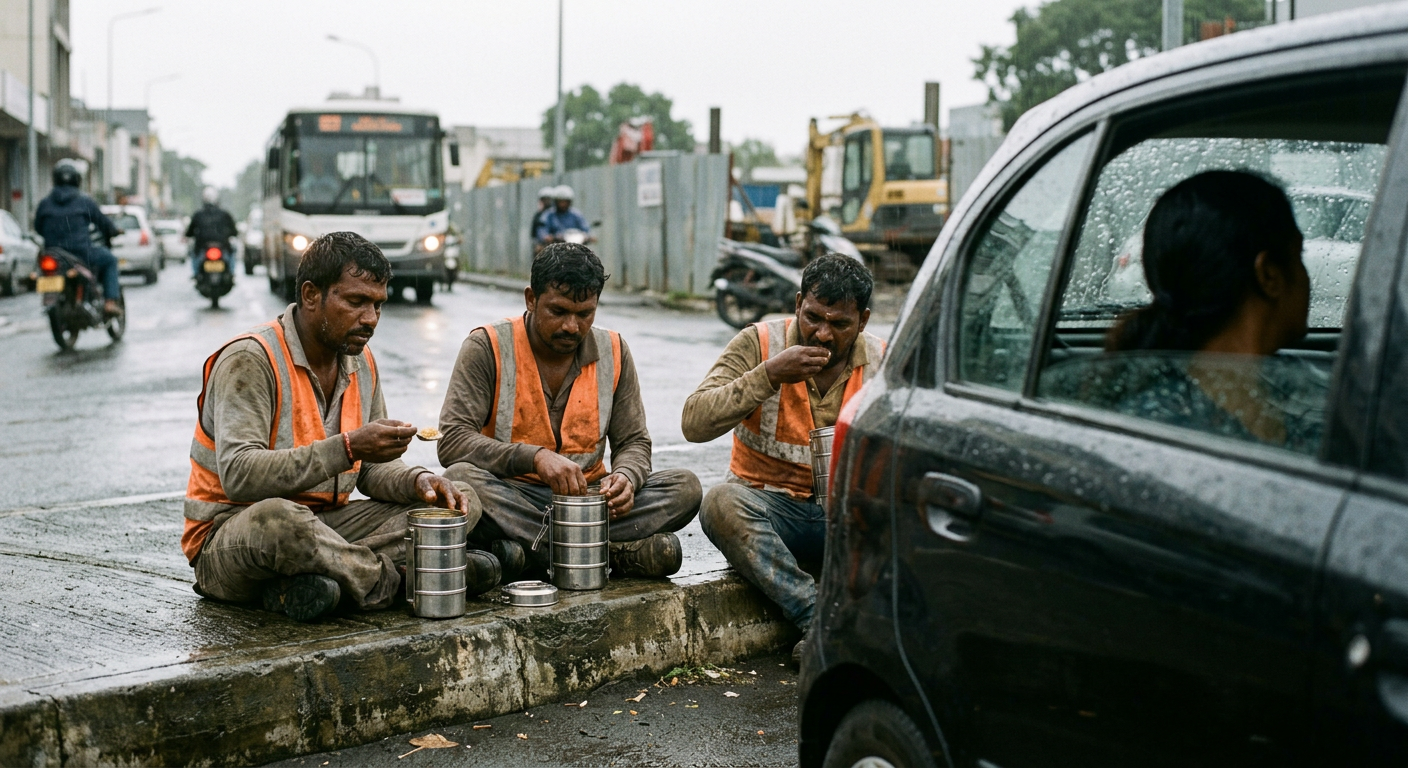
Last week, stuck in traffic near a construction site in Port Louis, I watched a group of workers eat lunch on the pavement in the rain while the rest of us complained about the weather from inside our cars. Nobody looked at them. That non-look is what this article is about.
Nearly 48,500 migrant workers in Mauritius stitch our garments, pour our concrete and process our seafood, yet most of us could not name a single one of them. They are the most visible invisible people on the island. We wear their stitching, live in buildings their hands raised, and then debate over dinner whether they belong here. This article lays out the facts, the history and the psychology of migrant workers in Mauritius: why they come, how they arrive, when this began, and what their presence reveals about us. Because the uncomfortable truth is that the question was never really about them.
How many migrant workers are in Mauritius, and where do they work?
Start with the numbers, because numbers discipline opinion. Approximately 48,450 foreign migrant workers, primarily from Bangladesh, India, Madagascar, Sri Lanka and Nepal, are employed in the garment, textile, manufacturing and construction industries, according to the US State Department’s 2025 report on Mauritius. A recent inter-ministerial committee counted around 45,300 foreign nationals holding work permits or exemption certificates, and concluded that foreign labour is not a threat to Mauritian workers but an essential catalyst for economic growth, as covered in this local report. The dependence runs deep: temporary foreign workers represent roughly 40% of the total workforce of export-oriented enterprises and just over half of the clothing and textile industry. Most arrive on three-year contracts. In plain language: remove these men and women tomorrow, and entire sectors of the economy stop breathing by Friday.
When did this begin? A history that rhymes
Mauritius knows this story intimately, because we have lived it from the other side. Every 2 November, the nation commemorates the arrival of the first indentured labourers at Aapravasi Ghat, people shipped across an ocean on contracts they barely understood. Then history rhymed. As demand for factory workers in the flourishing export processing zones increased in the 1980s, Mauritian employers began recruiting labour migrants from South Asian countries, and employers soon realised that foreign labour was more flexible and ready to accept poor conditions and overtime. By 2014, more than 38,000 workers, mainly from Bangladesh and China, were employed on the island. Researchers writing in The Conversation have drawn explicit parallels between colonial indenture and the modern contracting of migrant workers. The grandchildren of the indentured now sign the permits.
Why Mauritius cannot do without them
The reason is arithmetic, not sentiment. The working-age population of Mauritius is expected to shrink by 11.7% by 2038, over 182,000 Mauritians already live abroad, and more than 3,500 emigrate every year, according to this workforce analysis. Meanwhile, local workers have understandably turned away from low-paid, high-strain jobs in textiles and construction. A country that exports its own young people must import someone else’s. Migrant workers in Mauritius are not taking jobs; they are filling a demographic hole we dug ourselves.
How they arrive, and what the law now says
The journey typically begins with a recruitment agent in Dhaka, Chennai or Antananarivo. It has often begun with debt. The law has finally started catching up: the 2024 Private Recruitment Agencies Act banned all worker-paid recruitment fees, with penalties of up to five years’ imprisonment and fines of Rs 500,000 to one million. Accountability is arriving from buyers too: in February 2025, three international brands reimbursed nearly $390,000 in recruitment fees to migrant workers at a single garment factory, following an investigative report that documented indicators of forced labour. There is now a proposal for a Migrant Welfare Fund, with employers contributing Rs 500 annually per worker to cover subsistence and legal costs during disputes. Progress, yes. Sufficient, no.
What their lives look like, and what we do with our eyes
Consider a composite of many real accounts; call him Rafiq. He is 27, from Sylhet, sends 80% of his salary home, shares a dormitory room with seven men, and has seen his daughter twice in four years. He is one of the men who, in my language, have quietly stopped expecting anything for themselves. In neuroscience terms, he lives with chronic allostatic load, the cumulative wear on body and brain when stress never fully switches off. Separation, debt and precarity keep his nervous system in permanent low-grade alarm.
And what do we do? Half of Mauritians consider the economic impact of immigrant workers fairly bad or very bad, and nearly half say they would dislike having them as neighbours, according to a recent Afrobarometer survey. Read those two facts together: an economy that calls them essential, a society that would rather not live beside them. Psychology has names for this. In-group bias is the brain’s habit of extending warmth to “us” and suspicion to “them”. Moral disengagement is the mental trick that lets decent people benefit from someone’s labour while looking away from their conditions. Neither makes us evil. Both make us stop generalising only when we choose to.
I call this whole arrangement human scaffolding: treating people as essential to the structure but absent from the photograph. Scaffolding holds the building up during its most fragile phase, then gets dismantled and forgotten. That is precisely how we treat migrant workers in Mauritius, and human scaffolding is a contradiction the island cannot carry forever.
Sit with three questions for a moment. When did you last make eye contact with a migrant worker? If your daughter worked abroad under these conditions, what would you want her employer’s neighbours to feel towards her? And what does it cost you, personally, to keep not seeing?
A country cannot keep borrowing hands while refusing the humans attached to them. What holds a nation up deserves to appear in the photograph. Human scaffolding is not a labour policy. It is a mirror.
The freedom we owe them, and ourselves
Mauritius was built by people who arrived on boats with contracts and hope. Our national story is, at its core, a migrant story. So the treatment of today’s 48,000 is not a side issue of labour economics; it is a test of our emotional sovereignty as a nation, our ability to author our values rather than inherit our prejudices. The laws are improving. The eyes must follow.
If this stirred something in you, here is one small door: this week, learn the name of one migrant worker you regularly pass. Not to rescue. Simply to see. Everything humane begins there.


