
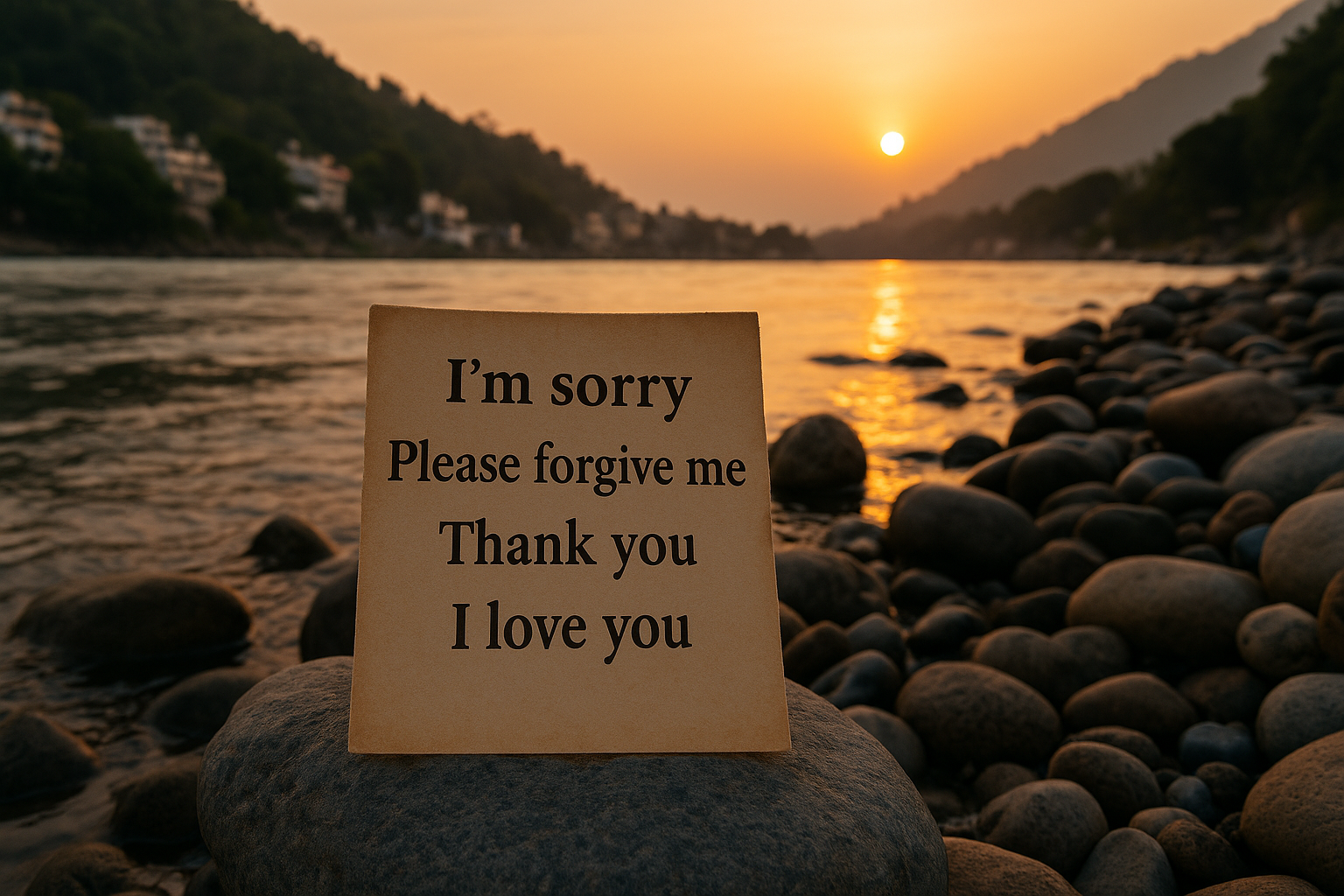
I am sitting by the Ganges in Rishikesh on this cold Sunday evening. The air has that clean bite that makes you pull your shawl tighter and your thoughts closer. The river keeps moving, unbothered by our inner storms.
And yet, the storms come anyway. They arrive as relationships we cannot stop replaying, careers that did not turn out the way we were promised, families that love us and still wound us, and memories that show up uninvited.
Tonight, I am reminded of a Hawaiian self-healing practice called the Ho’oponopono technique. I am dedicating this article to anyone struggling to let go. Not the motivational, “just move on” version. The real letting go, where your body still reacts, your mind still argues, and your heart still bargains. May you find solace. May you make peace. May you release what is not in your hands.
Why Letting Go Feels Hard in a World That Rewards Clinging
If letting go is so good for us, why do so many of us stay attached to pain?
Because modern life rewards obsession. We get applauded for overthinking, for proving loyalty through suffering, for staying “available” even when it costs our sanity. We are taught that closure must be received from the very person who caused the injury, as if our nervous system needs someone else’s permission to calm down. A healed person is harder to manipulate, harder to market to, and far less willing to settle.
Letting go is not laziness. It is maturity. It is the decision to stop bleeding on the altar of a story that refuses to become kinder.
Ho’oponopono, in Plain Language
Ho’oponopono is often described as a practice of taking 100% responsibility for your reality and cleansing inner patterns that keep you stuck. That phrase, “100% responsibility”, can sound like blame disguised as spirituality. If you have been mistreated, it can feel insulting. So let me draw a clear line.
Taking responsibility in the Ho’oponopono technique is not saying, “It was my fault.” It is saying, “My healing is my work.” It is choosing to clean the inner residue, even when the outer world refuses to apologise. It is agency, not self-punishment.
The practice rests on a simple mantra, repeated slowly and sincerely:
I’m sorry.
Please forgive me.
Thank you.
I love you.
You can direct these words to your inner self, to the memory you keep revisiting, to a person, or to life itself. The point is cleansing, not performance.
The Psychology Inside the Four Phrases
When I first heard the mantra, I had a slightly cynical reaction. Four lines? We, humans, write entire epics about our pain, and now we are offered four sentences like a spiritual shortcut.
Then I used it on a day when my mind felt like a courtroom, endlessly prosecuting the past. Something softened. Not dramatically. More like the first thaw after winter, quiet but undeniable.
“I’m sorry” acknowledges that something in you is carrying a burden. It interrupts denial and invites honesty.
“Please forgive me” invites release. Not because you are necessarily guilty, but because you are human. You have coped imperfectly. Forgiveness becomes a permission slip to stop re-living the same moment.
“Thank you” shifts the body out of threat-mode. Gratitude does not erase pain. It simply stops pain from becoming the only lens.
“I love you” restores connection. Many of us do not suffer only because of what happened. We suffer because we abandoned ourselves afterwards. Love is the return.
An Anecdote: When I Could Not Stop Replaying One Conversation
A while ago, I found myself obsessively replaying a conversation with someone I cared about. The words were not outright cruel, yet they carried a sharpness that stayed under the skin. I kept rehearsing my “perfect reply”, as if I could travel back in time and win the argument.
Then I noticed the absolute truth. I was not trying to change them. I was trying to change my own sensation of being small.
This evening, I used the Ho’oponopono technique, speaking the four phrases toward the tight feeling in my chest, not toward the person. After a few minutes, the urge to rehearse reduced. The situation did not magically improve, but I was no longer trapped inside it. That was the beginning of letting go.
Letting go does not mean you keep the same access open to the same harm. It is not a spiritual bypass that turns you into a polite doormat. You can practise the Ho’oponopono technique and still set boundaries, forgive and still say no, love and still choose distance. The practice cleans what is inside you, so that your boundaries come from clarity rather than rage.
A Simple Ho’oponopono Practice for Letting Go
Choose one situation you keep carrying. Not all of them. Just one.
Sit somewhere quiet. Place a hand on your heart or belly. Breathe as if you are reassuring a child. Then repeat the four phrases for 3-5 minutes:
I’m sorry.
Please forgive me.
Thank you.
I love you.
If your mind interrupts with cynicism, let it. Keep cleaning anyway. If tears come, let them. Tears are often the body’s honest confession that it is tired of holding.
Afterwards, ask yourself: What am I ready to stop carrying today?
Then take one small action that honours your answer. The small action matters because your nervous system believes behaviour more than it believes motivation.
When Pain Feels Too Big for Four Lines
Sometimes it is. Sometimes what you are carrying is grief, trauma, or a long history of neglect. In those cases, the Ho’oponopono technique is not a replacement for therapy, community, or safety. It is a companion.
If you notice panic, numbness, or shutdown, slow down. Anchor in your breath and your body. Reach out for support. Healing is not a solo sport, even if society keeps selling independence as the highest virtue.
The Real Letting Go: Releasing the Need to Control the Uncontrollable
Sitting by the Ganges, I watch the river accept everything and keep moving. It does not negotiate with the stone. It does not argue with the debris. It simply flows, and over time, it wears down what is sharp.
We are control addicts in a world that changes without consulting us. We want guarantees, refunds, and certainty. Life rarely offers those. It offers moments, lessons, and the choice of how we meet them.
Ho’oponopono is one way to meet them with softness rather than stiffness. It is not a magic spell. It is a mirror. It shows you where you are still gripping, and it gives you a way to loosen that grip.
If you take nothing else from this Sunday evening, take this. You do not have to wait for an apology to heal. You can honour what happened and still move forward. Try the Ho’oponopono technique. Let the four lines do their quiet work. The river will keep moving. You can too.


Leave a Reply