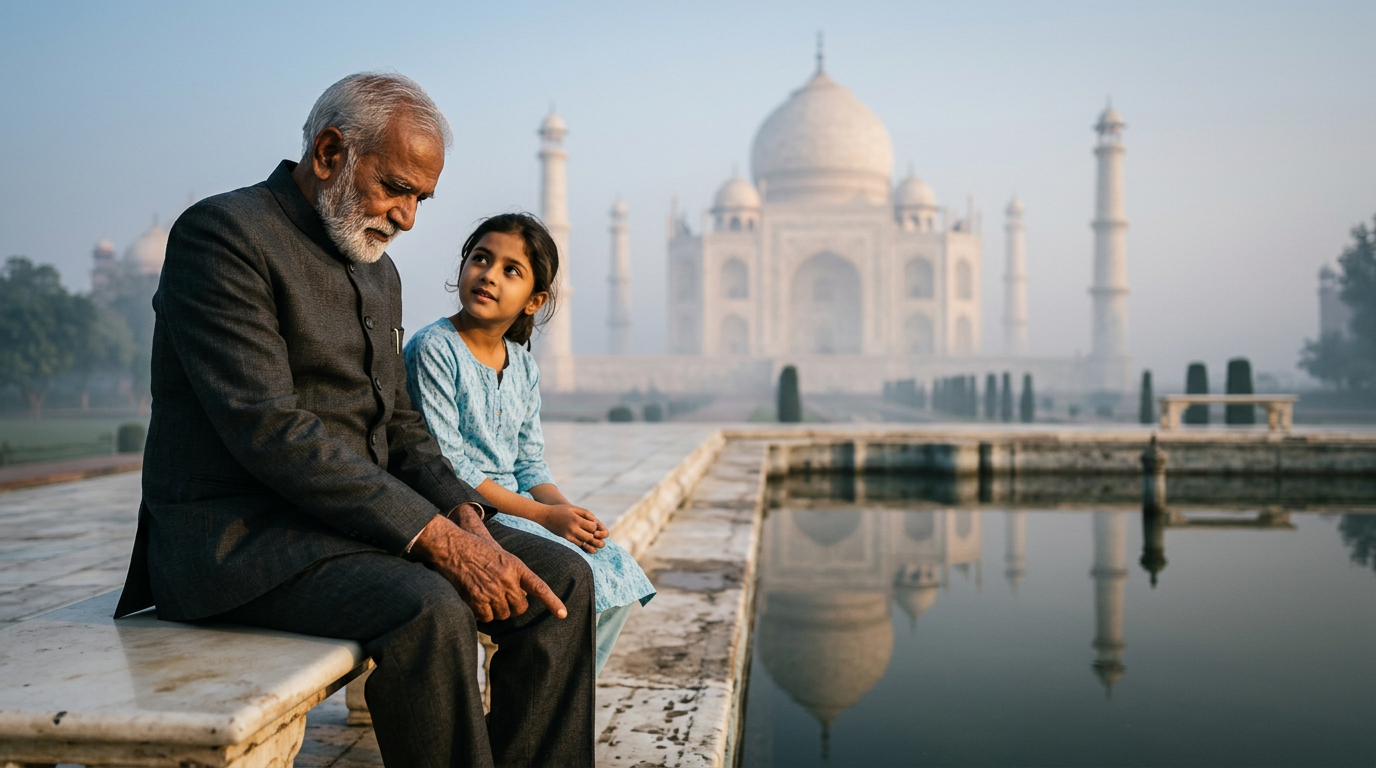
Was Taj Mahal really built by Shah Jahan? The question keeps resurfacing in reels, in family WhatsApp groups and, every few years, in a courtroom. The historical answer is not in doubt, and I give it plainly in the next paragraph. What interests me more is the second question hiding inside the first: why does a settled fact keep being reopened, and what does that habit reveal about how any of us decides what is true? Because the mind that reopens a monument’s history is the same mind that reopens a marriage, a career or a leadership decision long after the evidence has spoken.
Yes, it was. Shah Jahan commissioned the Taj Mahal in memory of his wife Mumtaz Mahal, who died in 1631 while giving birth to their fourteenth child. Construction of the mausoleum ran from 1632 to 1648, and the mosque, guest house, gateway and outer courtyard were completed by 1653. This is not romance or received wisdom. It rests on the emperor’s own court chronicle, on imperial orders sent to Raja Jai Singh of Amber for marble and carts, on dated inscriptions on the building itself, on the accounts of European travellers who saw it rise, and on the archaeological record. UNESCO’s World Heritage listing states it without hedging.
In 2017 the Archaeological Survey of India told an Agra court that the Taj is a tomb, not a temple, built by Shah Jahan on land obtained in exchange from Raja Jai Singh, grandson of Raja Man Singh. The Supreme Court had already rejected a petition to declare a Hindu origin in 2000, and in May 2022 the Allahabad High Court dismissed a plea to investigate the monument’s past and open its locked chambers. The short answer, then, is settled. The longer answer is about us.
What the evidence actually says
Start with the chronicle. The Badshahnama, Shah Jahan’s official court record, describes the site chosen for the mausoleum as the late Raja Man Singh’s mansion, then owned by his grandson Raja Jai Singh, who received another grand property in exchange. That passage is often quoted by people who doubt the mainstream account, and I will come back to it, because it is the one interesting card in their hand.
Then the building. Its main architect is recorded as Ustad Ahmad Lahori, artisans were requisitioned from across the empire and from Central Asia and Iran, and the historical and Quranic inscriptions in Arabic script on the structure are part of how its chronology was fixed. The inlay technique that covers the marble, pietra dura, did not exist in the period the alternative theory assigns to the building, and the ASI has confirmed the closed basement rooms exist for structural support and hold no hidden idols. Pietra dura is simply cut semi-precious stone set into marble to form patterns; in India it is a seventeenth-century craft, not a twelfth-century one.
Then the state. In November 2015 the Union culture ministry told the Lok Sabha that there is no evidence of any temple within the grounds of the Taj Mahal, and in its 2017 affidavit the ASI called the petitioners’ contentions concocted and imagined. In July 2026 a fresh plea for a court-appointed inspection reached the Allahabad High Court, after an Agra trial court in 2019 and a revisional court in April 2026 had already refused one; the court has sought responses from the Centre and the ASI. As I write, that matter is pending. Nothing in four decades of litigation has produced a single artefact, inscription or document that places a temple on the site.
Where the doubt came from
The alternative story is not ancient. It was stirred by the writer P.N. Oak’s 1989 book, which claimed the Taj Mahal was originally a Shiva temple and Rajput palace named Tejomahalaya that Shah Jahan seized and adopted as a tomb. Later petitions have attributed the supposed temple to Raja Paramardi Dev in 1155-56 and cited features such as the lotus-petal finial on the dome as proof of Hindu origin.
Here is the fair reading of the strongest point. The land did belong to a Rajput family; nobody disputes that. But a riverside property with a mansion on it is not a marble mausoleum, and the same chronicle that mentions the exchange records the tomb being raised there. Some of the sharpest criticism has come from Hindu writers themselves, who note that Oak conceded he could not establish which ruler supposedly commissioned the building or why, and that there is no evidence it was ever called Tejo Mahalaya. The rest of the case is pattern-matching: a shape that resembles a lotus, a doorway that is bricked up, a silence in the records where one would expect a sentence. Each of these feels like evidence. None of them is.
And yet the theory has not faded. It has grown. Which brings me to the part of this subject that belongs in a coaching conversation.
Why a settled question refuses to settle
Researchers at the University of Kent find that belief in conspiracy theories is driven by three motives: understanding one’s environment, feeling safe and in control of it, and maintaining a positive image of oneself and one’s group. You can read the psychology of conspiracy theories in full; the third motive is the engine here. A story in which your ancestors built the most beautiful structure on earth and were robbed of the credit does something for you that a chronicle cannot. It hands you a wound and a glory in the same sentence.
Notice what this does not say. It does not say believers are foolish. The same researchers conclude that conspiracy believers do not simply believe anything they hear, but are drawn to theories that answer these needs, and should not be dismissed as gullible. The psychologist Ziva Kunda described the mechanism decades ago as motivated reasoning: people tend to arrive at the conclusions they want to arrive at, limited only by their ability to construct seemingly reasonable justifications for them. The believer is not lazy. He is working hard, but the work is running backwards, from verdict to evidence.
Add repetition and the loop closes. Psychologists call it the illusory truth effect: repeated statements are easier to process and feel more truthful than new ones, and the effect occurs even when people already know better. Every reel, every forwarded message, every uncle at a wedding is a repetition. Knowledge, it turns out, does not protect us. Only the decision to check does.
I have a name for the shape all of this makes. I call it the reverse trial: a belief in which the verdict is delivered first and the evidence is called afterwards, to agree with it. In a real trial the evidence decides the verdict. In a reverse trial the verdict hires the evidence and dismisses whatever refuses to testify for it. The Taj question is a public reverse trial that has been running for nearly forty years. Most of us are running private ones.
A verdict reached before the evidence is not a belief. It is a wish wearing a robe.
I was reminded of this watching Dharm, a film about a priest torn between belief and love, and about mistaking rigidity for principle. Rigidity is what a reverse trial feels like from the inside. It feels like principle.
Is wanting a better story a kind of positive thinking?
Tomorrow happens to be Positive Thinking Day, and I can already hear the objection: is it not healthy to want a proud story about your own people? It is, until the story requires the facts to cooperate. In my article on whether positive thinking actually works, I argued that it works only when it follows an honest look at what is actually happening and points towards a specific next action; remove either condition and it becomes a sedative. Optimism that needs history rewritten is not positive thinking. It is a comfort purchased by looking away, and it never quite pays for itself, which is why the believer has to keep buying it, reel after reel.
Three questions worth sitting with privately:
- When did evidence last change your mind about something you cared about? If you cannot remember, what does that suggest?
- Which of your firmest beliefs would cost you the most if it were wrong: money, status, belonging, or a version of yourself?
- If you dated the verdict and dated the evidence, which came first?
What the Taj can teach you about your own beliefs
Nobody reading this needs the Taj Mahal to have been built by anyone in particular. But almost everyone reading this is protecting at least one verdict. “He will change once the pressure is off.” “This company will value me after the restructure.” “My team loves working for me; they just don’t say so.” Each is a reverse trial, and each is defended with the same tools as Tejo Mahalaya: a detail that could mean something, a silence read as confirmation, a repetition that has come to feel like proof.
Leaders are especially exposed, because a leader who has decided the strategy is right will hear every data point as support and every dissent as disloyalty. A good deal of my executive coaching work is reopening a case the leader closed too early, in a room where doing so costs nothing. A good deal of my life coaching work is the same thing in a more personal courtroom.
Three moves help. First, date the verdict: ask yourself plainly when you decided, and whether the evidence arrived before or after. Second, name the job the belief is doing for you: what would you lose if it were false, and is that loss steering the reasoning? Third, seek the strongest case against your conclusion from someone with no stake in it. That last move is the difference between checking and hoping. It is also not the same as circling a question for weeks; a reverse trial is not overthinking, it is under-thinking with the conclusion locked.
The Taj Mahal has survived four centuries of monsoon, empire and argument. It will survive our opinions about it too. The building was never the fragile thing. The fragile thing is a person who needs the past to flatter them before they can face the present, and the strongest thing I know is a person who can hear a fact that does not flatter them and remain standing.
If there is a verdict in your own life that you suspect arrived before its evidence, a free 15-minute conversation is a low-stakes place to give it a fair hearing.


