
Every year during Navratri, I find myself not only celebrating the festival with rituals, colours, and devotion but also pausing to reflect on what Goddess Durga truly represents. Beyond the lamps, the music, and the collective joy, there lies a deeper truth: Durga is not just a goddess; she is the ultimate life coach.
Her mythology, her symbolism, and her presence offer timeless lessons that touch both the psychological and emotional landscapes of human life. As I watch devotees across the world bow before her with reverence, I wonder—what does she teach me about living, leading, and thriving?
Strength in the Face of Fear
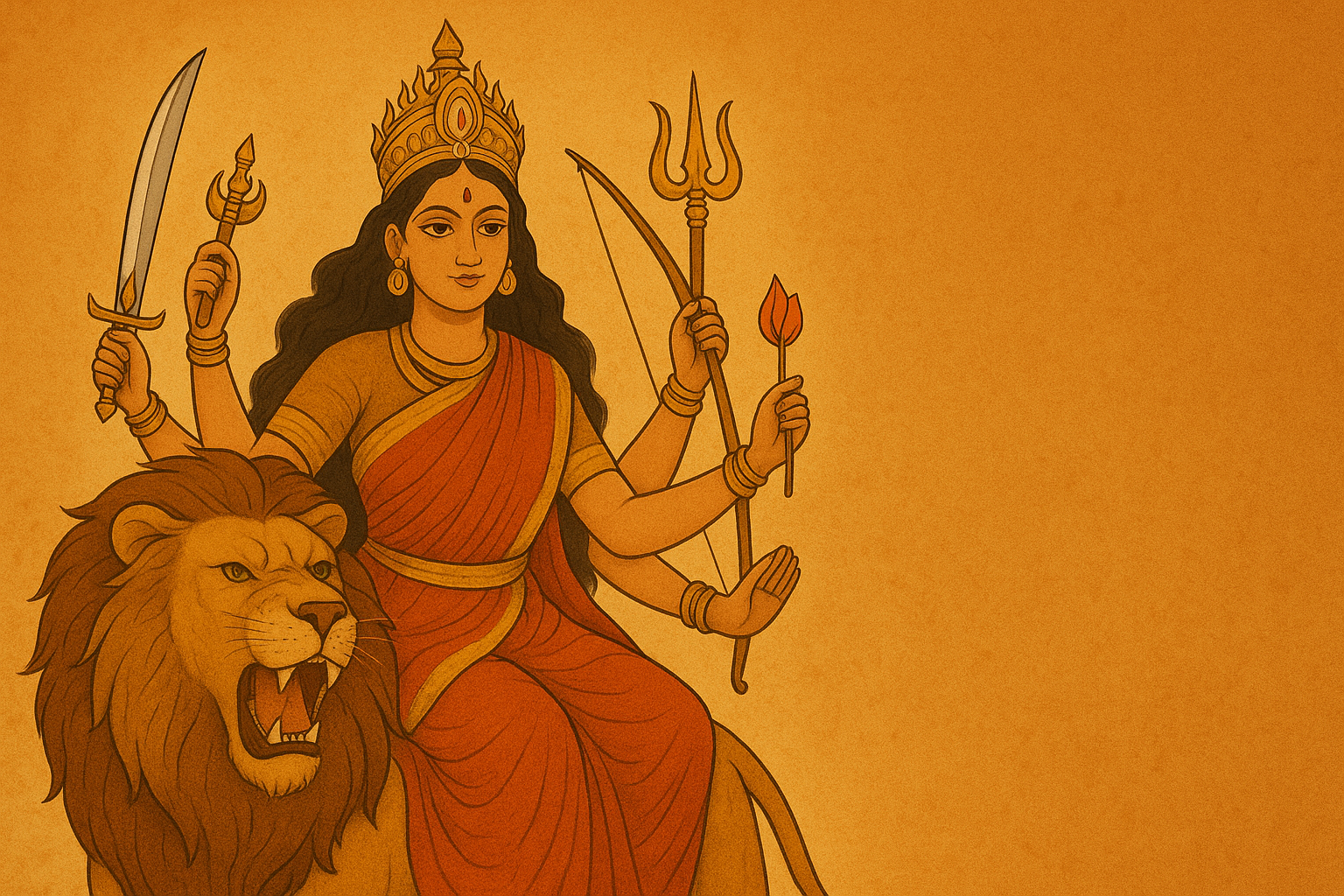
The most powerful image of Durga is her riding the lion, spear in hand, calm in the face of the demon Mahishasura. To me, this is not merely about an ancient battle. It mirrors the psychological warfare we all fight within—the battle against fear, self-doubt, and the parts of us that resist growth. As a coach, I often tell people that courage is not the absence of fear but the act of moving forward despite it. Durga shows me that strength doesn’t come from ignoring fear; it comes from befriending it, taming it like she tames her lion, and using it as energy to keep moving.
There was a time in my own life when I felt paralysed by the prospect of failure. No external pep talk could change it until I remembered Durga’s stance. She doesn’t wait for fear to vanish; she mounts it. That shift in imagery turned into a shift in action for me—choosing to lead workshops even when I wasn’t sure of the reception, choosing to write when rejection seemed inevitable. Fear became my lion; I had to ride it.
Balance Between Fierce and Compassionate
Durga is not only the fierce warrior but also the gentle mother. Psychologically, this duality is profound. We are often told to be either strong or kind, assertive or empathetic, professional or personal. Durga shows us that we can embody both, and the true art of leadership—of life itself—is in balancing these poles.
I remember once coaching a manager who thought showing empathy would make her look weak. She held back her tears even during the most moving conversations with her team. When I asked her to reflect on Durga, she realised that the goddess’ power did not lessen her tenderness, and her tenderness did not undermine her power. She began to allow herself to be both—the fierce protector of her team’s goals and the compassionate listener to their struggles. The result? Her team respected her more deeply than ever.
The Psychology of Many Arms
Why does Durga have multiple arms? To me, it is not about fantasy—it is about capacity. Each arm holds a different weapon or blessing, symbolising the many dimensions we must cultivate within ourselves. From a psychological perspective, this is the call to develop multiple intelligences, to embrace flexibility rather than one-dimensional living.
In my own journey, I have had to hold many “weapons”: the sword of discipline, the lotus of mindfulness, the bow of determination, and the conch of communication. Too often, we fall into the trap of saying, “This is who I am,” and stop growing. Durga’s image tells me that we are capable of far more than we assume. Growth demands that we stretch beyond the familiar, even if awkward at first, until we discover new capacities lying dormant.
Durga as the Mirror of the Inner Feminine
Navratri celebrates Shakti—the divine feminine. Yet, this energy is not restricted to women; it lives in all of us. For men especially, Durga becomes a reminder that wholeness requires embracing the feminine within: intuition, care, creativity, vulnerability. I think of the times I ignored my intuition because I thought logic was superior, only to realise later that my instincts were right all along. Durga whispers to me: listen inward, not only outward.
The psychological insight here is clear—balance between masculine and feminine energies leads to greater integration. Durga becomes a mirror to parts of myself I once neglected, teaching me that real power is not domination but integration.
The Slaying of Mahishasura: A Lesson in Self-Sabotage
The demon Mahishasura is not just a mythological enemy. He is the voice inside me that says, “You are not enough,” “Stay where you are,” “Why bother?” Every time I procrastinate, every time I shrink back from my own potential, I meet him again.
Durga’s battle is long and fierce, showing me that the process of overcoming self-sabotage is not immediate. It requires persistence. In therapy, psychology often speaks of “shadow work”—acknowledging the darker parts of ourselves instead of denying them. Durga does not turn away from Mahishasura; she confronts him until he transforms. Her fight tells me that growth is not linear and that inner demons don’t vanish at the first strike. It takes resilience, patience, and unwavering self-belief.
Durga’s Smile in the Midst of War
What moves me the most is that even in her most ferocious form, Durga is often depicted smiling. To me, this smile is the secret ingredient of her coaching. Life will test us. Work will stretch us. Relationships will break us open. Yet, if I can still smile—not in denial, but in faith—I have already shifted from victim to victor. Psychologically, this smile is resilience embodied. It’s a sign of inner alignment, of finding meaning even in chaos.
I recall a season when multiple projects were collapsing around me. The natural instinct was panic. But then I remembered Durga’s smile. I practised it, even when my body resisted. Oddly enough, my nervous system calmed, my clarity returned, and solutions emerged. Sometimes, a smile is not superficial—it is survival.
Durga as a Personal Life Coach
When I put all these threads together—her courage, her balance, her multi-armed wisdom, her embrace of the feminine, her persistence, her smile—I realise that Durga is the life coach I return to again and again. She doesn’t give me shortcuts. She doesn’t promise me that life will be easy. She shows me that life can be meaningful if I choose to meet it with strength, compassion, and resilience.
Navratri, then, is not only a cultural celebration. It becomes a psychological reminder. Each day I light a lamp, I ask myself: which weapon of Durga do I need to pick up today? Which inner demon am I ready to face? Which forgotten part of me needs nurturing? That is how she continues to coach me—not from outside, but from the depths of my own psyche.
In celebrating Durga this Navratri, I do not only worship her; I also allow her to hold a mirror up to me. She reminds me that I, too, carry the lion and the smile, the sword and the lotus, the battle and the peace. And in that realisation, I find myself coached, inspired, and quietly transformed.


Leave a Reply