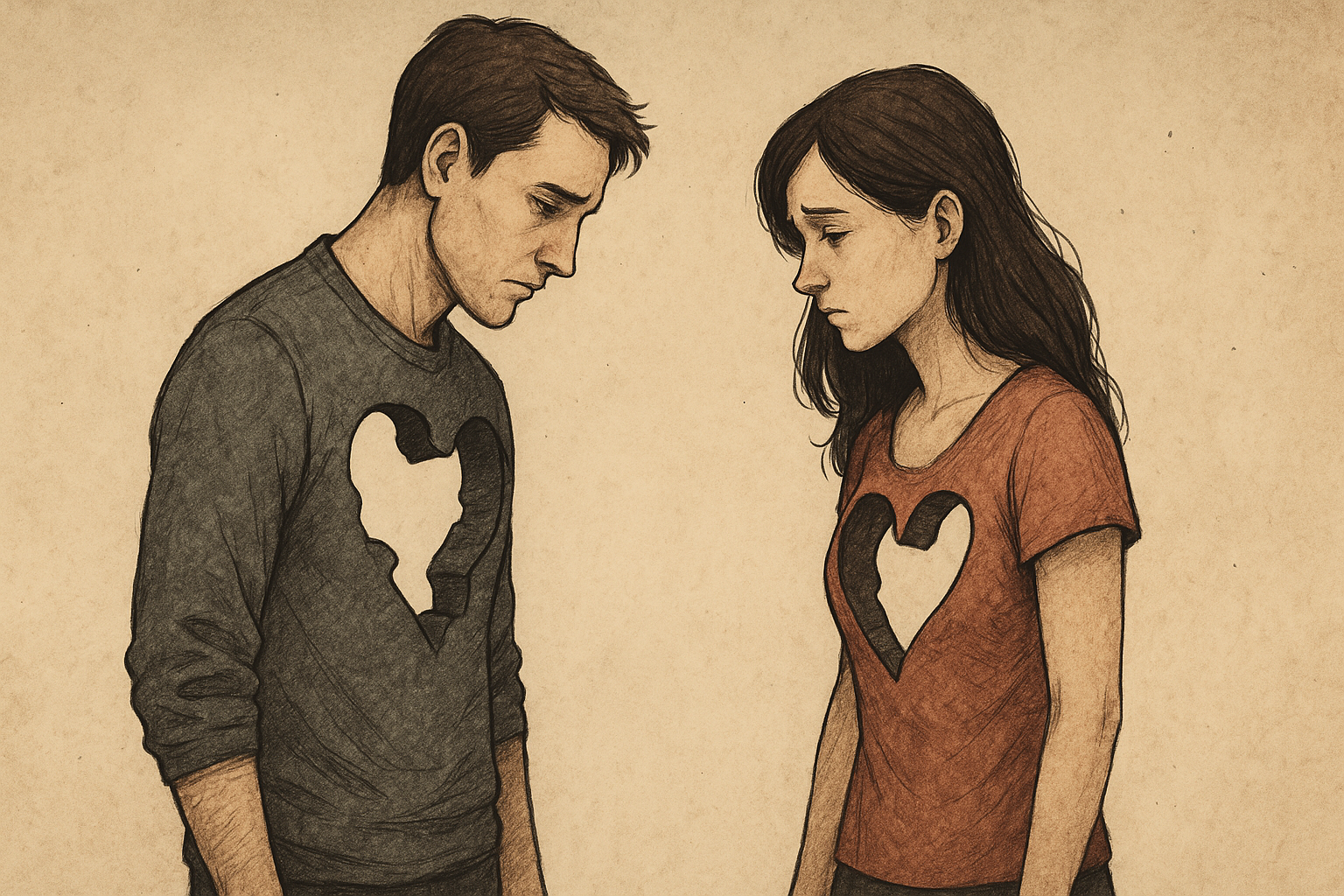
It feels as if everyone is keeping their suitcase half-packed these days. People enter relationships carrying exit strategies in their back pockets. They don’t move in with their whole heart; they rent a room with flexible terms. Somewhere along the way, commitment stopped meaning “I’m here” and started meaning “I’m here, until I’m not.”
I’ve watched it in friends, clients, even in myself. A message left unanswered for hours, a date cut short because “something came up,” a love declared in muted tones as if afraid of its own echo. It is as if modern intimacy has adopted the same safety net thinking as cloud storage: keep a backup, just in case.
But why are we doing this? Why is it that the past, like a stern headmaster, dictates the present so harshly? Why do scars from what once was have such authority over what could be?
The Psychology of Holding Back
Psychologists have long written about loss aversion. We are wired to fear losing more than we are wired to delight in gaining. In love, that wiring turns cruel. A heart bruised once whispers, “Don’t open too widely again, it will hurt worse the next time.” So we ration ourselves: a half smile, a half promise, a half love.
Yet rationing does not prevent pain; it only ensures a different kind of loneliness. The loneliness of sitting beside someone who is physically there but emotionally absent. It’s the equivalent of hugging someone’s outline instead of their body.
I remember sitting across from someone years ago who told me, “I like you… but I need to protect myself.” It sounded reasonable at the time. But in practice, what it meant was they could never really meet me where I was. I wasn’t dating a person, I was dating their defence mechanism.
The Baggage of the Past
It is easy to blame the past. Our failed loves turn into courtroom judges, pronouncing verdicts on anyone new who walks into our lives. We hold the current partner accountable for the crimes of the last.
But the past is not a god. It has no authority unless we grant it. That heartbreak you survived two years ago is not a law you must obey forever. It’s a memory. Memories should guide, not imprison. Yet so many of us build our present on ruins, forgetting we can also build on open ground.
Society’s Complicity
Society, of course, plays its part in this cautious half-loving. We’ve been taught that vulnerability equals weakness. We scroll through timelines of curated perfection and learn to present our own hearts as polished brands. When you’re used to measuring life in likes, risking rejection feels catastrophic.
And then there is the cult of independence. We glorify self-sufficiency to the point where dependence feels shameful. “Don’t need anyone,” they say, as if needing connection were some sort of disease. But relationships aren’t about weakness or dependence. They’re about interdependence. About choosing to let someone matter enough to unsettle your balance.
The Cost of Half-Love
Here’s the irony: in trying so hard not to get hurt, we guarantee a quieter kind of pain. The pain of never knowing what it means to be fully seen, fully chosen. Half-love always feels safer, until the day you realise you’ve built your life with placeholders.
I once coached a man who confessed he never unpacked emotionally in his marriage. He loved his wife, yes, but always feared she might leave. So he stayed guarded, always polite, never raw. When she did finally leave, he realised with bitter clarity: she had never known him, only the mask he thought would protect him. The pain wasn’t just losing her; it was knowing he’d never given her himself to lose in the first place.
The Fear of Missing Out on Pain
Strange as it sounds, pain is the price of intimacy. To shield yourself from it completely is to also shield yourself from joy. Imagine never touching fire for fear of burning and then never knowing warmth. Relationships demand a degree of risk. Love is not insurance, it’s surrender.
And yet, surrender doesn’t mean naivety. It means choosing to trust even when trust feels dangerous. It means saying, “I could get hurt again… and I still choose to love.” That choice is not foolish. It’s courageous.
Moving Beyond Backups
So how do we stop treating love like a trial subscription with easy cancellation? It begins with self-awareness. Notice when you’re rationing yourself. Ask: am I loving them, or am I just managing my fear?
It also requires honesty. Not just with others, but with ourselves. If we are too haunted by the past to love fully, then we owe it to ourselves to do the healing work first. Therapy, reflection, forgiveness—these are not luxuries. They are the ground we must clear if we hope to build something whole.
Above all, we need to question the very culture that glorifies detachment. Real intimacy isn’t stylish. It’s messy. It’s inconvenient. It pulls us out of curated poses and into the raw blur of humanity.
The Invitation to Go All In
What if, instead of holding back, we leaned forward? What if we unpacked the suitcase, even knowing we may need to pack it again one day? What if we treated each bond not as a rehearsal but as the main act?
I suspect our lives would feel less like cautious drafts and more like finished poems. Yes, some stanzas would end in heartbreak. But at least they would be written. At least they would be lived.
Because the real tragedy isn’t that someone might leave. It’s that we never arrived fully enough for them to know what they were leaving behind.


