

This morning in Rishikesh, the Ganges was not just a river. It felt like a therapist, a teacher and an ancient witness to human confusion. I rolled out my mat on the cold stone steps with my fellow travellers in practice – Kaushal, Kamal, Manisha, Mona, Leila, Ladan, Giridharan, Elisha, among others – and for a moment, the usual labels fell away—coach, professional, parent, seeker, overthinker. We were simply people trying to breathe a little more honestly.
In a world that often treats spirituality like a lifestyle accessory, practising yoga and meditation in Rishikesh, on the banks of the Ganges, felt disarmingly simple. No dramatic soundtrack, no perfect Instagram angles, just breath, body and a river that could not care less about our personal brands. As a life coach, I am used to structured frameworks and clear outcomes. The Ganges had a different syllabus. It invited me to feel rather than constantly fix.
When the Ganges Becomes a Classroom
As we moved into the first asanas, I noticed how each of us carried a different story into the practice. Kaushal’s focus, Kamal’s quiet strength, Manisha’s gentleness, Mona’s curiosity, Leila’s sensitivity, Ladan’s depth, Giridharan’s steadiness, Elisha’s soft presence. The psychology of a group practice is fascinating. The ego pretends it is an individual performer, yet the nervous system is always listening to the group.
I could sense it in myself. When the sequence felt challenging, my mind wanted to compete, to prove that I could hold the posture longer, stretch deeper, look more “yogi”. Then the Ganges roared a little louder, as if reminding me that no one is keeping score. Rivers are wonderfully uninterested in your personal performance review.
Yoga and meditation in Rishikesh confront a paradox. People often arrive to become “better” versions of themselves, yet the real work is usually about becoming more honest versions instead. Less polished, more real.
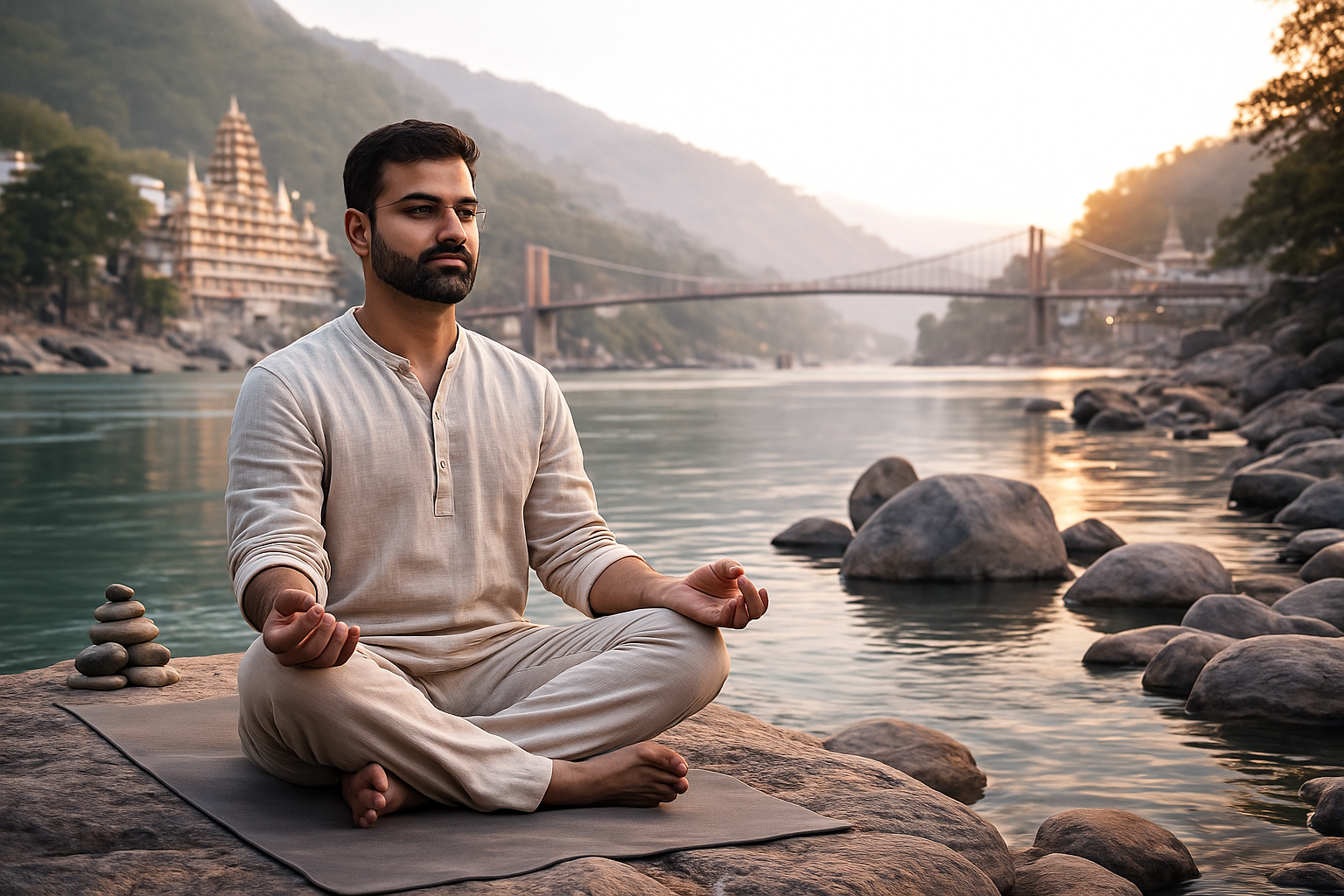

Yoga and Meditation by the Ganges What the River Taught Me About Being Human 
Yoga and Meditation by the Ganges What the River Taught Me About Being Human 
Yoga and Meditation by the Ganges What the River Taught Me About Being Human 
Yoga and Meditation by the Ganges What the River Taught Me About Being Human 
Yoga and Meditation by the Ganges What the River Taught Me About Being Human
The Psychology of Moving and Breathing Together
As our teacher slowed us into deeper breaths, I watched my own mind with professional curiosity. This is the same mind my coachees sit across. It loves speed, analysis and control. Now it was forced into something very unfashionable in modern life – stillness.
Group practice by the Ganges created a subtle emotional contagion. When one person softened into a posture, others followed. When one person struggled, tension rippled through the circle. This is why yoga and meditation in Rishikesh can be such a powerful catalyst. You are not only working with your own psyche. You are swimming in a shared emotional field.
There was something healing about watching a friend tremble in a posture, stay with it and then relax with a small, victorious smile. It reminded me that resilience is rarely loud. It often looks like a quiet exhale that says, “I stayed.”
What the Ganges Reflected Back to Me
When we moved from yoga into seated meditation, the real negotiations began. I closed my eyes, feeling the cool air on my face and the hum of traffic somewhere behind us. Rishikesh is not a fantasy postcard. It is a real town, with horns, conversations, chai stalls and wandering thoughts.
At first, my mind did what it always does. It began drafting emails, replaying old conversations, and planning future workshops. Then a simple cue from our teacher brought me back: “Listen to the river.” There it was, the sound of the Ganges, constant and indifferent to my ambitions.
In that moment, I saw a simple psychological truth. Much of our suffering does not come from what is happening, but from the story we keep repeating about it. The river flowed without narrative. It did not label itself spiritual or polluted. It simply moved. Yoga and meditation in Rishikesh, done with this awareness, become less about escaping life and more about meeting it as it is.
Why Our Hyper-Stimulated Minds Need Slowness
Sitting there, I could not ignore the contrast between this simple riverside practice and the hyper-stimulated world we live in. We are a generation that can scroll endlessly but struggles to sit with one breath. We chase productivity hacks while our nervous systems quietly beg for slowness.
Psychologically, slowness is not laziness. It is medicine. It gives the brain time to integrate, to process unspoken grief, unexpressed anger and unacknowledged joy. As I watched my friends sit in silence, I realised that each of us was probably holding a private storm. Work pressures, heartbreaks, health worries, identity questions. Yet for those few minutes by the Ganges, none of us had to explain or justify anything. We just had to stay.
This is where my societal questioning arises. Why have we built cultures where people feel guilty for needing rest, yet feel oddly proud of being exhausted and burnt out? Why is it easier to brag about a 14-hour workday than to admit, quite simply, “I took 20 minutes to breathe by a river and felt human again”?

Yoga and Meditation by the Ganges What the River Taught Me About Being Human 
Yoga and Meditation by the Ganges What the River Taught Me About Being Human 
Yoga and Meditation by the Ganges What the River Taught Me About Being Human 
Yoga and Meditation by the Ganges What the River Taught Me About Being Human
Lessons I Took Back From the River
As the session ended, our mats slowly rolled up, but the practice did not feel finished. Yoga and meditation in Rishikesh are not meant to stay on the steps of the Ganges. They are meant to travel back with you into your inbox, your relationships and your difficult conversations.
I walked away with a few quiet commitments that felt more like promises than resolutions. To treat my mind a little more like a friend and a little less like a machine. To notice when I am practising spirituality rather than living it. To remember that connection heals, and that sitting in silence next to another human being can sometimes be more powerful than any clever conversation.
I also felt a renewed responsibility as a life coach. If I invite people into yoga, meditation or coaching, then I must protect these spaces from becoming just another productivity tool. They are not here to help people “optimise” themselves into better employees. They are here to help people remember that they are more than their roles, titles and pay slips.
An Invitation to Practise Like a Modern Monk
You do not have to sit by the Ganges to experience the essence of yoga and meditation in Rishikesh. The river is a symbol, but the real work happens wherever you are willing to pause. Your kitchen sink can become a small ashram. Your bedroom floor can become a quiet Ganges ghat. Your morning commute can become a meditation on breath instead of a battle with notifications.
If there is one thing this morning gave me, it is this intention: to live a little more like a modern monk in the real world. Not by escaping emails, relationships or responsibilities, but by meeting them with a steadier breath and a kinder inner voice.
The river did not fix my life. It did something more honest. It reminded me that, beneath the noise, I am already part of something steady and flowing. The work now is to remember that, especially on the days when the mind is loud and the world is demanding.
Today, it took yoga and meditation by the Ganges in Rishikesh, with eight beautiful fellow travellers, to remind me. Tomorrow, it may only take one conscious breath. Either way, the practice continues.


Leave a Reply