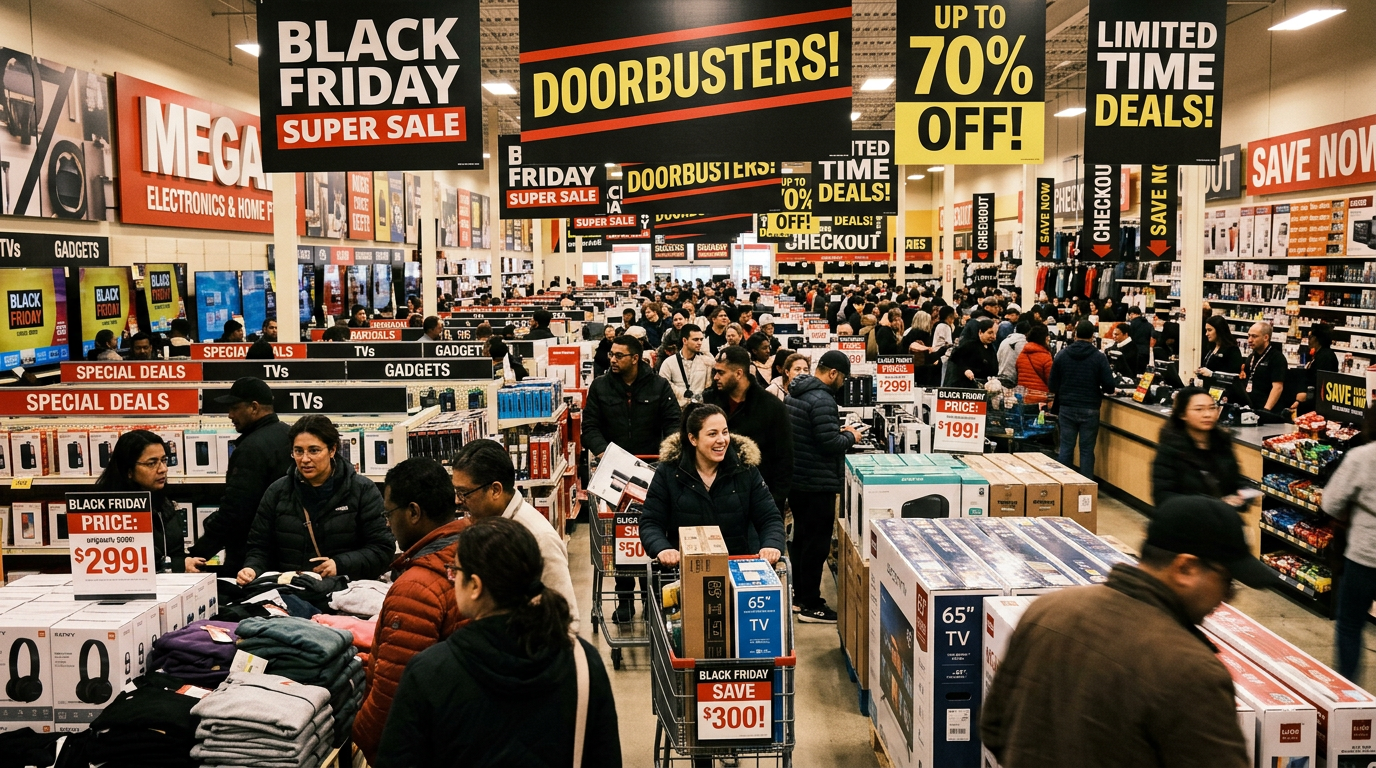
Black Friday 2026 falls on Friday 27 November, and your inbox already knows it. Countdown timers, struck-through prices and “only 3 left” banners are built to make an ordinary decision feel like an emergency. Most of us blame ourselves for what happens next, as though the overspend were a simple failure of discipline. It is closer to a nervous-system event, and once you can see the mechanism, you get your choice back. This article explains what Black Friday is, whether the deals are real, and what is happening inside you when a sale feels impossible to ignore.
Here is the short answer. Black Friday is the Friday after American Thanksgiving and the traditional start of the Christmas shopping season, now exported to India, Mauritius, Singapore and almost anywhere with a card machine. In 2026 it lands on 27 November, with Cyber Monday following on 30 November, although most retailers now stretch “Black Friday” across the whole month. Some deals are genuine. Many are not: when the consumer group Which? tracked 175 products from the 2024 sale, 83% were the same price or cheaper at least once outside the sales period. The price was rarely the urgent part. The urgency was.
What Is Black Friday, and Why Is It Called That?
Thanksgiving in the United States falls on the fourth Thursday of November, which in 2026 is the 26th, so Black Friday follows the next day. The popular explanation for the name is that this was the day retailers moved from loss, “in the red”, into profit, “in the black”. The earlier usage was less flattering: police in Philadelphia used the phrase to describe the crowds and gridlock the day brought. Both stories are about pressure, which turns out to be the more honest clue.
What began as an American trading day has become a global ritual. US shoppers alone spent a record $11.8 billion online on Black Friday 2025, and Indian platforms, Mauritian resorts and Singaporean retailers now run campaigns of their own. Scale matters psychologically. When millions of people do something at once, the mind treats it as evidence. Psychologists call this social proof: the tendency to read what others are doing as a guide to what is right, especially when we are uncertain.
Are Black Friday Deals Actually Worth It?
Sometimes, for a specific item you had already planned to buy, yes. As a category, the evidence is unkind. Year after year, Which?’s price tracking finds that most advertised “deals” can be matched or beaten at other points in the year.
Part of the trick is the struck-through number. A higher original price works as an anchor, so the sale price feels like relief rather than expense. I explored this in more depth in the psychology of why people buy expensive phones, where the iPhone Duo’s pricing does something very similar.
But the deeper cost is not overpaying. It is buying something you would never have wanted without the sale. A 40% discount on something you did not need is not a saving of 40%. It is a spend of 60%.
What Happens in Your Brain When You See a Deal
In a well-known Stanford and Carnegie Mellon study, Brian Knutson and colleagues scanned people’s brains while they viewed products, then prices, then decided whether to buy. Wanting a product activated the nucleus accumbens, a region associated with anticipating reward. Prices that felt too high activated the insula, a region involved in registering discomfort and anticipated loss, while quietening part of the medial prefrontal cortex, an area that helps weigh value. Activity in these regions predicted purchases beyond what people said about their own preferences.
This is one laboratory study, and it should not be stretched into a theory of everything. Still, it maps neatly onto lived experience. A discount does more than lower a number. It turns down the internal alarm that normally says “that is too much”, while the reward system stays switched on. The result feels like clarity. It is often just the absence of friction.
Notice, too, that the reward signal fires in anticipation. The most pleasurable moment of many purchases is the second before you press “Buy”. That is why the parcel so often arrives to a strangely flat feeling.
Scarcity, Countdowns and Borrowed Urgency
In a classic 1975 experiment, Stephen Worchel and colleagues asked people to rate identical cookies taken from two jars, one holding ten and one holding two. The cookies from the near-empty jar were rated as more desirable, and the effect grew stronger when a jar went from full to nearly empty in front of people. The countdown timer and the “selling fast” badge are that cookie jar, digitised.
I call what this produces borrowed urgency: urgency that belongs to a retailer’s calendar, not to your life, but is felt in your body as though it were your own. Your heart rate lifts, your attention narrows, and the question quietly changes from “do I want this?” to “can I get it in time?”. That state is useful when something genuinely threatens you. It is a poor state in which to evaluate an air fryer.
The deadline belongs to the retailer. The racing pulse belongs to you. Most Black Friday regret begins in the moment you mistake one for the other.
Why We Shop When We Are Not Really Shopping
Black Friday arrives at the tired end of the year. Deadlines are stacking up, the light is changing, and many people are running on reserves. A sale offers a small, reliable lift at precisely the moment when other sources of relief feel out of reach. It also offers something subtler: permission. “I was not being indulgent, I was being clever” is a far more comfortable story than “I was exhausted and wanted to feel something good”.
Consider a composite pattern rather than any one person. A senior manager closes a draining quarter, opens a sale page at eleven at night “just to look”, and by midnight has bought a premium fitness watch for a version of herself who has time to train. The purchase was not really about the watch. It was a down payment on a life she has not yet had the space to live, a pattern I have written about in why we buy more books than we can read.
None of this makes buying things wrong. But it is worth knowing that a large meta-analysis of 259 samples found that stronger materialistic values are consistently, if modestly, associated with lower well-being. The relationship is correlational, so it does not prove that shopping makes people unhappy. It does suggest that asking possessions to carry our emotional weight tends not to work, which is part of why inner peace is the new rich is more than a slogan.
Pause here for a moment:
- If this exact item sat at this exact price on an ordinary morning in March, would you still want it?
- What were you feeling in the ten minutes before you opened the sale page?
- Whose approval, including your own, are you hoping this purchase will buy?
How to Shop Black Friday Without Regret
You do not need to boycott the sales. You need to make sure the person doing the buying is you.
Write the list on a calm day. Decide what you genuinely need, and what you are willing to pay, before the sales begin. Your settled self is a far better shopper than your stimulated one.
Run the March test. Ask whether you would buy the item at this price on an unremarkable day months from now. If the answer is no, the deadline is doing the wanting.
Name the feeling before you name the product. Tired, bored, lonely, celebrating, anxious about money? A sentence of honesty with yourself interrupts the autopilot more effectively than any budgeting app.
Check the price history. Price-tracking tools and retailer histories will usually tell you within a minute whether a “deal” is a deal.
Let the cart sleep for 24 hours. If the offer disappears, notice whether you feel loss or relief. Relief tells you the urgency was borrowed.
Borrowed Urgency Beyond the Shopping Cart
Leaders will recognise this mechanism outside retail. The vendor whose offer “expires Friday”, the investor who needs an answer tonight, the inbox flag that turns every message red: each lends you a deadline and invites you to feel it as your own. Some of those deadlines are real.
Many are someone else’s anxiety, forwarded. The capacity to tell the difference, and to hold steady while you check, is one of the quiet skills that separates reactive leadership from considered leadership.
The Sale Ends. Does Your Sense of Enough?
Every sale ends. The harder question is whether your sense of enough ends with it. You will not win Black Friday by finding a better deal than everyone else. You win it the moment you notice, a few seconds earlier than last year, whose clock you are running on.
If you recognise that the cart is often where you go when something else feels unresolved, that pattern deserves a conversation rather than a budgeting app. My life coaching work is designed for exactly that kind of noticing, gently and without judgement.


