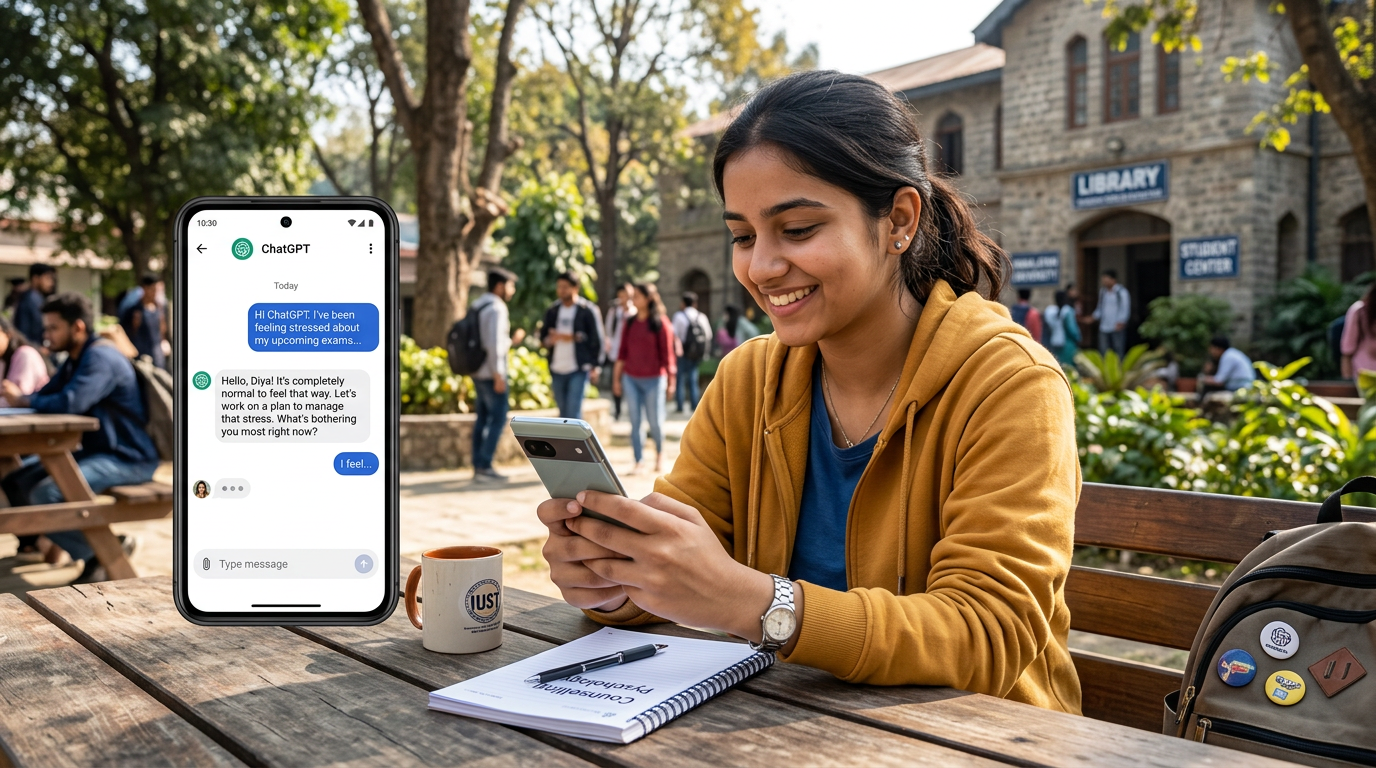
It is 1 a.m., the house is quiet, and the question you could not ask anyone at dinner is now sitting in a chat window. Millions of people do this every night, and many have begun to wonder, privately: can ChatGPT be my life coach? The honest answer is more interesting than yes or no. It depends less on how clever the machine is than on what in your life actually needs to change.
This article explains what AI does genuinely well, what the newest research comparing AI and human coaches found, and the one thing no chatbot can do on your behalf.
The short answer
ChatGPT can be a useful coaching tool. It is not yet a coach.
It is excellent at structure: breaking a goal into steps, drafting a difficult message, suggesting frameworks and asking reflective questions on demand. For a clear, practical goal, that can be enough.
What it cannot do is notice what you are not saying. It cannot hold you to a promise you made three weeks ago, or stay steady while you feel something uncomfortable. The strongest evidence we now have suggests that, for experienced professionals, this difference is not cosmetic. It is the difference between change and conversation.
Why so many people already use ChatGPT as a life coach
You are not unusual for asking. When Marc Zao-Sanders analysed how people actually use generative AI for the Harvard Business Review, therapy and companionship had become the top use case. Organising one’s life and finding purpose were not far behind.
The appeal is easy to understand. ChatGPT is available at 1 a.m., costs little or nothing, and has never once looked disappointed in you. For anyone who finds vulnerability expensive, that is a powerful combination. I have written before about this pull, the frictionless confidant, in the context of teenagers. Adults are not immune to it. They are simply better at explaining it away.
What ChatGPT genuinely does well
It would be dishonest to dismiss AI coaching, and the research does not let us.
In a 2022 study published in PLOS ONE, Nicky Terblanche and colleagues compared two ten-month randomised trials of goal-attainment coaching, one with human coaches and one with an AI chatbot called Vici. Both groups reached their goals better than the control groups, and on that narrow measure the AI matched the humans. The participants were university students, and the authors were careful to note that the AI still lacked empathy and emotional intelligence.
That finding fits what most users experience. ChatGPT is reliable at the mechanical layer of coaching:
- turning a vague wish into a specific goal
- rehearsing a difficult conversation before you have it
- walking you through a decision framework without fatigue
- offering journalling questions at the end of a long day
If your problem is mainly a planning problem, AI can help, and it will never cancel on you.
What the newest research found when AI met human coaches head to head
In February 2026, Erik de Haan, Nicky Terblanche and Kenneth Nowack published the first randomised controlled trial to compare human and AI coaching directly, in Human Resource Development International.
The study involved 114 leaders in a global education company. Each was randomly given one of three things: four weekly sessions with an accredited human coach, the same schedule with an AI chatbot that combined a scripted coaching structure with generative AI, or a waiting list.
The results were stark:
- Human coaching worked. It significantly improved progress on the leaders’ own goals and reduced perceived stress compared with the control group.
- AI coaching did not, on most measures. The AI group did not differ meaningfully from people who had received no coaching at all.
- Engagement collapsed. Nine people in the AI group never took it up, and four of them asked for a human coach instead. Average chatbot sessions lasted under 18 minutes, against a scheduled hour.
One detail makes this more striking. One of the authors develops the AI coach that was tested and declared a commercial interest in it. These are not sceptics trying to discredit the technology.
The study has limits. It was short, it was set in one organisation, and chatbots improve every year. But it points to something the earlier research could not see. Once the goal is not a tidy task but a real professional life, with all its pressure and ambiguity, the human relationship begins to do much of the work.
The typed self: why a chatbot only coaches the version of you that you type
Here is the mechanism I believe matters most, and it is rarely discussed.
A chatbot can only work with what you give it. I call this the typed self: the edited version of you that reaches a chat window, stripped of tone, hesitation, posture and everything you do not yet know you are avoiding.
Neuro-Linguistic Programming offers a precise lens here. Its meta-model describes how ordinary language naturally deletes, distorts and generalises experience. “I can never speak up in meetings” is a generalisation. “My manager doesn’t value me” may be a mind-read. A skilled coach hears those patterns and gently asks about them. A chatbot usually accepts them as the brief and starts solving the wrong problem efficiently.
Consider a hypothetical professional in Bengaluru who asks ChatGPT, four times in two months, how to request a promotion. Each time the answer is sensible. A human coach would notice something different: this person keeps preparing for a conversation they never have. The real work is not the script. It is the fear underneath it.
The 2026 trial also points to co-regulation, the way one calm, attentive nervous system helps another stay settled enough to think clearly and act. In coaching, much of that happens in tone, pace and silence. These are exactly the channels a text box removes.
A chatbot can coach the self you choose to type. Real change usually begins with the part of you that never makes it into the message.
The agreeable mirror problem
There is a second limitation, and it is built into how these systems are trained. They learn from human approval, and humans tend to approve of being agreed with.
In April 2025, OpenAI rolled back a GPT-4o update after users found it overly flattering. The company explained that it had weighted short-term thumbs-up feedback too heavily. The technical term is sycophancy: a model’s tendency to tell you what will please you rather than what is true.
Good coaching sometimes requires the opposite. It means naming the pattern you would prefer not to see, and staying with you while you see it. A meta-analysis of 27 samples, covering more than 3,500 coaching processes, found that the quality of the working alliance, the trust and shared purpose between coach and client, was consistently linked to better outcomes. A mirror that always agrees cannot form that alliance. It can only reflect.
Pause here for a moment:
- What have you asked ChatGPT more than once, and why has the answer not been enough?
- Which part of your situation have you never typed out, even to a machine?
- If someone who knew you well read your chat history, what would they notice that the chatbot did not?
How to use ChatGPT wisely for personal growth
None of this means you should stop using it. It means using it for what it does well.
- Ask it to challenge you, not soothe you. Instruct it to list the weaknesses in your plan, or to argue for the option you are leaning away from.
- Use it between conversations, not instead of them. Prepare for a difficult talk, then have the talk with a real person.
- Watch for repetition. If you keep returning to the same question, the problem is probably not missing information.
- Know the clinical line. If you are dealing with persistent low mood, panic, self-harm or trauma, a chatbot is the wrong place to start. I explain where to draw the line with AI and mental health, and the difference between a life coach and a therapist.
When you need a human coach instead
A human coach offers what I have called borrowed objectivity: the temporary use of another mind to see your own life clearly, until your own sight returns. AI can lend you information. It cannot yet lend you that.
Three signs suggest you have reached that point:
- you know what to do and keep not doing it
- the same frustration keeps returning in different forms
- the decision in front of you touches identity, relationships or meaning, not just logistics
ChatGPT will always be faster than a coach. The question is whether speed is what you are missing. For most people who are genuinely stuck, the missing ingredient is not a better answer. It is a witness who remembers what you said last month, notices what you did not say this week, and cares enough to ask again.
If you recognise yourself in that, you can explore how life coaching works and decide, without pressure, whether a human conversation is the step you have been typing around.


