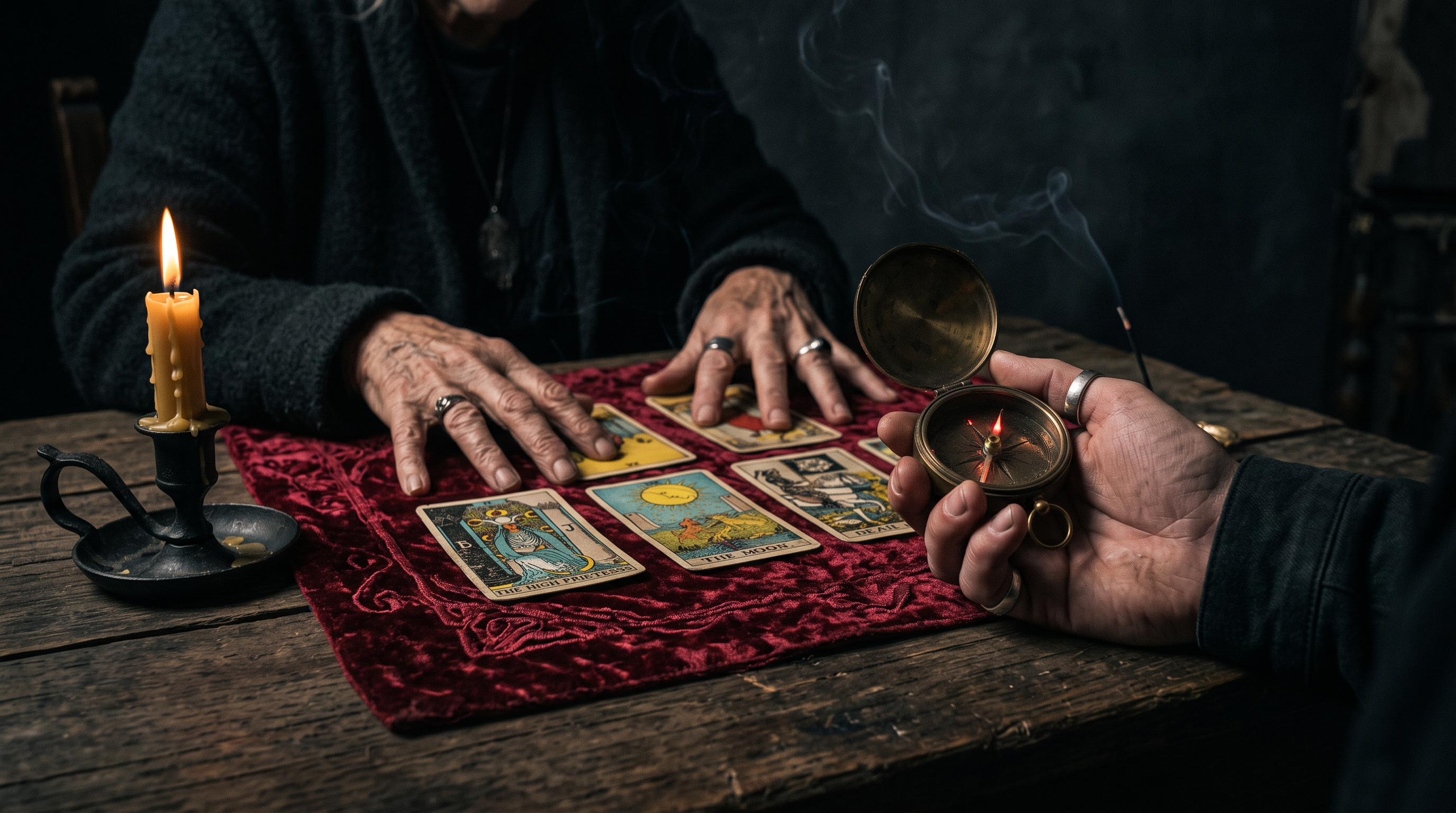
Tonight, somewhere between a shopping-mall kiosk and an Instagram DM, someone will pay a stranger to turn over a card with a skeleton on it and tell them whether their marriage will survive. They will walk away feeling deeply, unmistakably seen. That is the trick, and it deserves to be understood rather than mocked. The psychology of tarot reading has very little to do with the future and everything to do with the human hunger for certainty, the brain’s talent for finding itself in vague sentences, and an industry that has learnt to price that hunger by the minute. This is not an article about ridiculing anyone’s beliefs. It is an article about how the machinery works, and how to tell a harmless ritual from a quiet exploitation.
Why intelligent people pay strangers to read their future
Your brain is, at its core, a prediction machine. It spends every waking hour trying to guess what happens next, because for most of human history a wrong guess was fatal. When life turns genuinely uncertain, a divorce brewing, a business wobbling, a diagnosis pending, the brain’s threat circuitry treats that open question like a physical danger. It will accept almost any answer over no answer at all.
A tarot reading resolves that tension beautifully. For thirty minutes, someone gives you their complete attention, asks about your inner life, and hands you a story with a shape: past, present, outcome. Many accomplished people privately live with the loneliness of success, surrounded by colleagues yet known by no one. A reader who listens without judgement is offering something genuinely scarce. The cards are almost incidental. What is being sold is certainty and attention, and both are addictive precisely because both are rare.
The Barnum effect: when vague feels personal
In 1949, the psychologist Bertram Forer gave his students what he claimed were individually tailored personality profiles. Every student received the identical text, stitched together largely from astrology columns, full of lines about needing approval, carrying self-doubt, and holding untapped potential. Asked to rate its accuracy, the students scored it above four out of five. This is the Barnum effect: our tendency to experience vague, universal statements as uncannily personal.
Notice what this means for the reading room. When the reader says a card reveals “a burden you carry alone,” you do the heavy lifting. Your memory instantly supplies the burden, your emotion supplies the recognition, and the reader collects the credit. The accuracy is manufactured inside your own head. That is not a flaw in you. It is simply how meaning-hungry brains behave, and it is why the same spread can feel piercingly true to a hundred different people.
Cold reading: skill in a velvet costume
Layer on top of this a technique called cold reading, and no supernatural ability is required at all. The method is mechanical. Open with high-probability statements that fit nearly everyone. Watch the client’s face and posture for the flicker that says warmer or colder. Let the client talk, then feed their own information back as revelation. Claim the hits loudly and let the misses evaporate in silence.
None of this would matter much if it stayed a parlour game. It has not. Psychic services, spanning tarot, palmistry and mediumship, generate roughly $2.3 billion a year in the United States alone, according to industry market research, and a recent survey suggests younger adults, particularly younger women, are the most engaged audience. An industry that scales with public anxiety deserves scrutiny, especially at its predatory edge: the escalating fees, the “blocked energy” that mysteriously requires a costlier cleansing, the curse that only this reader can lift.
The card is not the con
Let me be fair, because fairness matters here. Let me tell you about a client I will call Reshma. She is not one person; she is a composite of several people whose stories rhyme. Reshma had one reading after a painful breakup and found it soothing. Eighteen months later, she was consulting the cards before accepting meetings, booking weekly sessions, and had recently been told that a “shadow” around her finances would need a special ritual at a special price. Her problem was never gullibility. Her problem was that relief had quietly moved outside her own body, and someone was charging her rent on it.
And yet the deck itself is not the villain. Used honestly, tarot can function as a projective tool, a set of evocative pictures onto which you externalise what you already feel, rather like journalling with images. Some people use it exactly that way, making no predictive claims at all, and I have no quarrel with them.
So sit with three questions before you read on. When you face a hard decision, whose voice do you consult first? What are you hoping a stranger can see in you that you have stopped looking for yourself? And what has outsourcing your certainty cost you so far?
The borrowed compass
I have come to call this pattern the Borrowed Compass: the habit of renting direction from someone else’s confidence because building your own feels unbearably slow. The borrowed compass always works for a moment. Relief floods in, the nervous system settles, the fog lifts. But rented certainty behaves like the numbing scroll: it soothes without strengthening, so the anxiety returns and the next appointment gets booked. Relief you must keep repurchasing is not peace. It is a subscription.
The alternative is slower and far more durable: learning to tolerate not-knowing, clarifying your values so choices have something to land on, and practising confident decision-making in small, low-stakes ways until your own judgement earns your trust back. The test I offer clients is simple. Support that is genuine, whether a wise friend, a therapist, or working with a coach, works to make itself unnecessary. Exploitation works to make itself indispensable. Fear-based pricing, manufactured urgency, secrecy, and dependency by design all sit on one side of that line. Questions that hand authority back to you sit on the other.
The future is not written in seventy-eight cards. It is written, slowly and imperfectly, in the decisions you are still free to make. If you would like to rebuild trust in your own compass, you are welcome to book a fifteen-minute conversation with me. No cards required.


