
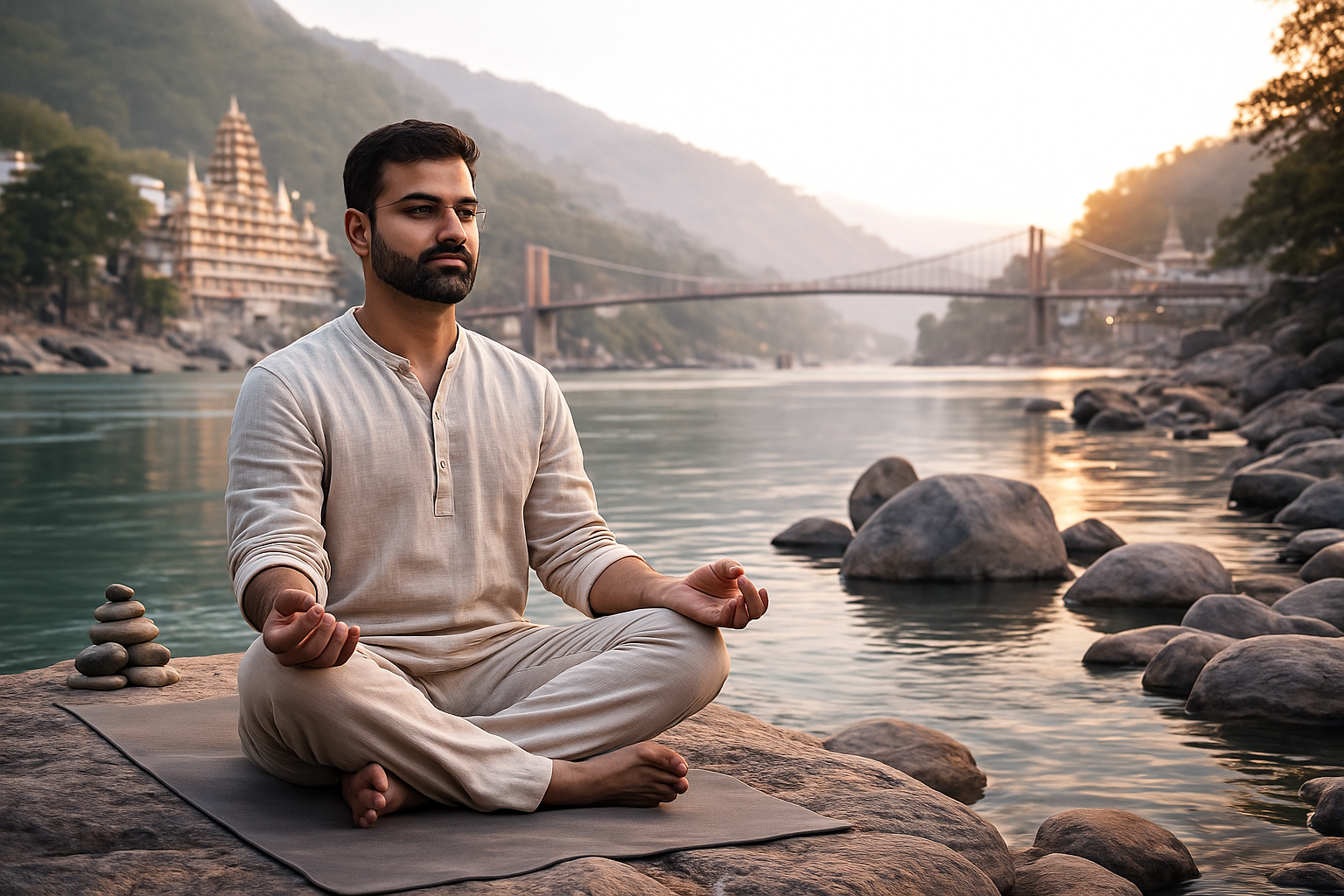
Since the beginning of this year, my life has revolved around helping others find clarity, strength, and direction. I have listened to hundreds of stories (some heartbreaking, some inspiring) while coaching individuals through loss, burnout, and transformation. Yet, even as I guided others towards balance, I found myself slowly tilting off-centre. Carrying other people’s emotions, decisions, and pain can quietly build an inner storm, one that a coach must learn to recognise before it consumes their calm.
In less than a week, I will begin a one-month yoga and meditation retreat at the Rishikesh Yog Nirvana, a decision I’ve made not as an escape but as an act of responsibility. To serve, teach, and lead consciously, one must first return home to oneself.
The Psychology of Pausing: Why Stillness is Not Laziness
We live in an age that worships busyness. There’s a strange pride attached to exhaustion, as though running faster makes life more meaningful. But psychology tells a different story. Our nervous system, constantly in high alert, begins to lose its ability to self-regulate when deprived of stillness. The mind becomes like a radio with too many frequencies playing at once; static everywhere, clarity nowhere.
A retreat, therefore, is not a holiday. It is a reset of the nervous system. It allows the body to slow down enough for the mind to catch up, for emotions to settle, and for self-awareness to return. When we stay in motion too long, we forget what peace feels like. Rishikesh, with its quiet mountains and the hum of the Ganga, offers that rare permission to pause.
Healing After Betrayal: The Journey from Shock to Acceptance
This year has been particularly heavy for me. Professionally, it has been rewarding. Personally, it has tested every fibre of my emotional strength. The brutal betrayal by someone I loved and trusted deeply left a silence far louder than any argument could. Pain like that doesn’t always scream; sometimes, it lingers quietly in the body, showing up as fatigue, disinterest, or emotional detachment.
In psychology, betrayal trauma shakes one’s core sense of safety. When the person you believed in breaks your trust, it fractures your belief system too. Healing that wound requires more than rational processing; it needs space, solitude, and spiritual cleansing. My month in Rishikesh is, therefore, an emotional pilgrimage. It’s not about forgetting; it’s about rebalancing what was thrown off-course, releasing bitterness, and allowing compassion to return.
Why Coaches, Leaders, and Empaths Need Spiritual Maintenance
One of the least spoken truths in helping professions is emotional residue. No matter how trained or mindful a coach may be, human energy transfers. Every story we hold, every trauma we witness, leaves an imprint. Over time, it begins to blur the boundaries between one’s own emotions and the emotions of those we guide.
Taking an annual spiritual retreat is like cleaning the lens through which we see others. Without that cleansing, empathy can become fatigue, compassion can become irritability, and listening can become mechanical. A retreat allows a coach or leader to return to neutrality; to lead again without emotional noise.
For my coachees, I often recommend this: take at least one deep spiritual break each year. Not a weekend getaway, not a rushed escape, but a deliberate immersion into silence and self-reflection. Because growth requires both exposure and retreat; the yin and yang of personal evolution.
Rishikesh: The Energy of the Ganga and the Science of Letting Go
There’s something about Rishikesh that science can’t quite measure but the psyche can feel instantly. The city vibrates differently. The river flows with an ancient rhythm that invites surrender. Every breath of its air feels like a dialogue between chaos and calm.
Modern research in environmental psychology shows that natural surroundings, especially those linked to spiritual traditions, can alter our physiological state, lowering cortisol and restoring inner equilibrium. When you practise yoga or meditation in such an environment, the body doesn’t just stretch; it resets its narrative.
Rishikesh offers me a mirror to see my own patterns more clearly: my restlessness, my attachment, my need to control outcomes. Yoga will realign my body, but meditation will realign my intentions.
Learning to Sit with Silence
We often fear silence because it reveals what our noise hides. For me, this retreat is also about learning to sit with my own silence again. To listen without responding. To feel without analysing. To allow emotions to exist without needing to fix them.
In coaching, I’ve always told people that silence is not absence, it’s space. It’s the gap between reaction and response, between pain and peace. In Rishikesh, I hope to live that truth more deeply.
Why Spiritual Breaks Create Better Humans
Taking a spiritual break is not indulgence; it’s emotional hygiene. Just as our physical body needs rest, our inner self needs renewal. When people pause to reflect, to breathe, and to reconnect with purpose, they return sharper, kinder, and clearer.
A spiritual break helps us remember who we are beneath the roles we play: coach, partner, parent, leader. It reminds us that the point of growth is not endless striving but balanced being.
After this retreat, I intend to return to my work not as someone “healed” but as someone realigned, rooted again in presence, patience, and purpose.
And to every person reading this: give yourself permission to pause. The world will not collapse if you step away for a while. In fact, it might start making sense again.


Leave a Reply