
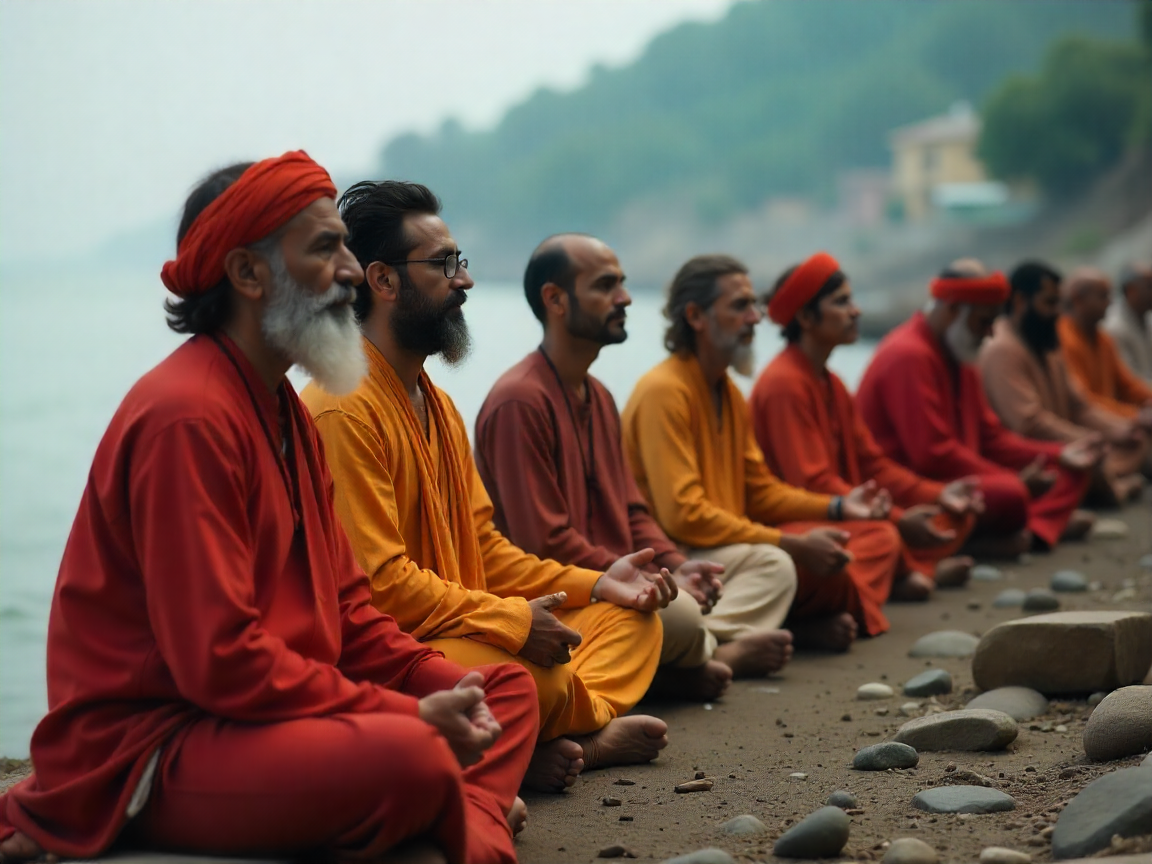
On my first day at Rishikesh Yog Nirvana, someone asked our group a simple question: What is meditation? I smiled, expecting the usual explanation about closing the eyes and trying very hard not to think.
Instead, my teacher Sajan Negi said calmly, “You can never do meditation. It is not an act of doing. You can only reach the state of meditation.”
What is meditation, really?
In psychology we speak of states and traits. You can be in a state of anger without being an angry person. In the same way, you can be in the state of meditation without becoming a monk.
The definition of meditation that I learnt in Rishikesh is simple and uncompromising: meditation is a state of separation from thoughts with one hundred percent awareness in the present moment.
Meditation is not an activity on your to-do list. It is a result, a presence, a destination your mind reaches when certain inner conditions are fulfilled.
“I am not my thoughts”
One of the first lines I wrote in my notebook today was: I am not my thoughts.
In India and Mauritius our minds are often as crowded as our streets. Family expectations, money worries, health scares, social media, exam pressure. Thoughts rush in like local trains, packed and noisy.
When a scary thought appears, most people fuse with it. “I had a thought that I am a failure” quietly becomes “I am a failure.” As a coach, I see this every week. A single frightening thought starts dictating identity.
Meditation breaks that unhealthy fusion. You begin to notice: “A thought of failure just passed through my mind.” The thought is real, but it is not you. This psychological distance is not spiritual poetry. It is emotional first aid.
Separation from thoughts, not suppression of thoughts
Many people tell me, “I tried meditation and I failed, because my mind was full of thoughts.” I usually reply, half-joking, “Congratulations, your brain is alive.”
The point is not to kill thoughts. The point is to stop being kidnapped by them. The state of meditation creates a gentle separation between the thinker and the thought. You are aware of what passes through your mind, yet you remain rooted in a deeper presence that is not shaken by every story your mind tells.
Modern society rewards overthinking. The more anxious you are, the more “responsible” you often look. In that environment, the state of meditation is quietly rebellious. It refuses to let thoughts run the entire show.
One hundred percent awareness
The second quality of the state of meditation that I noted in the class today was “100% awareness”. That sounds intense, yet it is not about straining. It is about being fully here.
Think of the last time you really listened to someone you love. In that moment your awareness was not split between three screens and ten worries. You were simply present. The state of meditation is like that, but turned inward. Awareness rests in the present moment.
From a psychological perspective, this is very different from dissociation or numbness. You are not escaping reality. You are awake to it, without being restless about the past or terrified by the future.
A far away lens: detachment without running away
Another line from my notes reads: “Meditation means looking at situations from a far-away lens, without being in the situations. Detached.”
Detachment is a dirty word for many people. They imagine coldness, withdrawal, a kind of emotional laziness. In my experience, true detachment is the opposite. It allows you to care more wisely.
When you look at your life from a little distance, you see patterns that are invisible from inside the drama. You notice how you repeat the same argument with your partner, how you always sacrifice your well being for your boss, how you confuse love with rescue.
Meditation invites you to step out of the scene mentally, like a director watching a film. You still feel, you still care, but you are no longer drowning. From that place you make decisions that are kinder and more intelligent.
From searching for a peaceful place to creating one
My favourite line from day one at Rishikesh Yog Nirvana was this: “You are not supposed to look for a peaceful place. You are supposed to make any place peaceful.”
We imagine that if we escape to the mountains or get the right scented candle, then our mind will relax. Sometimes the scenery helps. Often, the noise simply travels with us.
The definition of meditation that I am learning refuses that escape fantasy. It invites you to become the peaceful place. Whether you are in a Mumbai local train, a Port Louis office, a family gathering or a hospital waiting room, you can bind your mind to one supporting element in the present. It may be your breath, a mantra, a body sensation or the feeling of your feet on the ground.
With practice, this anchor keeps you present while thoughts shout in the background. You are not running away from life. You are standing in the middle of it with a quiet centre.
Meditation as a psychological result, not a performance
We live in performance-driven cultures. Even spirituality can become a competition. Who sits longer, who chants better, whose app streak is longer.
If you treat meditation as another performance, the mind simply finds a new way to feel “not good enough”. The definition of meditation that I am offering you is kinder. Meditation is not a task you succeed or fail at. It is a state that arises as a result of certain attitudes.
When you separate from thoughts, stay anchored in one element of the present and cultivate one hundred percent awareness, the mind naturally slips into meditation. You do not force it. It happens, the way sleep happens when the body feels safe enough to let go.
How do you begin?
For the next seven days, choose one ordinary daily activity as your meditation lab. It could be brushing your teeth, drinking tea, walking from your car to your office or standing in a queue.
During that activity, practise three inner moves. First, notice the thoughts that appear and gently remind yourself, “This is a thought, not my identity.” Second, connect with one supporting element in the present, like the sensation of your breath. Third, stay with that sensation with as much awareness as you can, just for that short period.
You have simply turned an ordinary moment into a training ground for the state of meditation.
A quiet revolution
For Indians and Mauritians, where noise is normal and busyness is worn like a badge of honour, the true definition of meditation is quietly revolutionary. It says: you are allowed to step back from the storm in your head without abandoning your responsibilities. You are allowed to live with more presence than panic.
Meditation is not about adding more days to your life. It is about adding more life to your days. And that begins the moment you realise that you are not your thoughts, and that any place can become peaceful when your awareness fully arrives there.


Leave a Reply