
Have you noticed how quickly we confuse volume with value?
The loudest voice becomes the leader. The boldest speaker gets promoted. The most certain face gets trusted. Not because they are the most capable, but because they reduce everyone’s anxiety. In many Indian and Mauritian workplaces, we treat confidence like competence, and we treat certainty like wisdom. It makes life easier in the short term. It also makes organisations fragile in the long term.
As a life coach, I have sat with founders, managers, doctors, educators, entrepreneurs, and high-performing professionals who all describe the same fatigue in different accents: “I’m tired of theatre.” They do not always use that word, but their nervous system does. When leadership becomes performance, the system may look energised, but people feel unsafe, unseen, or quietly exhausted.
This is what I call The Podium Illusion. The stage looks like leadership. The spotlight feels like proof. But reassurance is not leadership. It is a sedative.
Why the human brain worships certainty
Let’s be kind to ourselves first. The brain is a prediction machine. In uncertain environments, it craves signals that say, “We’re safe.” A confident voice offers that signal. A strong posture offers that signal. A decisive sentence offers that signal.
In India, where competition is fierce and outcomes are often high-stakes, the pressure to appear sure can become cultural. In Mauritius, where relationships, proximity, and reputation travel quickly, the pressure to look competent can become social survival. In both contexts, we often reward the person who can calm the room, even if they cannot build the system.
From a psychological perspective, this is not stupidity. It is anxiety-management. The problem begins when a leader confuses anxiety-management with leadership itself. When soothing becomes the job, truth becomes optional.
Confidence is a costume. Competence is a contract.
Here is the difference I have learned the hard way. Confidence is what you can display. Competence is what you can sustain.
Confidence can be rehearsed. Competence has to hold up on a difficult Tuesday, when the client is angry, the team is tired, the numbers are tight, and your own mood is not cooperative.
I remember an early training programme where the most articulate participant became the informal “leader” of the room within minutes. He had quick answers, a polished tone, and the kind of social ease that makes others relax. During a group exercise, he dominated the discussion and summarised everyone’s views so fluently that people nodded without noticing they had been edited.
After the session, a quieter participant waited until the room emptied and said, softly, “Sir, I did not agree with half of what he said. I just did not want to fight it.” That sentence stayed with me because it described an entire culture in miniature: performance wins, truth retreats.
That is the podium illusion at work. Not oppression in a dramatic sense, but a slow and polite disappearance of honest reality.
The sedative leadership style
Reassurance becomes dangerous when it replaces responsibility.
A sedative reduces discomfort without curing the condition. In organisations, sedative leadership sounds like “Don’t worry, everything is under control” when it is not. It looks like grand announcements without infrastructure. It feels like inspiration without follow-through.
In families, sedative leadership is the parent who shuts down difficult conversations with authority rather than presence. In communities, it is the loud moral voice that performs righteousness while avoiding accountability.
This is where society deserves a gentle question. When did we start preferring a comforting lie over a hard truth delivered with dignity? When did we start calling discomfort “negativity” and avoidance “peace”?
A mature leader does not inject anxiety into the room. But they also do not anaesthetise the room into denial.
Quiet leaders, invisible labour, and the breaking point
If you’ve ever been the quiet one carrying the system, you know this pain.
You can hold everything together and still be invisible. You absorb dysfunction. You patch holes. You smooth conflicts. You quietly do the thinking others don’t have the patience for. You become the hidden operating system.
Then one day you stop. Not dramatically. Not to punish anyone. You just stop compensating.
And suddenly, everyone notices the collapse they were calling “normal”.
I have coached people in that moment. A senior manager who finally refuses to fix a colleague’s recurring mistakes. A daughter who stops mediating between emotionally immature parents. A team lead who stops translating vague instructions into workable plans. In each case, the person is labelled “changed” or “difficult”, as if their boundaries are a betrayal.
But what really happened is simpler. The invisible labour became visible through its absence. That is not rebellion. That is reality finally speaking.
Real leadership happens before the fire
Real leadership is what happens when nobody is watching.
It is the person who makes truth safe. The one who creates conditions where bad news can arrive early, not late. The one who prevents the fire, not the one who gives a speech after the fire.
In neuroscience terms, psychological safety is not a slogan. It is a nervous-system state. When people feel safe, they bring information forward. They name risks. They admit mistakes. They ask for help. When people feel unsafe, they hide. They perform. They agree outwardly and resist quietly. They protect themselves from shame.
This is why the best leaders I know are not always the loudest. They are the steadiest. Their presence lowers threat without lowering standards. Their clarity does not humiliate. Their authority does not require fear.
As an aspiring yogi, I see a parallel. In yoga, you can force a posture and look impressive, but your breath will tell the truth. When you are misaligned, the body tightens. When you are aligned, the breath becomes quieter. Leadership works the same way. You can force control and look powerful, but the team’s emotional breath will tighten. When you lead cleanly, the system breathes.
The Inner Weather question
So here’s my Inner Weather question for you.
Are you addicted to being seen, or committed to being useful?
This is not a moral question. It is a self-awareness question. Many good leaders drift into visibility addiction because it gets rewarded. Many competent leaders drift into visibility avoidance because they are tired of politics. Both patterns have a cost.
The work is to build a relationship with visibility that is free of addiction and free of avoidance. Step forward when the room needs clarity. Step back when the system needs agency. Speak when truth needs protection. Be silent when your ego wants attention.
That is not charisma. That is practice.
A new book, released today
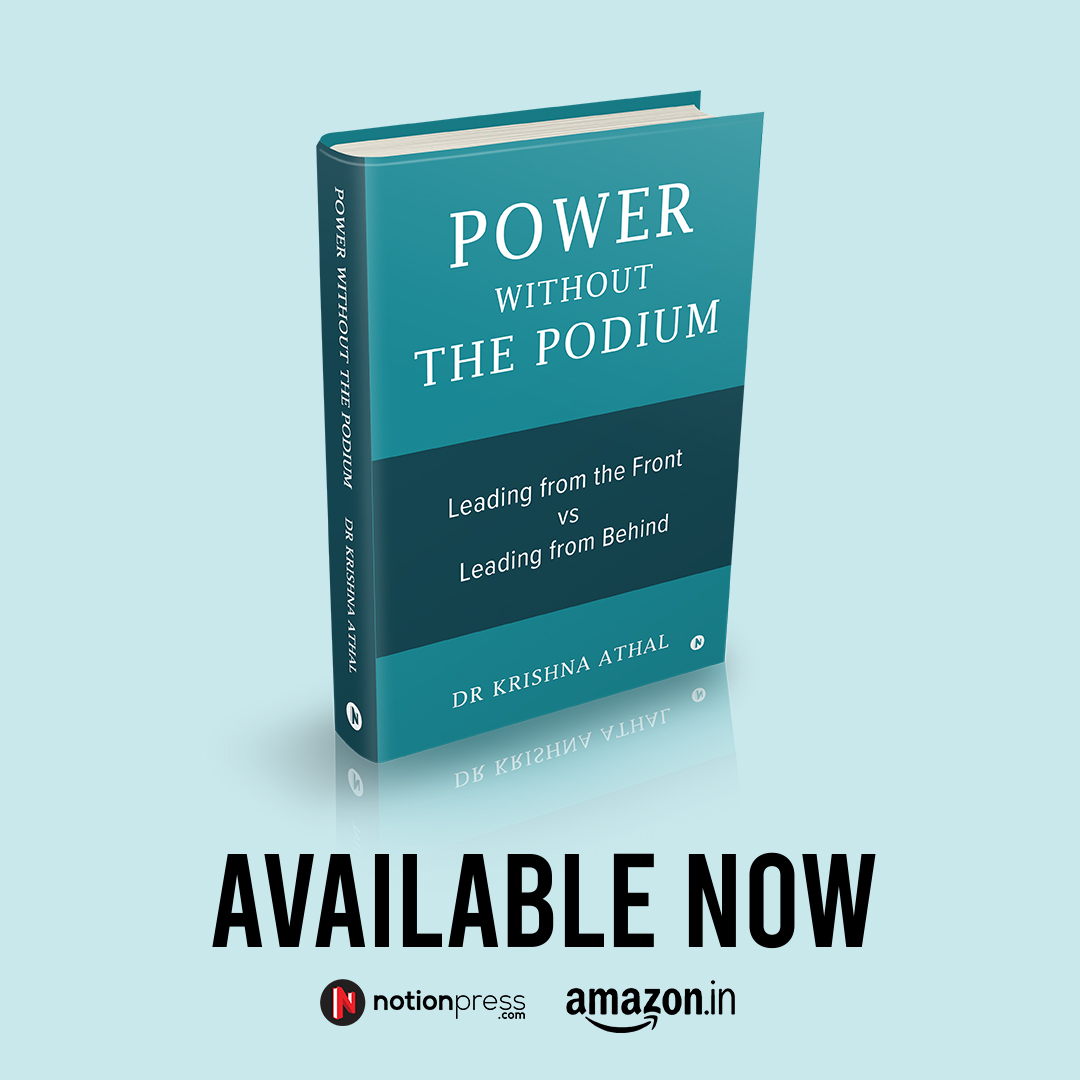
I wrote my new book, Power Without The Podium, for leaders who want that practice. It’s rooted in research and written for real life. If you are leading a team, a business, a classroom, a clinic, a home, or simply your own mind on a difficult day, this book will meet you there.
Pre-order now:
My Website: https://drkrishnaathal.com/academy/power-without-the-podium/
Notionpress: https://notionpress.com/in/read/power-without-the-podium
Amazon: https://www.amazon.in/dp/B0GNN56CG1/
Flipkart: https://www.flipkart.com/power-without-podium/p/itm068b8313ff7a6
If this idea stirred something in you, don’t just nod. Try one behaviour today. Make truth slightly safer in one conversation. Reduce theatre by one degree. Build one small structure that prevents tomorrow’s fire.
That is how the podium disappears. And leadership begins.


Leave a Reply