
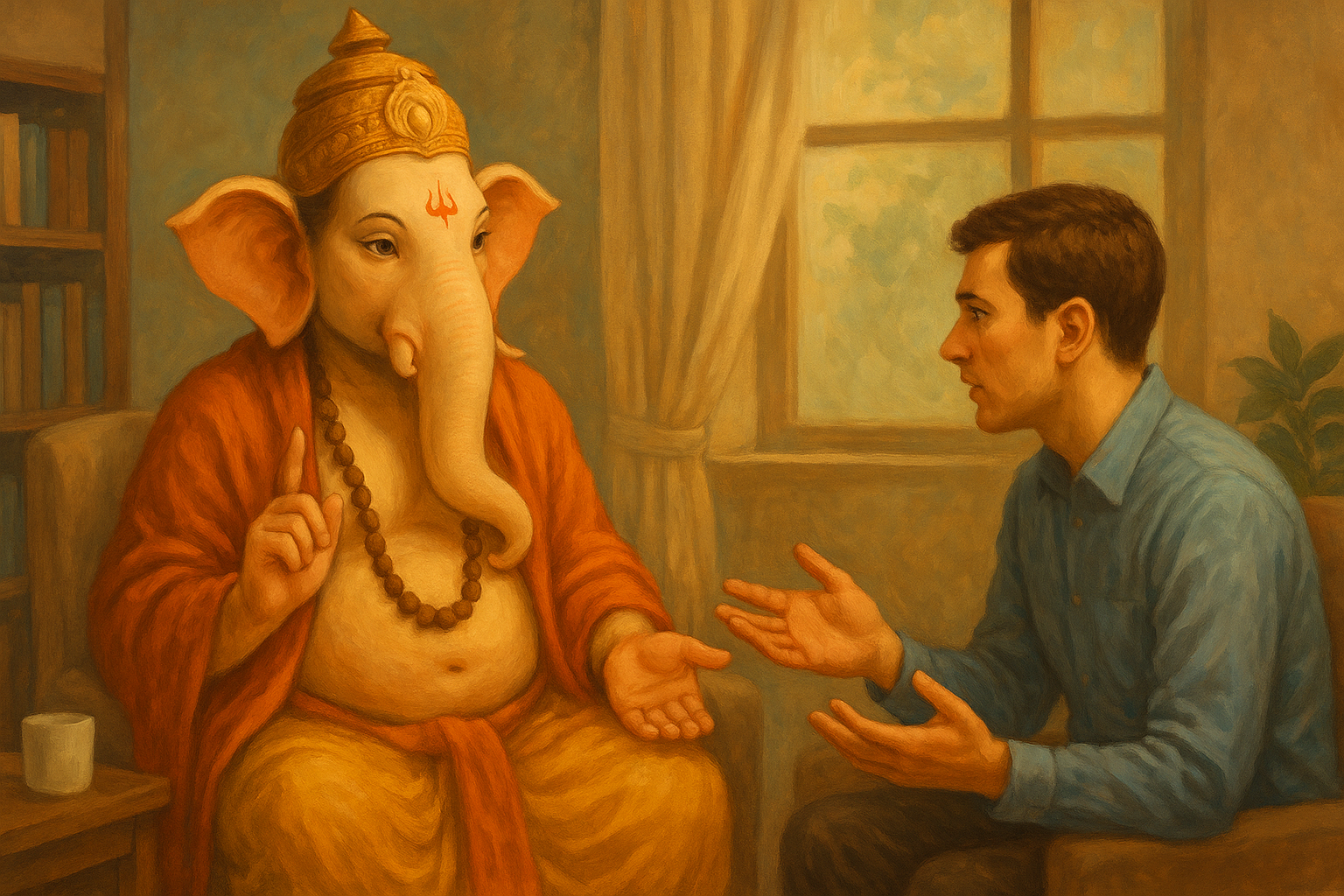
As I sit in reflection on Ganesh Chaturthi, I am reminded that the figure of Lord Ganesha is not merely a deity in Hindu tradition but also an enduring symbol of psychological wisdom, adaptability, and emotional resilience.
Over the years, I have increasingly looked at Ganesha as a metaphorical life coach—an archetype guiding us through obstacles, fears, and personal limitations. His stories, his form, and his symbolism provide profound lessons that are as relevant in our modern lives as they were centuries ago.
The Psychological Symbolism of Ganesha
When I think of Ganesha, I see a striking image: an elephant-headed god with a large head, a broken tusk, a round belly, and a tiny mouse as his vehicle. At first glance, it may appear strange, even contradictory. Yet, this very contradiction is what makes Ganesha such a powerful psychological teacher.
- Large Head: To me, it symbolises the importance of broad thinking, reflection, and perspective. Life coaching often begins by expanding the client’s worldview beyond narrow self-beliefs.
- Small Eyes: These signify focus—seeing clearly, looking deeper rather than getting distracted by noise. In psychology, this is akin to mindfulness, the practice of being present.
- Big Ears: A coach’s role is often to listen more than to speak. Ganesha reminds us that listening is the first step towards empathy and understanding.
- Trunk: Flexible and adaptable, able to uproot a tree or pick up a needle. This is what resilience looks like—shifting between strength and subtlety when required.
Each element of his form symbolises a life skill, a coaching principle, and a psychological truth.
Story One: The Broken Tusk and the Art of Letting Go
One of my favourite stories about Ganesha is how he broke his own tusk to write the Mahabharata. When sage Vyasa sought a scribe to record the epic, Ganesha agreed on the condition that the narration must be continuous. When his pen broke, he snapped off his tusk and continued writing without hesitation.
From a coaching perspective, this story embodies sacrifice, adaptability, and letting go of perfection. I often encounter individuals who struggle because they cling to an idealised version of themselves, unwilling to release what no longer serves them. Ganesha teaches us that sometimes we must let go of our pride, our rigidness, or even parts of ourselves to achieve something greater. Psychologically, this is what we call “radical acceptance”—the willingness to accept reality as it is and respond with creativity.
Story Two: The Race Around the World
Another beloved anecdote is when Ganesha and his brother Kartikeya were challenged to race around the world. Kartikeya, with his fast peacock, set off immediately. Ganesha, with only his mouse, instead circled his parents, Shiva and Parvati, declaring, “For me, you are the world.”
On the surface, this is a story of wit. But as a coach, I see a deeper psychological insight: prioritisation and redefining success. Ganesha recognised that meaning is not always about external victories; sometimes it is about inner clarity and values. In our lives, we often chase endless races—career ladders, material possessions, validation. Ganesha’s act teaches us the courage to define success on our own terms.
Overcoming Obstacles: The True Role of a Life Coach
Ganesha is known as Vighnaharta, the remover of obstacles. Yet what strikes me most is not that he magically clears the path, but that he equips us with the strength to face obstacles.
As a life coach, I never promise clients a life without difficulties. Instead, I guide them to develop resilience, reframing, and emotional agility. This is precisely what Ganesha symbolises. His image reminds us:
- Obstacles are not permanent blocks; they are invitations to grow.
- Fear shrinks when faced with wisdom and presence.
- Success lies not in the absence of problems but in our response to them.
Psychologically, this aligns with cognitive behavioural principles—shifting how we interpret challenges alters how we experience them.
Lessons in Humility: The Mouse as His Vehicle
What fascinates me is Ganesha’s choice of vehicle—a tiny mouse. The contrast between the enormous elephant-headed god and the fragile mouse is striking. For me, this pairing is a profound symbol of humility and control.
The mouse represents desires, fears, and impulses that can easily spiral out of control. By making the mouse his vehicle, Ganesha symbolically teaches us to ride our impulses rather than be ridden by them. This is one of the most powerful lessons in emotional intelligence: to acknowledge our urges without being enslaved by them.
As a life coach, I often help people recognise the “mice” in their lives—their cravings, anxieties, and compulsions—and learn how to channel them constructively.
Joy in Simplicity: The Modak in His Hand
Ganesha is often depicted holding a modak, a sweet dumpling. It represents the sweetness of inner fulfilment, the joy that comes from simplicity, gratitude, and contentment.
We live in a culture that often postpones happiness—“I’ll be happy when I get that promotion,” or “I’ll celebrate once I achieve this milestone.” Ganesha teaches us to savour life’s sweetness now. From a psychological perspective, this mirrors the concept of savouring in positive psychology—the conscious practice of noticing and enjoying life’s small pleasures.
Emotional Anchoring: What Ganesha Teaches Me Personally
As I reflect on Ganesha not as a distant deity but as a coach by my side, I find myself emotionally anchored. Whenever I face uncertainty or anxiety, I remember the stories of his wit, resilience, and humility. They remind me that:
- I don’t have to win every race; I only have to stay true to my values.
- I don’t have to be flawless; I just need to be adaptable.
- I don’t have to suppress my impulses; I can learn to guide them.
- I don’t have to fear obstacles; I can use them as stepping stones.
In many ways, this is what I also tell those I coach. Ganesha is not simply a remover of difficulties—he is a guide who teaches us to remove our inner obstacles.
My Last Words: Lord Ganesha as the Eternal Life Coach
As a life coach, I often draw inspiration from modern psychology, neuroscience, and behavioural science. Yet, I find that ancient wisdom—when interpreted with insight—offers equally powerful lessons. Lord Ganesha, in all his symbolism and stories, serves as a timeless coach.
He teaches us to think big yet stay humble, to let go of what holds us back, to prioritise meaning over blind ambition, to guide our impulses with discipline, and to savour life’s sweetness.
On this Ganesh Chaturthi, as people bring home idols of Ganesha and celebrate with devotion, I invite you to also bring his lessons into your heart and mind. For in doing so, we discover not only the remover of obstacles but also the greatest life coach we could ever have.


Leave a Reply