On the afternoon of Sunday 2 November 1834, a ship called the Atlas sailed into Port Louis harbour with 36 labourers from India on board, and the arrival of indentured labourers in Mauritius began. Over the following decades, almost half a million people would pass through the depot we now call Aapravasi Ghat, and most Mauritians alive today descend from them. The dates and numbers are easy to find. What is harder to see is what a migration made under contract still asks of the families who carry it, five and six generations later.
This article gives you both: the history, stated plainly, and a psychological reading of what that crossing left behind.
The arrival of indentured labourers in Mauritius: the short answer
The arrival commemorated every year is that of the Atlas. Research in the Mauritius National Archives shows the ship reached Port Louis after more than six weeks at sea, that the 36 men each received six months’ pay in advance before boarding, and that permission to land was granted on 3 November, with the men going ashore on the 4th. The contract they signed was written in Bengali, according to archival research published by Le Mauricien.
The scale that followed is hard to hold in the mind. Between 1834 and 1920, almost half a million indentured labourers arrived from India at Aapravasi Ghat. Some stayed to work the island’s sugar estates, and others were sent on to Réunion, Australia, southern and eastern Africa and the Caribbean, as UNESCO’s World Heritage listing records. About 97.5% came from India, with smaller numbers from China, the Comoros, Madagascar, Mozambique and South-East Asia. More than two-thirds of them settled for good.
Mauritius made 2 November a public holiday in 2001, and UNESCO inscribed Aapravasi Ghat as a World Heritage Site in 2006, as Britannica notes. In 2026, the anniversary falls on Monday 2 November. It is the 192nd.
One honest footnote: 1834 is a symbolic beginning, not the very first arrival. Mauritian historians have pointed out that hundreds of Indian and Chinese indentured workers had already arrived between the mid-1820s and the mid-1830s. Commemoration chooses a date. History is usually messier.
Why Mauritius, and why 1834?
Britain abolished slavery in most of its colonies in 1834, and then tried what it called the “Great Experiment”: a system of indentured labour. Mauritius, with its profitable sugar estates and its proximity to India, was chosen first. The experiment was judged a success, and other colonial powers adopted it from the 1840s, setting in motion a worldwide migration of more than two million indentured labourers.
The word “free” in that story has always deserved its inverted commas. In 1974 the historian Hugh Tinker called the system A New System of Slavery, and the debate about how voluntary these contracts really were has never fully closed. I think both truths can be held at once. There was a contract, and there was coercion. There was recruitment, and there was hunger at home that made recruitment look like rescue.
This matters psychologically because Mauritius carries two foundational wounds side by side: slavery, remembered at Le Morne, and indenture, remembered at Aapravasi Ghat. A mature national memory does not rank them. It lets each be fully grieved without turning the other into a rival.
From Coolie Ghat to Aapravasi Ghat
For much of the twentieth century, the depot carried a degrading name. In November 1989, the name Coolie Ghat was replaced by Aapravasi Ghat, a term coined in Mauritius, to show greater respect for the memory of the indentured labourers. Aapravasi means immigrant, and a ghat is a landing place: the step between water and land, and between the old life and the new.
I find the renaming one of the most psychologically intelligent acts in the island’s history. Psychologists use the term narrative identity for the internal, evolving story a person tells about who they are and how they came to be. Changing one word changed the protagonist of the national story from a unit of labour into a human being who migrated. Therapy does this slowly, one life at a time. Mauritius did it with a signboard.
What they carried across the water
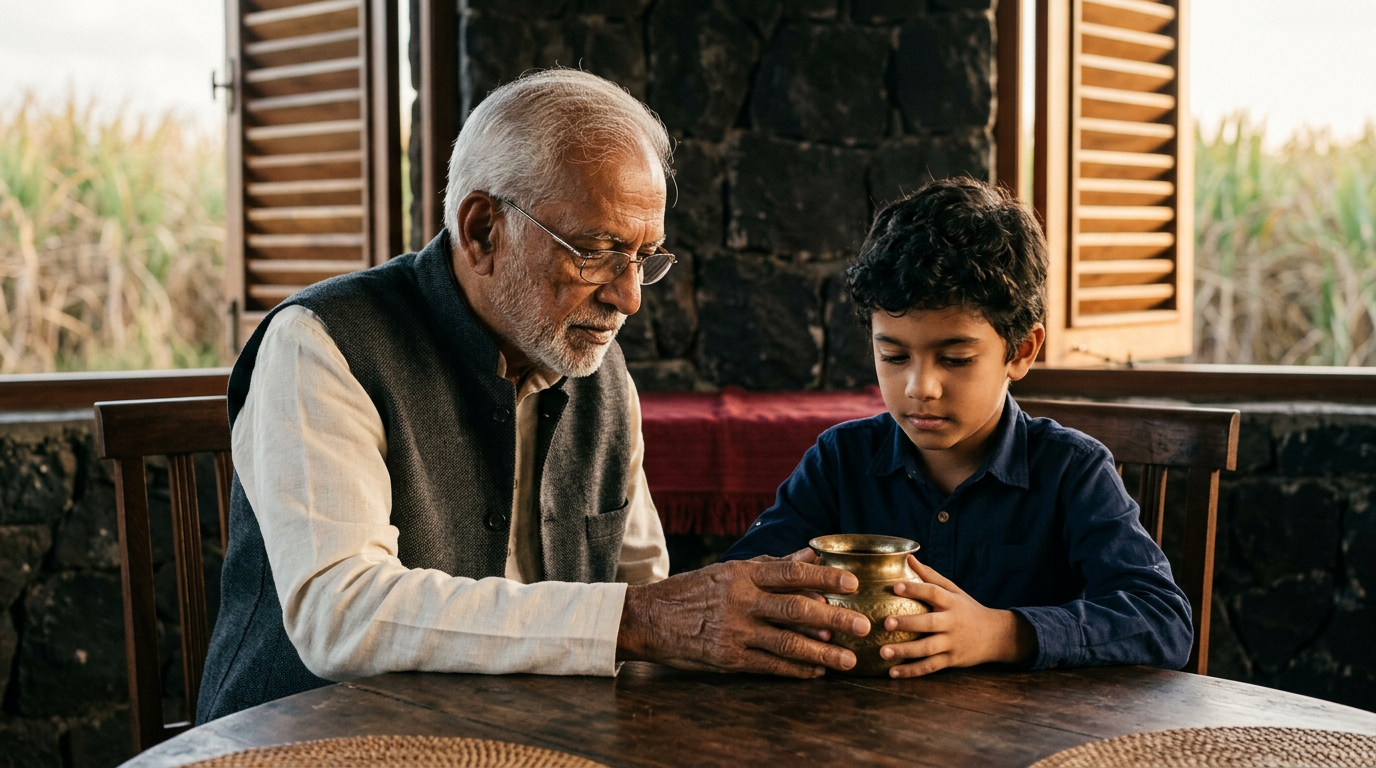
The labourers carried very little that could be weighed. A few clothes, perhaps a brass vessel, and a great deal that could only be carried in the body: prayers, recipes, festival calendars and songs.
Some of those songs survived intact. UNESCO traces the Bhojpuri wedding songs of Geet Gawai back to the immigrant experience of indentured labour, and inscribed them in 2016 on the Representative List of the Intangible Cultural Heritage of Humanity. When a people loses its land, its language and its extended family in one crossing, ritual becomes a portable home. I explored that idea through another festival in Durga Puja in Mauritius, where the nine nights of the goddess were rebuilt by descendants who mostly never went back.
What a crossing leaves inside a family
Here we need care, because this is where popular writing tends to overclaim.
There is serious research on how the effects of severe hardship may pass between generations. Rachel Yehuda and Amy Lehrner’s review examines possible social, intrauterine and gametic routes by which trauma effects might be transmitted, and stresses the role of cultural narratives and the real possibility of resilience and adaptation; their review on cultural trauma and epigenetic inheritance is a good place to start. The biological evidence in humans is still early. Nobody can tell you that your great-grandmother’s voyage is written into your genes.
What is far easier to observe is what families teach. Behaviour is inherited more reliably than biology. A household that survived scarcity tends to pass on its survival rules: work before rest, save before spending, do not complain to people with power, and treat comfort as something that can be taken away.
Consider a composite drawn from a pattern that comes up often in life coaching in Mauritius. She is a finance director in Ebène, in her mid-thirties, and the first in her family to own a home outright. Her grandmother cut cane. She has never taken a holiday without checking email, she feels uneasy when work goes well, and she describes rest as something she has not yet earned. Nothing is wrong with her. She is simply still keeping terms that were written for a different century.
The unsigned contract
I call this the unsigned contract: the unwritten terms of endurance a family keeps honouring long after the original agreement has expired.
The terms made perfect sense once. On an estate where illness, a complaint or a missed day could cost wages or worse, hypervigilance (the nervous system’s habit of scanning constantly for threat) was intelligence, not anxiety. Endurance kept people alive. But a nervous system cannot read a calendar. It keeps the rules until someone consciously reviews them.
Your ancestors’ contract expired more than a century ago. The question 2 November quietly asks is whether you are still serving it.
Pause here for a moment:
- Which rule about work, money or rest did you inherit without ever being asked to agree to it?
- When you feel guilty for resting, whose voice is that, and in which decade was it first spoken?
- What would honouring your ancestors look like if it meant living freely rather than enduring well?
Reviewing those terms, one clause at a time, is much of what life coaching is for. None of this is about rejecting the past. It is about telling the gifts apart from the survival strategies. The courage, the faith and the stubborn love of education are gifts. The inability to rest is a clause.
How to tell the story so it strengthens rather than burdens
Psychology offers a hopeful finding here. Marshall Duke, Robyn Fivush and their colleagues at Emory University found that children’s knowledge of family history was significantly linked to a stronger internal sense of control, higher self-esteem, better family functioning and lower anxiety (the study is summarised here). Duke and Fivush also identified three kinds of family story. The ascending narrative says things have got better. The descending narrative says they have got worse. The oscillating narrative holds both success and failure, and the experience of living through adversity and overcoming it. It is the oscillating story that seems to build resilience best.
Mauritius often tells the arrival of indentured labourers in only one of the first two registers. Either it is a story of pure suffering, or it is a triumphant success story that quietly turns into pressure: they sacrificed everything, so you had better not waste it. Both flatten real people into symbols. The oscillating version is truer, and kinder. They were exploited and they were afraid. They also laughed, sang, married, argued and built.
Four ways to mark 2 November 2026 with that kind of honesty:
- Ask one elder one real question. Not “what was it like?” but “what did your grandmother never talk about?” The silences are part of the story.
- Visit Aapravasi Ghat on purpose. Attend the commemoration, or go on a quieter weekday afterwards. Stand on the landing place for a few minutes before you take a photograph.
- Read one clause of your unsigned contract. Write down one rule you inherited, then decide, as an adult, whether you still sign it.
- Remember who is arriving now. The island that once received contract labourers now depends on contract labour again, a story I examined in migrant workers in Mauritius. And many great-grandchildren of the Atlas generation are making the crossing in reverse, as I explored in youth emigration in Mauritius.
The crossing that is still underway
The Atlas dropped anchor in 1834, but in a psychological sense the arrival is not finished. Every family descended from that voyage is still deciding what it brought ashore and what it can finally put down. I have written before about the original address, the body’s earliest sense of what being safe felt like. For the descendants of indenture, part of that address is a landing place in Port Louis, and part of it is still being built.
The deepest way to honour people who arrived with nothing is not to keep enduring on their behalf. It is to become the generation that is finally allowed to rest, choose and belong, and to do so without apology.
If you recognise an unsigned contract in your own life and would like to read its terms with someone beside you, a free 15-minute consultation is a quiet place to start.


