
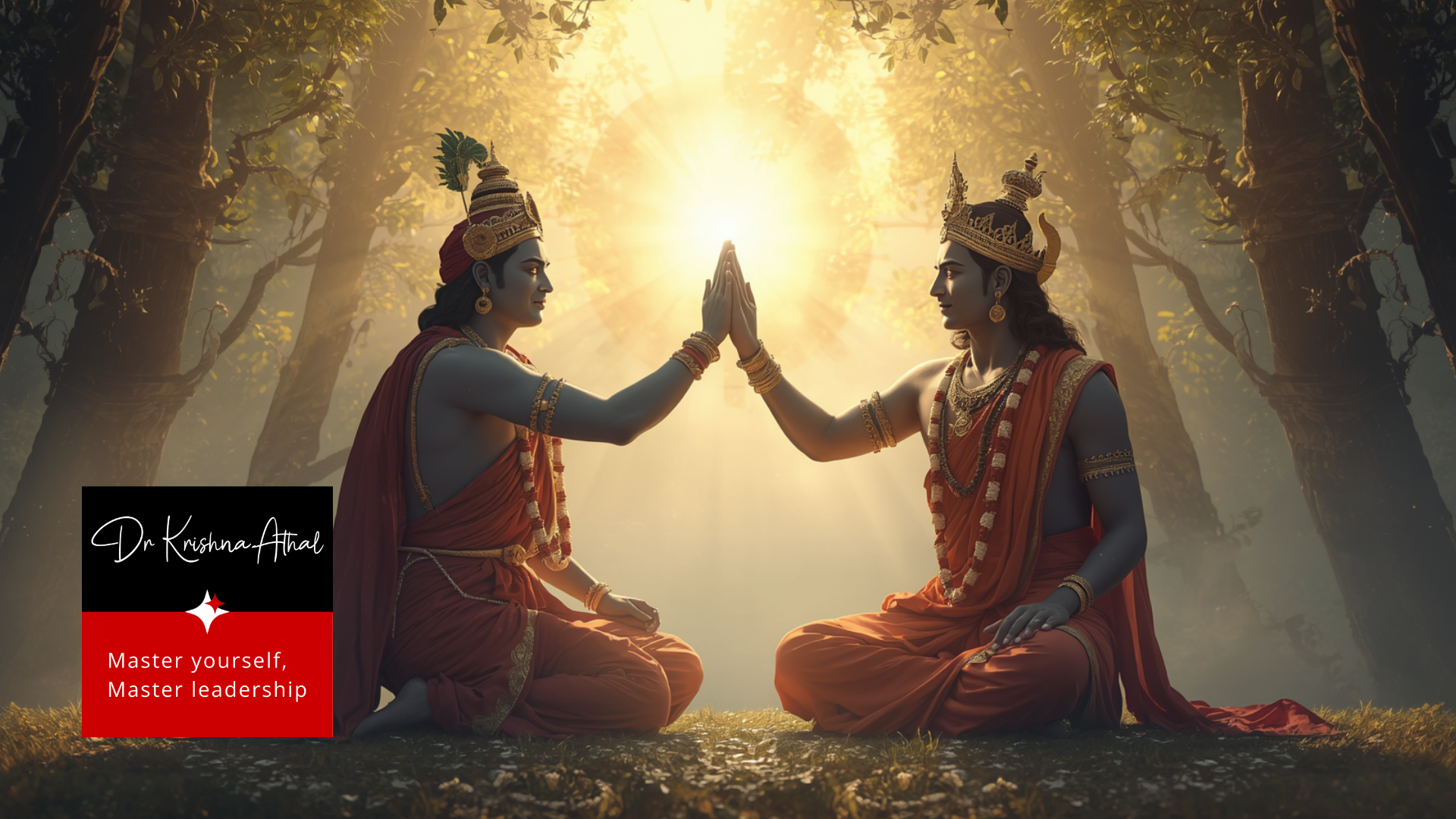
Long before the coaching profession had a name, an accreditation body, or a 5.34 billion dollar global industry, two men sat in a chariot between two armies and held the most important conversation of their lives. Krishna and Arjuna gave us, in the Bhagavad Gita, what I consider the finest coach-coachee relationship ever recorded. Krishna did not fight Arjuna’s war for him, did not hand him a tidy answer, and did not flatter him out of his despair. He did something far harder and far more useful. He stayed, he listened, and he let Arjuna find his own way back to himself.
A Breakdown Before the Breakthrough
The Gita opens not with wisdom but with collapse. Arjuna, the finest archer of his age, looks across the battlefield of Kurukshetra, sees his teachers and cousins waiting to be killed, and falls apart. He tells Krishna that his limbs are failing, his mouth has gone dry, his skin is burning, and his famous bow, the Gandiva, is slipping from his hand (Bhagavad Gita 1.28 to 1.30).
In neuroscience, we would call this an amygdala hijack, a phrase coined by the psychologist Daniel Goleman to describe the moment the brain’s threat-detection centre, the amygdala, floods the system and effectively switches off the prefrontal cortex, the region responsible for reasoning, perspective and self-control. Arjuna is not being weak. He is being human under unbearable load.
Here is the first thing Krishna gets right, and the first thing most of us get wrong. He does not rush in. He lets Arjuna speak the whole of his despair. Anyone who has coached a senior leader in a genuine crisis knows the pull to reach for reassurance early, to tidy the discomfort away because their discomfort unsettles us, too. Krishna resists that pull. He lets the breakdown finish before he allows the breakthrough to begin.
Why Krishna Refused to Hand Arjuna the Answer
This is the part that ought to be printed above every coach’s desk. Krishna is divine. He could have ended the matter in a single sentence. Instead, he spends eighteen chapters and roughly seven hundred verses asking, reframing, illustrating and provoking, until Arjuna himself declares, in the final chapter, that his delusion is gone and his clarity is restored (Bhagavad Gita 18.73). The insight is Arjuna’s. Krishna only midwifed it.
Modern neuroscience explains why this matters. David Rock, drawing on insight research, notes that we solve roughly sixty per cent of our problems without being able to say how we did it. The answer simply arrives. Self-generated insight, the kind a coach draws out rather than installs, creates fresh neural connections strong enough to overcome the brain’s natural resistance to change. Advice tends to bounce off. When a person is told what to do, especially under pressure, the brain often reads it as a status threat and quietly files it under things to ignore. Krishna seems to have understood, three millennia early, that a borrowed conclusion changes nobody.
The Chariot Was the First Coaching Container
Notice where Krishna places himself. Not on a throne. Not above Arjuna, issuing commands. He sits in front of him, lower, holding the reins, in the role of the charioteer. The most powerful figure on the field takes the humbler seat. That single choice creates what the Harvard scholar Amy Edmondson would much later call psychological safety, the shared belief that one can be honest, uncertain and even ashamed without being punished for it.
Arjuna says things to Krishna that a proud warrior could say to almost no one. I do not want to win. I would rather be killed than kill. I cannot see what is right. He can say them because the chariot is safe. I often tell trainee coaches that we are not paid for our cleverness. We are paid to build a space steady enough that the truth can be spoken inside it. Krishna and Arjuna built that space on the worst possible morning, between two armies, with the conch shells already sounding.
What the Modern Coaching Industry Quietly Forgot
The coaching profession is now enormous. The 2025 ICF Global Coaching Study, conducted by PwC across 127 countries, counted 122,974 coach practitioners worldwide and an industry generating an estimated 5.34 billion US dollars a year. Yet I worry about what scale has done to it. Too much of the market now sells outcomes, hacks, ten-step formulas and the seductive promise that someone else can do your thinking for you.
Krishna sells the opposite. His central teaching, Nishkama Karma, is the discipline of acting wholeheartedly while loosening the grip on the result. A coach raised in that lineage does not promise a promotion, a funding round, or a saved marriage. A coach raised in that lineage helps you become the kind of person who could earn those things, and then lets you own whatever follows. We have built a billion-dollar industry, and somewhere in the building of it, we mislaid the chariot.
Krishna and Arjuna: A Relationship, Not a Transaction
Here is the detail I find most moving. Before the war, both Arjuna and his cousin Duryodhana came to Krishna for help. Krishna offered a choice. One side could have his vast army. The other could have him alone, unarmed, as counsel. Duryodhana, who measured everything, took the army. Arjuna took Krishna.
That choice is the whole philosophy of coaching in miniature. A coach is not a weapon you deploy. A coach is a relationship you enter. The Sanskrit word the Gita uses for their bond is sakha, friend, and the friendship is not decoration around the work. The friendship is the work. The trust between Krishna and Arjuna is precisely what allows the hardest questions to land as challenge rather than as wound.
I once coached a chief executive who opened our first session by sliding a notepad across the table and saying, just tell me what to do, I will pay for the answer. I told him, gently, that if the answer were the sort of thing you could buy and write down, he would have found it years ago. He looked irritated for about a minute. Then, like Arjuna, he began to talk. Krishna and Arjuna have been quietly running that conversation for me ever since.
What Krishna and Arjuna Still Teach Every Coach
If you are a leader, the lesson of Krishna and Arjuna is not to wait for a god. It is to refuse to face your own Kurukshetra alone, and to choose wise counsel over a loud crowd whenever the two compete. If you are a coach, the lesson is sterner. Take the lower seat. Hold the reins, not the sword. Let the silence do its work. Resist the quiet flattery of being needed for the answer.
Three thousand years on, with all our neuroscience and all our accreditation, we have not improved on two friends in a chariot, one of them brave enough to fall apart and the other wise enough not to rescue him too soon. That, to me, is still the best coaching relationship the world has ever seen.


