
India loves the image of the lone strong leader. The iron will. The sleepless patriot. The person who is somehow beyond confusion, beyond fear, beyond the very human wobble we all experience when the lights go off, and the mind begins its nightly commentary.
But leadership does not cancel the nervous system. Power does not exempt you from doubt. If anything, it intensifies it. The bigger the chair, the louder the consequences, the more the mind tries to control everything. And control, as any psychologist will tell you, is often just fear dressed in crisp clothing.
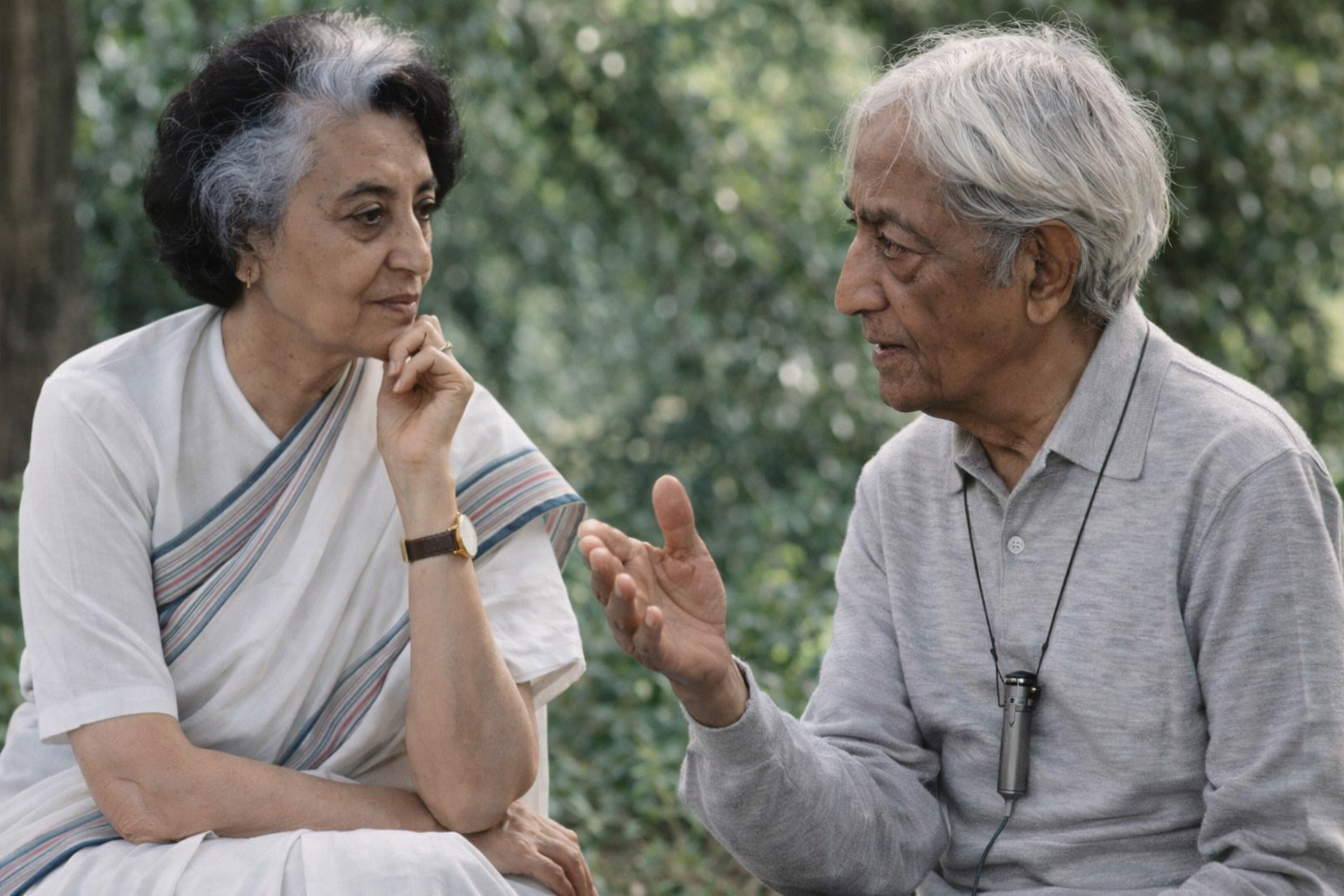
This is why the story of Indira Gandhi seeking counsel from J. Krishnamurti matters. Not because we need to romanticise the past, but because it quietly exposes a truth our culture still struggles to admit: even the most powerful people need a place to think, feel, and return to centre.
Today, we call that place life coaching.
When Power Meets Silence
Krishnamurti was not a politician, not a strategist, not a man of slogans. His work was fundamentally inconvenient. He kept pointing people back to their own minds, their own contradictions, their own hidden motives. He spoke about freedom, but not the kind that comes from changing governments. The kind that comes from seeing your own conditioning without flinching.
Now picture Indira Gandhi, carrying a nation’s volatility in her calendar. Think of the loneliness of command. The constant performance of certainty. The pressure to decide quickly, while the inside of you might be begging for one honest minute.
In my work as a life coach, I often meet leaders who look calm in meetings and unravel in the car. They do not lack competence. They lack a safe space to be human without being judged, used, or advised to death.
When a leader seeks a wise counsellor, it is not weakness. It is hygiene. Like washing your hands. Like cleaning a wound before it festers.
What Life Coaching Really Offers (And What It Refuses to Sell)
Let me be sharp about this, because the coaching industry sometimes confuses people. Life coaching is not motivation with good lighting. It is not positive thinking sprinkled over emotional wounds. It is not someone chanting “You’ve got this” while you quietly fall apart.
Real-life coaching is a structured relationship that strengthens self-awareness, emotional resilience, and decision-making. It helps you notice what you are doing to yourself. It helps you see the patterns you keep calling “personality”. It helps you stop outsourcing your inner authority to your past, your partner, your parents, or public opinion.
And it does something modern society rarely encourages: it slows you down long enough to feel what is true.
Krishnamurti’s approach was radical in a similar way. He did not hand out comforting identities. He challenged the machinery of the mind. If Indira Gandhi sought his counsel, I imagine it was not for quick reassurance. It was for clarity. The kind that does not come from more information, but from deeper perception.
The Nervous System Does Not Care About Your Status
Here is the neuroscience piece we often ignore. When you live under chronic pressure, your brain becomes biased towards threat. The amygdala gets jumpy. The mind starts scanning for danger everywhere, including in harmless feedback from a colleague. You become more reactive, more controlling, and strangely less creative.
This is not a moral failure. It is biology.
So when I hear someone say, “Coaching is for people who are lost,” I want to ask: lost according to whom? The world is loud, contradictory, and performance-obsessed. If you are not occasionally disoriented, you might simply be dissociated.
Life coaching supports nervous-system regulation in a practical way. Through reflection, emotional labelling, perspective-taking, and values-based planning, you shift from reaction to response. You stop living like every email is a tiger in the bushes.
And yes, you still get things done. Often more effectively. Calm is not laziness. Calm is precision.
A Personal Coaching Room Anecdote
A senior leader once told me, “I do not have time to feel.” He said it like a badge. Ten minutes later, his hands were trembling. His sleep was fragmented. His patience with his children was thinning. His staff were avoiding him because his mood had become unpredictable.
We did not begin with productivity hacks. We began with honesty.
As he spoke, one sentence kept repeating itself, “I can’t afford to be wrong.” That, right there, was the psychological core. The fear of being wrong had become the fear of being seen. And the fear of being seen had become a cage.
Over weeks, he learned to separate self-worth from performance. He began to lead with clearer boundaries, fewer outbursts, and better listening. His results improved, yes. But more importantly, his relationships stopped bleeding.
This is what life coaching can do when it is done properly. It returns you to yourself.
Why Society Still Mocks Inner Work
Here is the societal question we need to face. Why do we praise external success and ridicule internal care? Why is a gym subscription respectable, but a coaching commitment “extra”? Why do we accept physical training as normal, but emotional training as indulgent?
My slightly wicked theory is this: a regulated, self-aware person is harder to manipulate.
A person who can pause before reacting does not buy every outrage. A person who knows their values does not crumble under peer pressure. A person who understands their own wounds stops passing them down like family heirlooms.
So yes, life coaching is personal. But it is also quietly political. Because a nation is not only built by policies. It is built by the quality of human behaviour in homes, offices, and institutions.
Indira Gandhi and Krishnamurti as a Mirror for Modern India
Let us be careful with labels. Krishnamurti would likely reject being called a “life coach”. He challenged the very idea of authority. And yet, the function of those conversations, at least from the outside, looks familiar to what life coaching offers at its best: a space for reflection, a confrontation with one’s own mind, and a return to clarity.
Indira Gandhi’s interest in such counsel signals something important. Even in an era without the language of coaching, the need for inner guidance was recognised. Not as a trend, but as a necessity.
Today, we have more access than ever, and yet we are often less inwardly skilled. We have apps for everything except sitting with ourselves without flinching.
Life coaching, when ethical and well-trained, helps close that gap.
A Quiet Invitation
If you are reading this and thinking, “I should be able to handle life on my own,” I hear you. Independence is a beautiful value. But independence does not mean isolation. Even the strongest minds need mirrors.
Life coaching is not about being fixed. It is about becoming more conscious. More choiceful. More emotionally agile. It is about leadership of the self, so you stop leaking your unprocessed stress onto everyone around you.
Indira Gandhi did not become less powerful by seeking counsel. If anything, it suggests she understood a truth many people learn too late: the outer world bends more easily when the inner world is not at war.


Leave a Reply