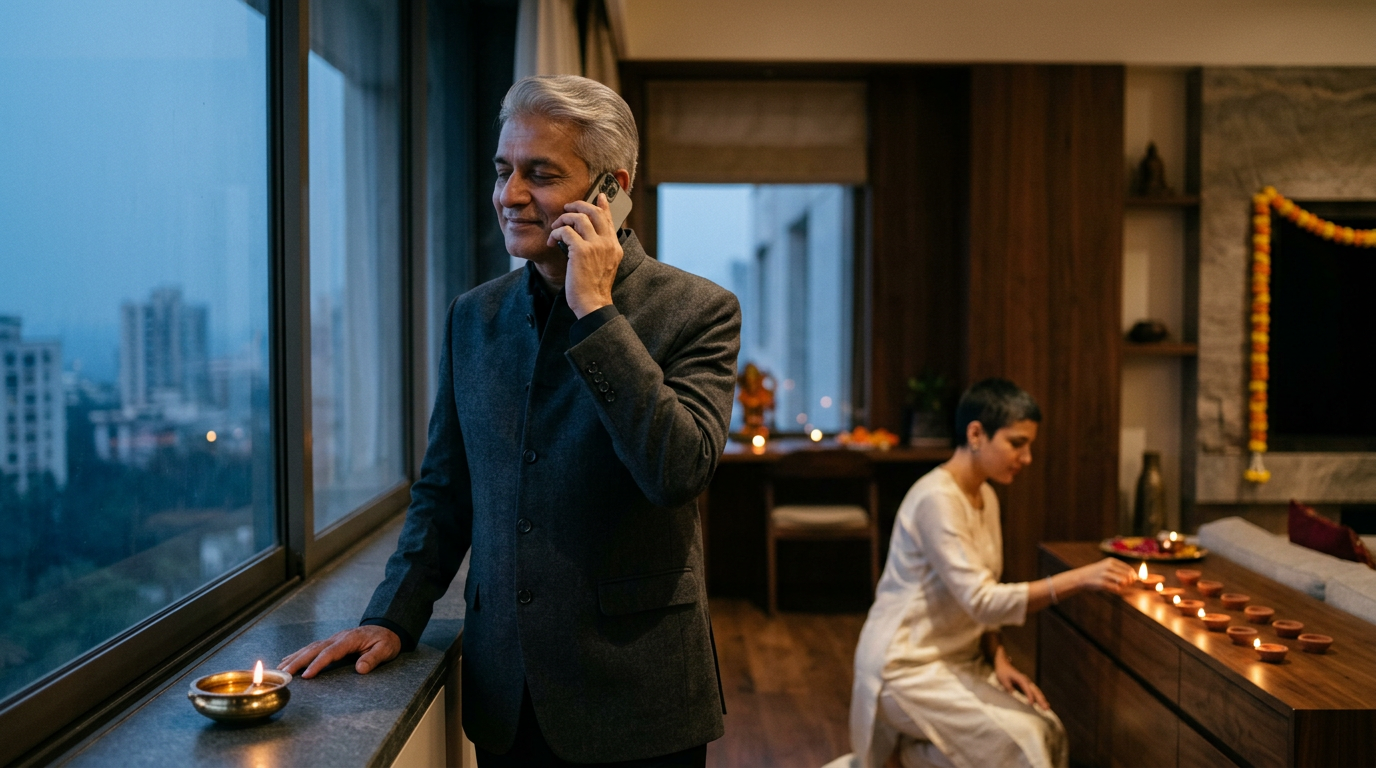
This Diwali, most of us will send dozens of messages and receive hundreds more, and if we are honest, very few of them will land. The festival that celebrates the return of light has quietly become a season of forwarded graphics, borrowed verses and group broadcasts that warm nobody. That is not a failure of affection. It is a failure of attention, and the psychology behind it is more interesting, and more fixable, than it looks. Here is my message for Diwali this year, and a practical way to make yours mean something.
This year, Diwali falls on Sunday, 8 November 2026, with Lakshmi Puja performed in the evening Pradosh Kaal window. The name is a shortened form of the Sanskrit Deepavali, meaning a row of lamps, and that image holds the whole answer to this article.
My message is simple: send fewer Diwali messages, and let each one carry proof that you thought of the person, not just the occasion. A Diwali message that lands does three things. It names one detail only you could know. It acknowledges the year that person actually had. And it offers a wish sized to their life rather than to the festival. Where you can, it is also spoken rather than typed.
Why So Many Diwali Messages Feel Empty
When a message arrives, the recipient is not really reading the words. They are reading for one signal: was I thought of?
A forwarded greeting answers that question politely, and in the negative. The diyas may be beautifully animated and the Sanskrit perfectly chosen, but the message could have been sent to anyone, which means it was sent to no one in particular. The receiver feels this instantly, even if they reply with a folded-hands emoji of their own.
What makes a message meaningful is not its eloquence. It is its specificity. Specificity is the evidence that, for a moment, your attention left the festival and rested on them.
A forwarded message proves you remembered the festival. Only a specific detail proves you remembered the person.
What Research Says About Reaching Out
The reason we hide behind the forward is rarely laziness. It is self-protection. We worry that a personal message will sound clumsy, intrusive or oddly timed after months of silence. The research suggests that worry is almost always miscalibrated.
A series of studies published in the Journal of Personality and Social Psychology found that people consistently underestimate how much friends and acquaintances appreciate an unexpected call, text or email, and that the gap was largest when the contact was more surprising, or the tie between the two people was weaker. In other words, the person you feel most awkward contacting is often the one who will value it most.
A related line of work on gratitude found something similar. In research from the University of Chicago and the University of Texas, people writing letters of thanks markedly underestimated how much the letters would affect the people receiving them. The authors point to an egocentric bias, which simply means judging a situation from inside our own head. The sender is preoccupied with how competently they are expressing themselves, while the recipient is mostly noticing the warmth.
And the medium matters. The same researchers found that people feel considerably more connected through voice than through text, yet fear of awkwardness keeps steering them towards typing. In their studies, adding video produced no meaningful extra closeness; the voice itself carried the warmth.
Put together, the evidence says something quietly liberating: the bar you are afraid of failing is not the bar the other person is measuring you against.
Before you open your contact list this week, sit with three questions. Who would be genuinely surprised to hear your voice on Diwali night? Whose year do you know was harder than they have admitted? And whose silence have you been reading as indifference, when it might simply be the same hesitation as yours?
How to Write a Diwali Message That Lands
You do not need to be a poet. You need a structure that makes attention visible.
1. One detail. Name something specific: a memory, a quality, a moment from this year. “I still think of the Diwali we spent on your terrace in Pune” does more than any verse.
2. One acknowledgement. Recognise the year they actually had, not the year a greeting card assumes. If it was hard, say so gently. If it was a triumph, name the triumph.
3. One wish, sized to their life. “Wishing you prosperity” is sized to the festival. “I hope the new role finally gives you your evenings back” is sized to them.
Then, if the relationship can hold it, call. Two minutes of your voice will outlast twenty well-designed graphics.
Diwali Messages for the People Who Matter
These are frames, not scripts. The brackets are where the meaning lives.
For a parent or elder: “Happy Diwali, Ma. This year I kept noticing how much of the way I [handle pressure / host people / cook] is really yours. Thank you for the lamps you lit long before I understood them.”
For a friend you have drifted from: “I realised this week that I have not heard your voice since [moment]. I miss you more than my silence suggested. Happy Diwali. Can I call you on Sunday?” I wrote at Raksha Bandhan about the assumed bond: the relationship we never tend because we are sure it cannot be lost. Diwali is a good night to tend it.
For someone grieving: A first Diwali after a loss is not a happy one, and pretending otherwise isolates the person further. “I know this Diwali will feel different without [name]. I am lighting a lamp for them tonight, and thinking of you.” This is what I have called the second diya: the lamp you light for a darkness that is not your own.
For your team: If you lead people, resist the branded graphic. A short note to each direct report naming one specific contribution from this year will do more for trust than any festival bonus announcement. In my executive coaching work with senior leaders, recognition that is precise is consistently the kind that is remembered.
For a client or colleague: “Happy Diwali. Working with you on [project] was one of the more thoughtful collaborations of my year. Wishing you and your family a peaceful festival.”
My Diwali Message for 2026
Diwali commemorates Rama returning to Ayodhya, with Sita and Lakshmana, after fourteen years of exile. I find it moving that the most famous festival of light in the world began not as a public spectacle, but as a city lighting its doorways for someone specific coming home.
That is my message this year. Light was never meant to be generic. Every lamp in Ayodhya was, in a sense, a personal message: we waited for you, and we are glad you are here. I have written before about the lamps we light within; this Diwali, I am asking you to light a few outwards, by name.
So send fewer messages. Say more in each one. And on Sunday night, pick up the phone for at least one person who will not be expecting you.
The darkness of Amavasya is total, and it is answered not by one great flood of light but by small flames, each placed deliberately in a particular doorway. Your words can work the same way.
If this season has surfaced a relationship you keep meaning to repair, or a silence you no longer want to carry, that is exactly the kind of work I do in life coaching.


