
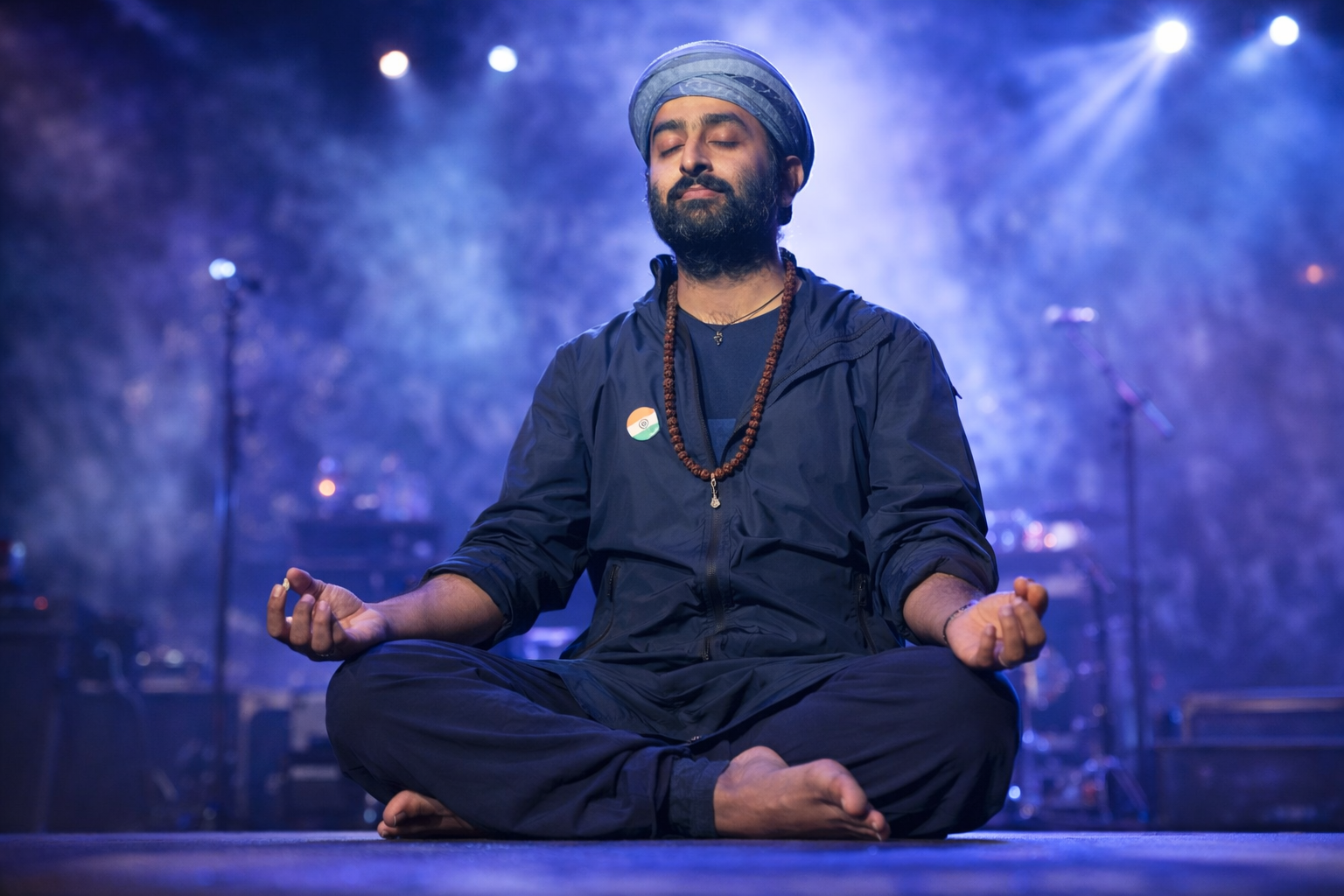
When most people hear the word “yogi”, they imagine saffron robes, incense, a calm gaze, and a mountain in the background. Fair enough. Our minds love theatre.
But yoga, at its core, is far less performative and far more inconvenient. It is how you behave when you could easily become arrogant. It is how you keep returning to discipline when nobody is clapping. It is how you hold power without being possessed by it.
That is why I keep coming back to one unusual thought, especially when I listen to Arijit Singh. I believe Arijit Singh is a real yogi.
Not a yogi as a brand. A yogi as a way of being.
And if that sounds like a stretch, stay with me. This is not fan worship. This is behavioural evidence, psychological patterns, and a little societal interrogation. Because in a country obsessed with volume, his quietness deserves study.
What makes someone a “real yogi” in modern India?
In my work as a coach, I look for inner markers, not outer labels. A real yogi is not someone who looks spiritual, but someone who consistently practises non-attachment, self-regulation, service, and steady devotion to their craft.
Arijit’s life and choices read like a case study in lived yoga.
Here are my five reasons.
1) His discipline looks like sadhana, not ambition
Arijit’s musical training began early, rooted in classical learning and years of practice. That matters. In yoga, we call this abhyasa, the repeated return. Not the glamorous return. The boring one. The one where you do the work again, even when yesterday’s work did not “go viral”.
If you listen closely to his singing, you can hear the discipline. He does not merely perform notes. He places them. Like a breath placed deliberately in pranayama.
Psychologically, this kind of mastery is rarely built on motivation. Motivation is moody. Mastery is routine. It is nervous-system conditioning. It is choosing the long road when the short road exists.
In a culture that loves overnight success stories, his journey quietly asks a better question: are we celebrating talent, or are we respecting training?
A real yogi does not chase intensity. He commits to consistency.
2) He practises non-attachment to fame in an attachment-driven industry
There is a particular hunger that fame can create. The hunger to be seen. To be praised. To be constantly relevant. Many brilliant artists get trapped in that loop. Their work becomes a plea.
Arijit’s public persona, by contrast, often feels like a refusal to be owned by attention. He stays private. He avoids excessive spectacle. He is known to keep himself rooted in his hometown rhythm, not only in a metro celebrity bubble.
One moment that stays with me is the widely shared image of him simply being himself in his own familiar spaces, even alongside international attention. No grand security theatre. No “look at me” performance. Just a human being moving through life.
That is yogic, because non-attachment is not indifference. It is freedom. The freedom to be successful without becoming a slave to success.
As a society, we reward noise. We monetise visibility. Then we wonder why anxiety is endemic. Maybe the deeper flex is not being famous. Maybe it is being famous and still staying inwardly unhooked.
3) His humility is not a pose, it is a nervous-system signature
Humility is often misunderstood. People think it means low confidence. No. Real humility is regulated confidence. It is when your self-worth is not inflated by applause or crushed by criticism.
Arijit’s humility, as many observers note, comes through as a consistent tone rather than an occasional statement. In yogic psychology, this matters because humility is a sign of a stable identity. You do not need to dominate a room when you are at home inside yourself.
I often tell clients this: arrogance is usually armour. Humility is usually healing.
When I hear Arijit sing, I hear a man who does not need to overpower the song to prove anything. He lets emotion move through him, not make a hostage of him. That is advanced self-regulation.
In a world where many public figures build personality cults, his energy feels almost subversive: “Let the work speak.”
That is not PR. That is practise.
4) His service reflects seva, not charity-as-image
Yoga is not only inward. Real yoga eventually becomes outward, because the boundary between “me” and “others” softens. This is where seva comes in: service that is not performed for applause.
Arijit has been associated with community-focused initiatives, including support for rural communities and causes that do not conveniently amplify celebrity shine. Whether through structured foundations or specific relief efforts, the pattern is meaningful: giving back without constant self-advertisement.
Here is the psychological point: service becomes shallow when it is used to manage reputation. Service becomes spiritual when it is used to reduce suffering.
In India, we are deeply religious, yet often socially harsh. We touch feet, yet we humiliate people online. We worship gods, yet we forget empathy in traffic, in offices, in homes. When a public figure shows consistent, quieter forms of giving, it gently exposes our contradiction.
A real yogi does not ask, “How can I look good?”
He asks, “How can I be useful?”
5) His voice carries bhakti and emotional truth, which is also yoga
Let me say something that might sound poetic, but is also neuroscientific: voice is regulation.
Music can co-regulate the nervous system. A voice can slow breathing, soften muscle tension, and give language to emotions we have been hiding from ourselves. This is why, in therapy and coaching, songs often become emotional doorways.
Arijit’s gift is not merely technical. It is emotional accuracy. He sings like someone who has sat with longing, grief, devotion, and hope, not like someone imitating them.
That is bhakti energy. Devotion. Surrender. Not necessarily to a religion, but to truth.
And this is where I feel his yogi-quality most: he helps people feel without falling apart. He gives shape to ache. He dignifies softness in a culture that often confuses hardness with strength.
When a man’s voice becomes a safe place for millions, that is not “just entertainment”. That is a kind of cultural healing.
So yes, I call him a yogi. Because yoga is union, and his music reunites people with parts of themselves they had abandoned.
What if we have been looking for yogis in the wrong places?
Maybe the next era of Indian spirituality will not be measured by how loudly someone preaches wellness, but by how quietly someone lives it.
Arijit Singh yogi is not a slogan for me. It is an invitation.
An invitation to practise discipline without drama. To succeed without ego. To serve without spectacle. To stay rooted while the world pulls you into performance.
And perhaps, most importantly, to remember this: you do not need a monastery to be a yogi. You need integrity. Repetition. Presence.
If Arijit’s life and music point to anything, it is this question for all of us:
What would change if we cared more about inner stature than outer status?


Leave a Reply