
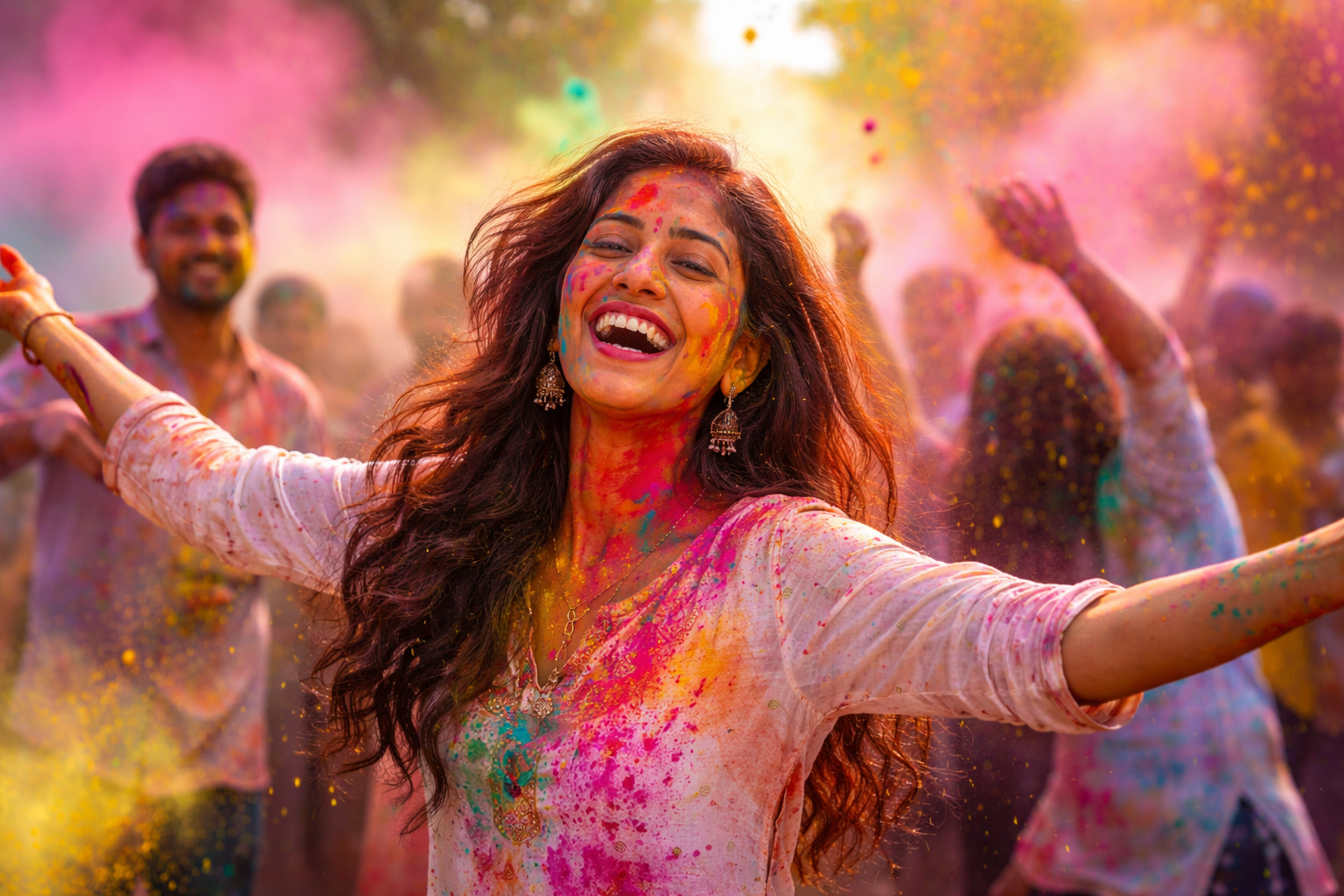
Holi arrives like a friendly invasion. It stains your hair, your clothes, your plans, and sometimes, your mood. In India, it can feel like the whole nation has agreed to become eight years old again. In Mauritius, it carries that sweet duality of diaspora life: devotion and celebration, tradition and reinvention, intimacy and community, often all in one afternoon.
I have always loved the symbolism of Holi. And I have also learnt to ask sharper questions about it, the kind we usually avoid when the dhol is loud, and the gujiya is warm. As a life coach, I watch how people behave when the usual rules soften. As an aspiring yogi, I notice what the festival does to the breath and the nervous system. As a psychologist, I see archetypes walk around in colour. As a neuroscientist, I see the brain light up on social reward, novelty, and belonging.
Holi, for me, is not just a festival of colours. It is a social laboratory. It reveals who feels safe, who feels invisible, who feels entitled, and who is quietly practising courage.
The Colour-Release Illusion and the Real Work of Letting Go
We say Holi is about letting go. And it is, but not in the tidy way motivational quotes promise. Colour works like permission. People who are normally self-conscious suddenly allow mess. People who are emotionally guarded allow contact. People who are socially anxious suddenly find themselves laughing with strangers.
The brain likes this. Novelty jolts attention. Play reduces threat. Group celebration signals safety, at least to the parts of us that evolved in tribes. In coaching sessions, I often say: “Your nervous system does not respond to your intentions; it responds to your environment.” Holi is environment on steroids.
But here is the uncomfortable bit: a festival can create the illusion of transformation. One day of uninhibited joy can feel like healing, and it can be a beautiful doorway. Yet, if we do not carry anything forward, we return to our usual patterns by Monday. The real work of letting go is not throwing colour, it is releasing the ego’s grip on control, resentment, and old identity stories.
I have met people who play Holi wildly, then return to work the next week and cannot tolerate a colleague’s different opinion. That is not letting go. That is a holiday from self-awareness.
Holi Psychology and the Social Mask That Finally Slips
There is a moment in Holi when everyone is unrecognisable. You could be a CEO, a student, a single mother, a priest, a trainee, a driver, a shy introvert, a loud extrovert. Colour makes status blurry. That is the romance of it.
Yet the social mask slipping can reveal both tenderness and shadow. Holi amplifies what is already within a group. If your circle is emotionally safe, Holi becomes communal affection. If your circle has unspoken power games, Holi becomes an excuse to dominate. The same colour that feels like bonding to one person can feel like a violation to another.
This is where Holi psychology becomes deeply relevant. Humans are suggestible in crowds. We mirror what others do. We cross lines we would normally respect, especially when everyone laughs it off. In India and Mauritius, where “adjust kar lo” and “it’s just fun” can be cultural defaults, Holi can expose our collective difficulty with one word: consent.
Consent, Boundaries, and the Courage to Say “No” in Colour
Let me say this plainly, because love without clarity becomes messy: not everyone enjoys being touched, smeared, sprayed, or cornered. Some people have sensory sensitivities. Some have trauma histories. Some have skin conditions. Some simply do not want it.
As a coach, I do not spiritualise discomfort into virtue. If you say “no” and someone insists, that is not Holi. That is entitlement wearing colour.
I remember once, years ago, standing in a lane where the crowd had decided that every passer-by was fair game. A young woman near me kept stepping back, smiling politely, trying not to offend. The group kept moving closer, teasing, singing, escalating. I watched her nervous system speak before her mouth did: shoulders up, breath shallow, eyes searching for exit. I stepped in, not heroically, just firmly, and said, “She said no.” The energy shifted, not because I was strong, but because the spell broke. Someone finally named reality.
Holi can be a yearly practice in boundary-muscle building. Can you ask before you apply colour? Can you accept “no” without taking it personally? Can you protect someone else’s “no” without performing masculinity or moral superiority? This is emotional intelligence in real time, not in a corporate workshop.
The Neuroscience of Play: Why Holi Can Feel Like Medicine
When Holi is safe, it is genuinely good for us. Play regulates the nervous system. Laughter changes breathing patterns and softens threat responses. Social bonding releases a sense of belonging that many adults quietly starve for. Even the ritual aspect can ground identity. In Mauritius, especially, where community ties can feel both close and complex, Holi becomes a reminder that you are held by something older than your current stress.
Colour also does something psychologically clever. It disrupts perfectionism. It makes you stop performing “togetherness”. You cannot keep your image spotless when your face is purple. For many high-functioning adults, that is liberation.
But the medicine depends on dosage and context. Too much stimulation, too much noise, too much alcohol, too much peer pressure, and the same brain that loves play flips into overload. I have coached people who dread Holi, not because they hate joy, but because their nervous system cannot handle chaos. For them, mindful participation is not anti-social, it is self-respect.
Holi as a Mirror: What Are We Really Celebrating?
We often narrate Holi as the victory of good over evil. Beautiful. But I like asking a more intimate question: what is “evil” in my own psychology right now?
Sometimes it is not a villain. Sometimes it is a pattern.
The part of me that reacts instead of responds.
The part of me that holds grudges like family heirlooms.
The part of me that needs to be right to feel safe.
The part of me that confuses attention with love.
Holi gives me a yearly invitation to look at what I want to burn, and what I want to renew. In yoga, we speak of tapas, the disciplined inner fire. Not dramatic destruction, but purifying heat. Holi, at its best, is tapas in technicolour. It asks: can you forgive a little faster? Can you soften a little sooner? Can you reconnect without needing someone to suffer first?
And then comes the societal questioning. Why do we need a festival to express affection? Why is warmth seasonal? Why do some communities feel included while others feel like outsiders? Why do we call it unity while casually ignoring who feels unsafe? A mature Holi does not avoid these questions. It uses joy as fuel to grow up.
A Coach’s Holi Ritual: Joy With Intention
My personal practice is simple. Before I meet people, I check my inner weather. Am I carrying irritation? Am I craving validation? Am I numb and hoping colour will fix me? This matters because whatever I carry, I will spread.
Then I set one intention: to be fully present, not performatively happy. I try to meet people’s eyes, not just throw colour. I ask before I apply. I bless, silently, the bodies that carry stories I will never fully know. And I make space for those who celebrate differently, or not at all.
Holi does not have to be a test of stamina. It can be a practice of awareness. Holi psychology, when lived well, is the art of joyful connection without emotional violence.
When the colours wash off, what remains is character. And that, more than any gulal, is what I want to strengthen year after year.


Leave a Reply