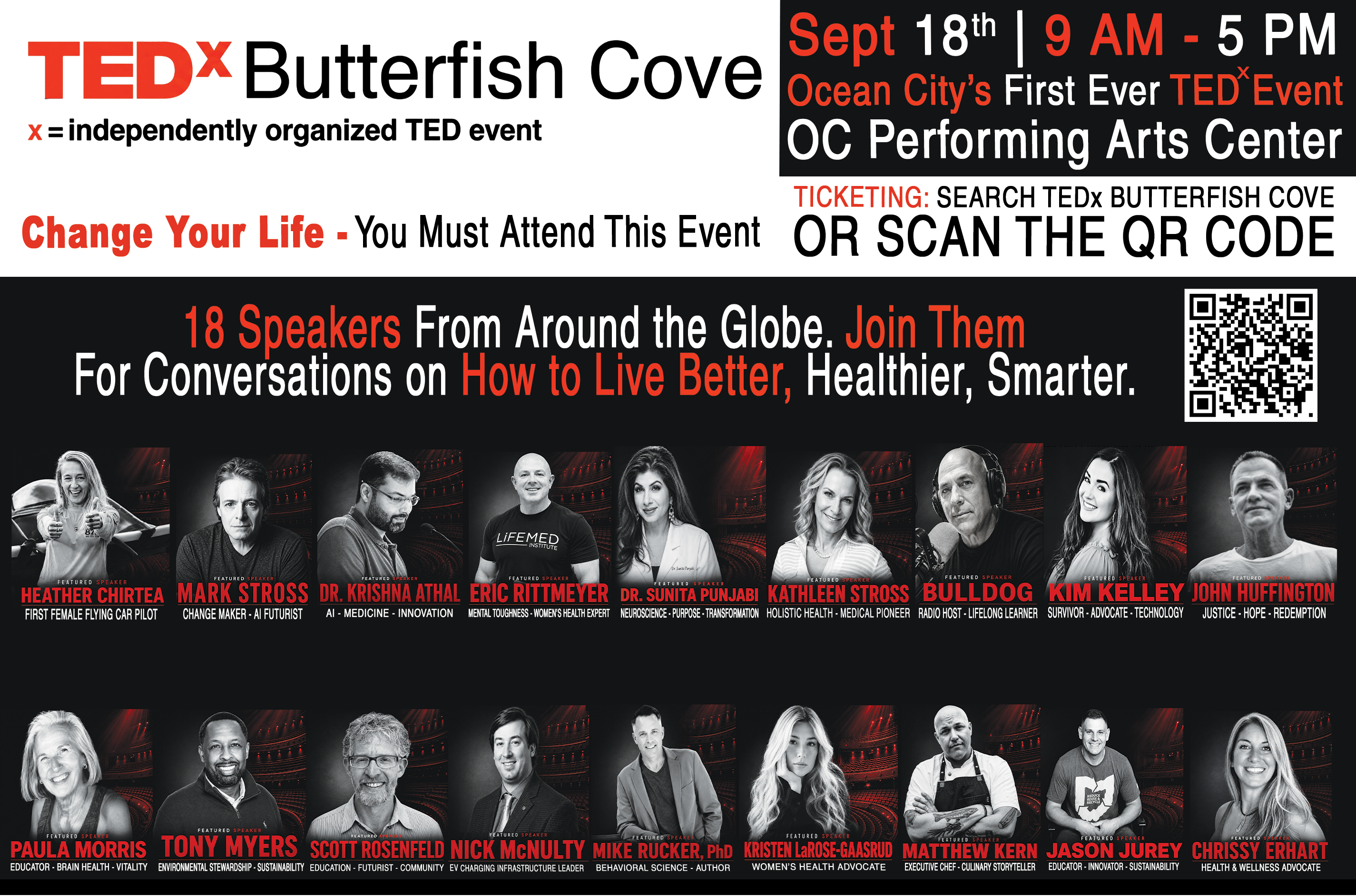
Yesterday morning, a client sat across from me in Mumbai, a founder with a thriving company and thousands of admirers online, and said quietly, “I have no one to call at eleven at night.” A few hours later, the official poster for TEDxButterfish Cove arrived in my inbox, with my face among the eighteen TEDx speakers announced for Ocean City’s first ever TEDx event. The timing felt less like coincidence and more like confirmation. Because the talk I will deliver on that stage on 18 September 2026 is about exactly what my client described: the loneliness of success. This article is my announcement, my gratitude, and a first glimpse of the idea I will carry to Maryland.
Ocean City’s First-Ever TEDx Event
On 18 September 2026, from 9 am to 5 pm, the OC Performing Arts Center at the Roland E. Powell Convention Center will host TEDxButterfish Cove, the first TEDx event in the history of Ocean City, Maryland. The details are live on the official event page, and the theme is refreshingly unpretentious: conversations on how to live better, healthier and smarter.
If you have ever wondered how TEDx differs from TED, the x stands for independently organised. Local teams build these events under TED’s guidance, which is precisely what gives them their character. They are not corporate showcases. They are communities deciding which ideas deserve a stage.
I am deeply grateful to the organising team for this opportunity, and I do not use the word grateful lightly. For a boy from Mauritius who now works across India and Singapore, standing on a TEDx stage in the United States is not a line on a CV. It is a full circle.
Meet All Eighteen TEDx Speakers
The line-up of TEDx speakers is gloriously eclectic, and I mean that as the highest compliment. It opens with pure audacity: Heather Chirtea, the first female flying car pilot, sharing a stage with Mark Stross, a change maker and AI futurist who has spent years asking what technology is doing to the human story.
The scientists and clinicians form a quiet powerhouse. Dr Sunita Punjabi works at the junction of neuroscience, purpose and transformation. Kathleen Stross is a holistic health expert and medical pioneer. Paula Morris, an educator, speaks on brain health and vitality. Mike Rucker, PhD, brings behavioural science and the discipline of an author who tests his ideas before publishing them. Eric Rittmeyer adds mental toughness and women’s health expertise, while Kristen LaRose-Gaasrud advocates for women’s health and Chrissy Erhart champions health and wellness more broadly.
Then come the storytellers of resilience. John Huffington speaks on justice, hope and redemption. Kim Kelley is a survivor, advocate and technologist. Bulldog, a radio host and lifelong learner, has spent a career listening to people for a living, which may be the most underrated qualification on the entire bill.
The builders round out the eighteen. Tony Myers and Jason Jurey speak on environmental stewardship, sustainability and innovation in education. Scott Rosenfeld is an education futurist focused on community. Nick McNulty leads in EV charging infrastructure. And Matthew Kern, an executive chef and culinary storyteller, reminds us that how we feed people is never just about food.
Notice what this range quietly argues. Living better is not a single discipline. It is aviation and neuroscience and food and justice and technology, all circling the same question: what does a good human life actually require? I am honoured to be listed among these TEDx speakers, and slightly amused that my profile card reads AI, medicine and innovation, because my talk will go somewhere far more intimate.
Why I Am Speaking on the Loneliness of Success
My talk is titled The Loneliness of Success, and it names something I have watched for years in my coaching room. High achievers who are admired by hundreds and known by no one. Leaders whose calendars are full and whose evenings are hollow. I have written before about leadership loneliness, and about how imposter syndrome quietly isolates the very people who look most secure. The TEDx stage lets me take that thinking further.
I call this phenomenon the applause gap: the distance between how celebrated your life looks and how accompanied it actually feels. The applause gap widens with every promotion, every award, every follower gained, because visibility and intimacy are not the same currency. You can be seen by thousands and known by none.
Neuroscience treats this seriously, and so should we. Loneliness is not merely a mood; it registers in the brain through what researchers call social pain, the finding that the brain processes social disconnection using some of the same circuitry it uses for physical injury. In plain language, feeling cut off hurts in a way your nervous system treats as real damage. Chronic loneliness keeps the body in a low hum of threat, a state of hypervigilance, which simply means the system stays braced for danger even in safe rooms. That is why so many successful people describe being exhausted by gatherings they technically enjoyed.
Yogic philosophy saw this long before the laboratories did. The Bhagavad Gita distinguishes between what you achieve and what you are, and warns that a self built entirely on outcomes will always feel unaccompanied, because outcomes cannot sit with you at dinner. Success without connection is not fulfilment. It is decorated isolation.
A Reflection Before You Read On
Sit with these for a moment, honestly and privately. When something wonderful happened to you last, who did you call, and did you hesitate first? How many people in your life know your struggles rather than your highlights? And if the applause stopped tomorrow, who would still be in the room?
Success was never designed to be a solo sport. We simply built ladders too narrow for two people to climb together. The applause gap is the price of confusing being admired with being known.
What I Hope to Carry to That Stage
I will bring my coaching room to Ocean City. The founder with no one to call at eleven at night. The executives I have worked with who mastered emotional silence so thoroughly that success became the loneliest chapter of their lives. And the way out, which is neither dramatic nor complicated, because the research on helping others keeps confirming that connection is rebuilt through small, repeated acts of being useful and being honest, not through grand reinvention.
I am looking forward to September with the particular excitement of someone who knows the stakes. Eighteen TEDx speakers, one day, one stage, and a town hosting its first ever TEDx event. If you are anywhere near Maryland on 18 September 2026, come. If you are not, the talk will find you online in time.
And if the phrase the applause gap landed somewhere tender as you read, do not let that feeling dissolve into your to-do list. Sit with one question this week: who knows me, rather than knows of me? If you would like to explore your answer with a professional alongside you, my door is open for a fifteen-minute conversation. One door. Walk through it if it is time.


